Telemonitoring for home non-invasive ventilation did not change nocturnal carbon dioxide levels at 6 months
Real-world telemonitoring and remote support for home non-invasive ventilation to improve therapy effectiveness: the exploratory, multicentre randomised eVENT study
Prospective, multicentre, open-label randomised trialMixed results
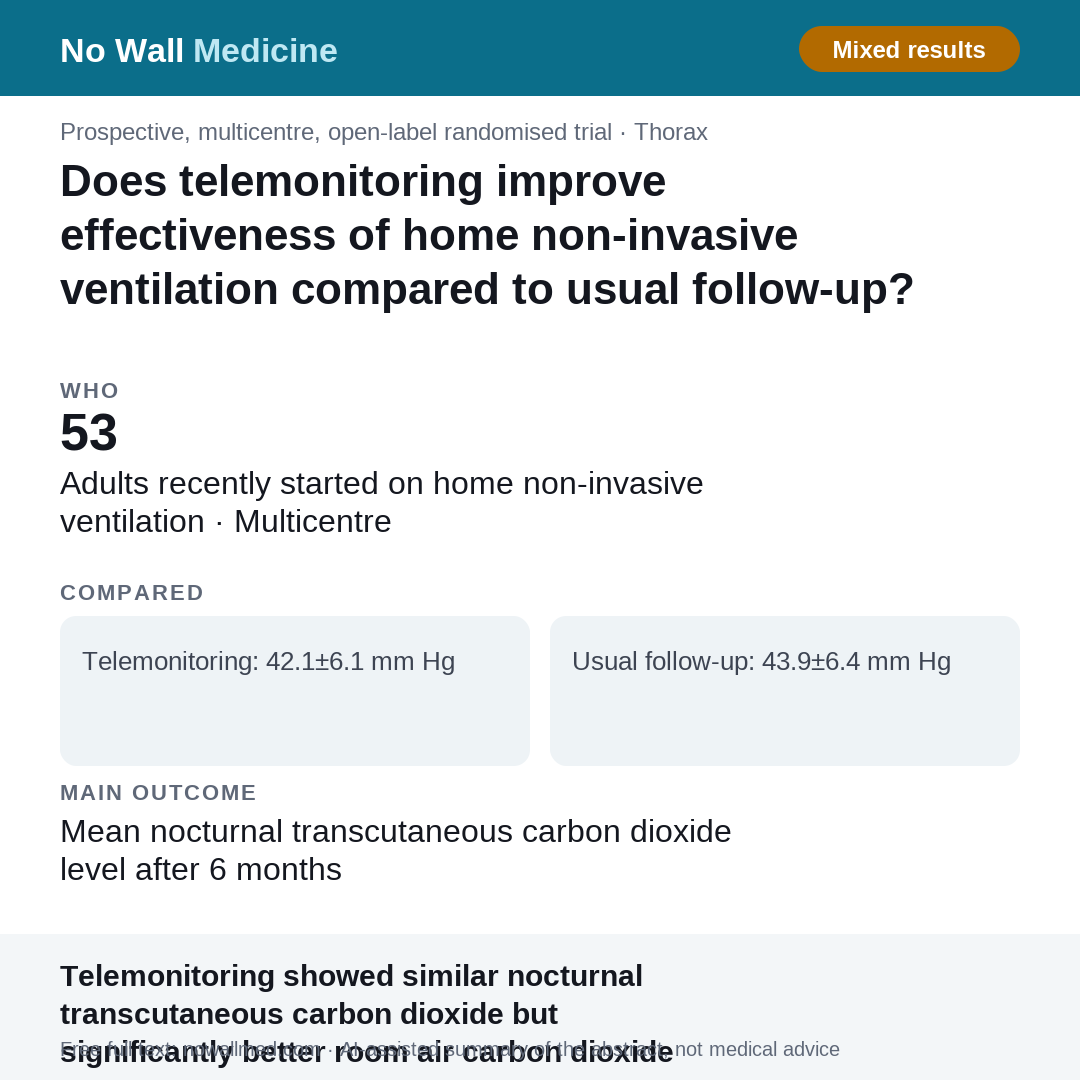
Does telemonitoring improve effectiveness of home non-invasive ventilation compared to usual follow-up?
Who
53
Adults recently started on home non-invasive ventilation · Multicentre
Compared
Telemonitoring: 42.1±6.1 mm Hg
Usual follow-up: 43.9±6.4 mm Hg
Main outcome
Mean nocturnal transcutaneous carbon dioxide level after 6 months
Bottom line: Telemonitoring showed similar nocturnal transcutaneous carbon dioxide but significantly better room air carbon dioxide levels and ventilatory support quality.
Thorax · 2025-09-15Download image
Clinical question: Does telemonitoring improve effectiveness of home non-invasive ventilation compared to usual follow-up?
Why it matters: Evidence is lacking regarding whether telemonitoring provides benefits during the follow-up phase of home non-invasive ventilation therapy.
Key points
- Researchers randomized 56 adults recently started on home non-invasive ventilation to either a telemonitoring program or usual follow-up.
- At 6 months, mean nocturnal carbon dioxide levels did not differ significantly between telemonitoring (42.1±6.1 mm Hg) and usual follow-up (43.9±6.4 mm Hg).
- The telemonitoring group had a higher proportion of participants without daytime or nighttime high carbon dioxide levels at 82.6% compared to 27.3% in usual follow-up.
Headline and key points written with AI from the paper’s abstract, with every number checked against it. Read the paper before relying on them.
Was this summary helpful?
Abstract
Rationale
Telemonitoring has shown benefits during the initiation of home non-invasive ventilation (NIV) but evidence is lacking regarding its use during follow-up. A French national telemonitoring programme incorporating remote support and therapeutic education is designed to improve patient pathways and reduce healthcare resource utilisation. This study investigated the impact of the telemonitoring programme versus usual follow-up on the effectiveness of home NIV. Methods
The prospective, multicentre, open-label eVENT trial enrolled adults recently started on home NIV. Participants were randomised to the telemonitoring or usual follow-up group. In the telemonitoring group, a CE-marked algorithm generated alerts based on teletransmitted ventilator data. Specialised nurses managed alerts and provided therapeutic education. The primary outcome was mean nocturnal transcutaneous carbon dioxide level (PtCO2) on NIV after 6 months. Results
56 patients were randomised and 53 were analysed (telemonitoring: n=27, usual follow-up: n=26). At 6 months, mean PtCO2 did not differ significantly between the telemonitoring and usual follow-up groups (42.1±6.1 vs 43.9±6.4 mm Hg; p=0.352) but mean room air partial arterial carbon dioxide pressure (PaCO2) was significantly lower in the telemonitoring versus usual follow-up group (41.7±6.8 vs 46.2±3.5 mm Hg; p=0.003). The proportion of participants without diurnal or nocturnal hypercapnia at 6 months was 82.6% with telemonitoring and 27.3% with usual follow-up (p<0.001). Compared with usual follow-up, the telemonitoring group had greater NIV use, more days with NIV usage ≥4 hour and less non-intentional leaks. Conclusions
In patients on home NIV, PtCO2 was similar with telemonitoring and usual follow-up, but PaCO2 levels and the quality of ventilatory support were significantly better with telemonitoring. Trial registration number
NCT04615078.
Abstract reproduced under the article’s CC BY NC licence.
Subject terms
Cite this article
Prigent A, Texereau JB, Schmitz C, Ropars C, Degreef JM, Teulier M. Real-world telemonitoring and remote support for home non-invasive ventilation to improve therapy effectiveness: the exploratory, multicentre randomised eVENT study. Thorax. 2025. doi:10.1136/thorax-2024-222033
Spotted a mistake? Suggest a correction
Top studies every Monday
The week’s key trials and guidelines in your specialties, plus any topics you follow. By email, free.
Get the weekly digest