Admission timing had no effect on patient outcomes in 30 years of studies
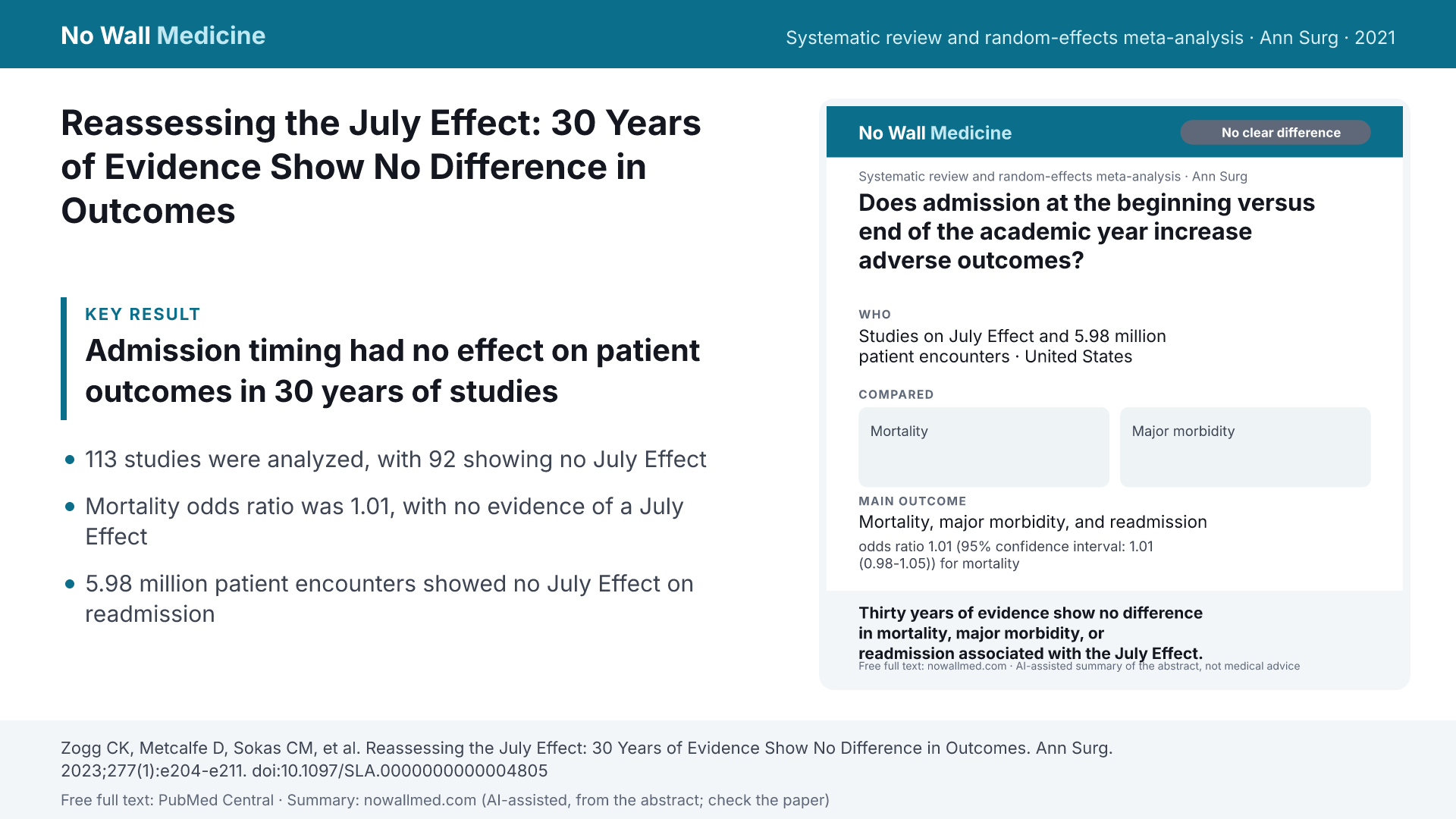
Reassessing the July Effect: 30 Years of Evidence Show No Difference in Outcomes
Systematic review and random-effects meta-analysisNo clear difference
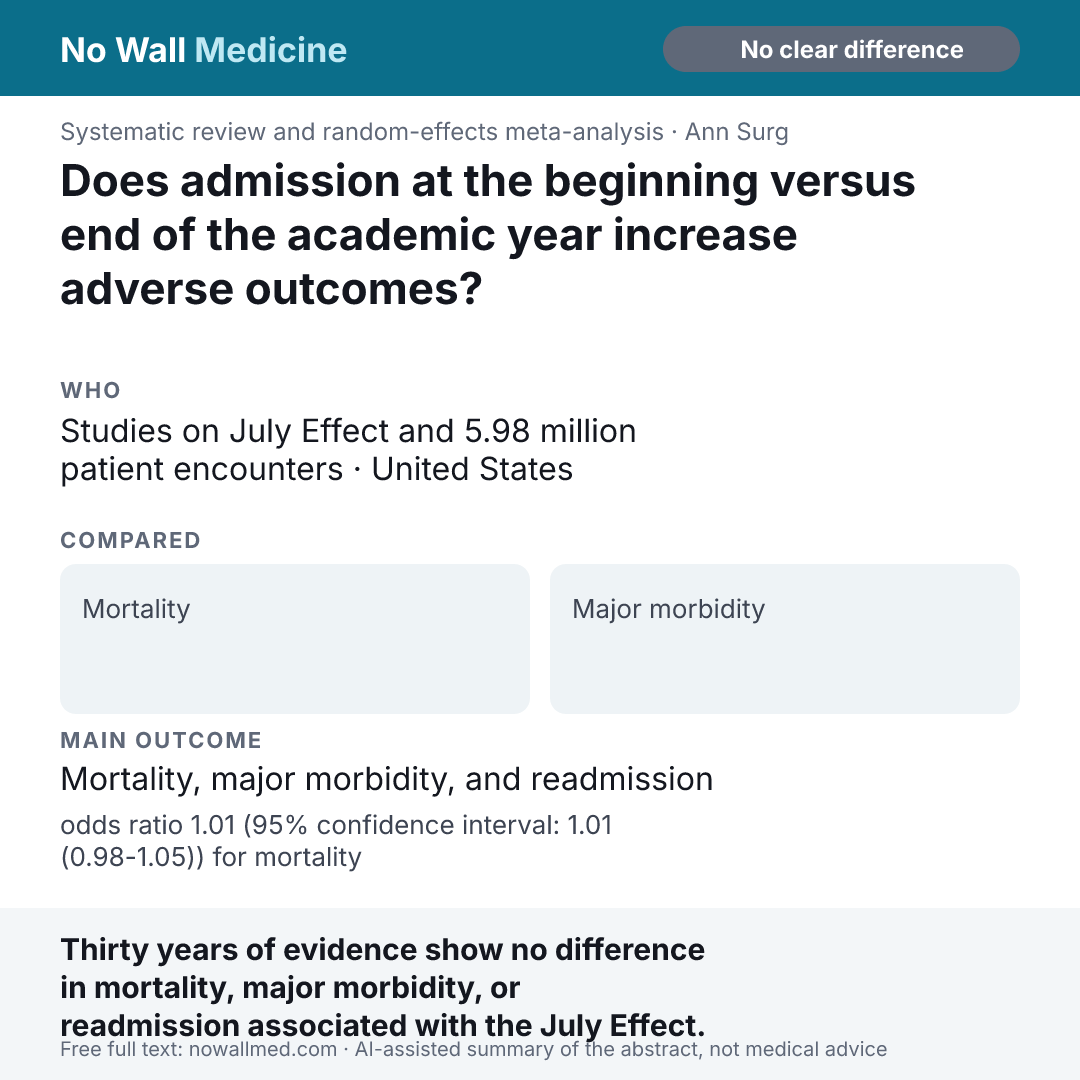
Does admission at the beginning versus end of the academic year increase adverse outcomes?
Who
Studies on July Effect and 5.98 million patient encounters · United States
Compared
Mortality
Major morbidity
Main outcome
Mortality, major morbidity, and readmission
Result: odds ratio 1.01 (95% confidence interval: 1.01 (0.98-1.05)) for mortality
Bottom line: Thirty years of evidence show no difference in mortality, major morbidity, or readmission associated with the July Effect.
Ann Surg · 2021-02-25 · Save PNG
Clinical question: Does admission at the beginning versus end of the academic year increase adverse outcomes?
Why it matters: The existence of a July Effect on patient outcomes was unknown and disputed
Key points
- 113 studies were analyzed, with 92 showing no July Effect.
- Mortality odds ratio was 1.01, with no evidence of a July Effect.
- 5.98 million patient encounters showed no July Effect on readmission.
Headline and key points written with AI from the paper’s abstract, with every number checked against it. Read the paper before relying on them.
Was this summary helpful?
Subject terms
Headline, design, result, key points, caveat and citation as plain text.
Cite this article
Zogg CK, Metcalfe D, Sokas CM, et al. Reassessing the July Effect: 30 Years of Evidence Show No Difference in Outcomes. Ann Surg. 2023;277(1):e204-e211. doi:10.1097/SLA.0000000000004805
Spotted a mistake? Suggest a correction