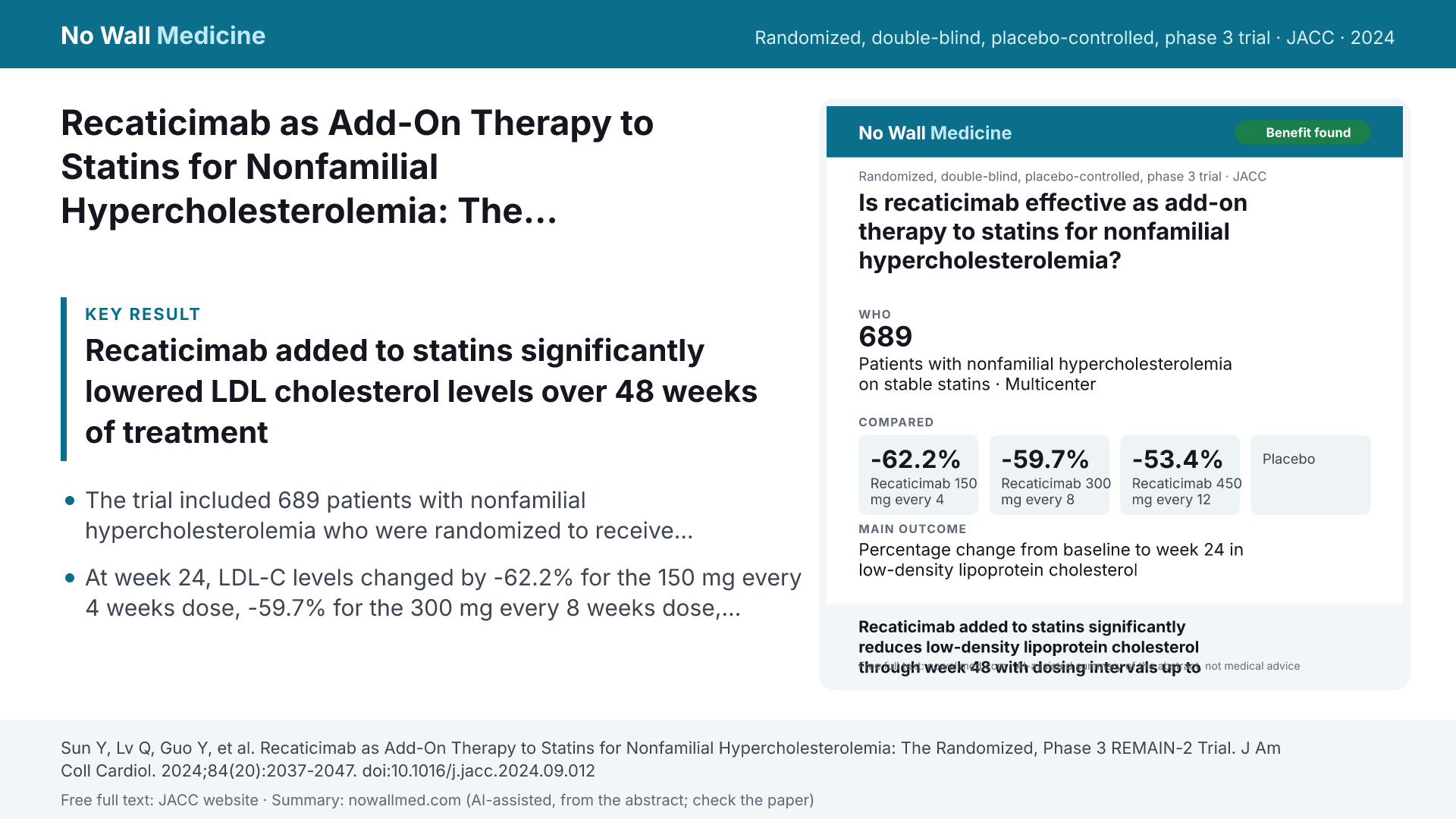
Recaticimab added to statins significantly lowered LDL cholesterol levels over 48 weeks of treatment
Recaticimab as Add-On Therapy to Statins for Nonfamilial Hypercholesterolemia: The Randomized, Phase 3 REMAIN-2 Trial
Randomized, double-blind, placebo-controlled, phase 3 trialBenefit found
Is recaticimab effective as add-on therapy to statins for nonfamilial hypercholesterolemia?
Who
689
Patients with nonfamilial hypercholesterolemia on stable statins · Multicenter
Compared
-62.2%Recaticimab 150 mg every 4 weeks (95% CI: -67.0% to -57.4%)
-59.7%Recaticimab 300 mg every 8 weeks (95% CI: -65.0% to -54.4%)
-53.4%Recaticimab 450 mg every 12 weeks (95% CI: -58.7% to -48.2%)
Placebo
Main outcome
Percentage change from baseline to week 24 in low-density lipoprotein cholesterol
Result: P < 0.0001
Bottom line: Recaticimab added to statins significantly reduces low-density lipoprotein cholesterol through week 48 with dosing intervals up to every 12 weeks.
JACC · 2024-11-07Download image
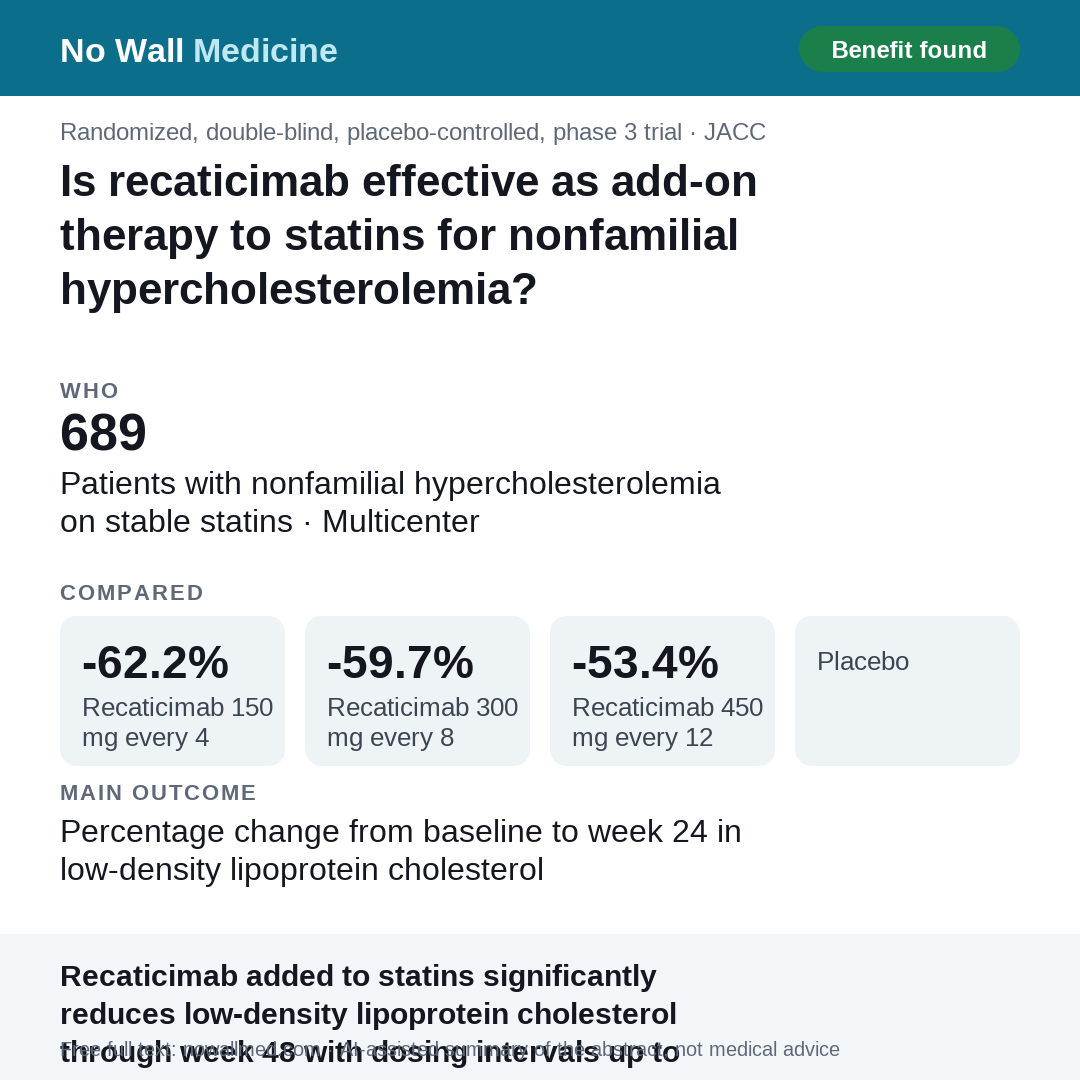
Clinical question: Is recaticimab effective as add-on therapy to statins for nonfamilial hypercholesterolemia?
Why it matters: Existing monoclonal antibodies that target proprotein convertase subtilisin/kexin type 9 require frequent dosing for patients with high cholesterol.
Key points
- The trial included 689 patients with nonfamilial hypercholesterolemia who were randomized to receive different doses of recaticimab or a placebo alongside stable statin therapy.
- At week 24, LDL-C levels changed by -62.2% for the 150 mg every 4 weeks dose, -59.7% for the 300 mg every 8 weeks dose, and -53.4% for the 450 mg every 12 weeks dose.
- Treatment-related adverse events occurred in 28.5% of the recaticimab groups compared to 26.6% in the placebo group, while serious treatment-related adverse events were 0.4% for both.
Headline and key points written with AI from the paper’s abstract, with every number checked against it. Read the paper before relying on them.
Was this summary helpful?
Subject terms
Cite this article
Sun Y, Lv Q, Guo Y, et al. Recaticimab as Add-On Therapy to Statins for Nonfamilial Hypercholesterolemia: The Randomized, Phase 3 REMAIN-2 Trial. JACC. 2024. doi:10.1016/j.jacc.2024.09.012
Spotted a mistake? Suggest a correction