Recovery expectations can be assessed with single-item measures: findings of a systematic review and meta-analysis on the role of recovery expectations on return-to-work outcomes after musculoskeletal pain conditions
Systematic review and meta-analysisBenefit found
Do recovery expectations predict return-to-work outcomes in adults with musculoskeletal pain?
Who
28741
Adults with musculoskeletal pain conditions
Compared
Low recovery expectations: twice as high odds of being work disabled
High recovery expectations
Main outcome
Return-to-work outcomes
Result: odds ratio 2.06 (95% CI 1.20-2.92)
Bottom line: Low recovery expectations are associated with higher odds of work disability, and single-item measures can validly predict outcomes.
Pain · 2022-09-26Download image
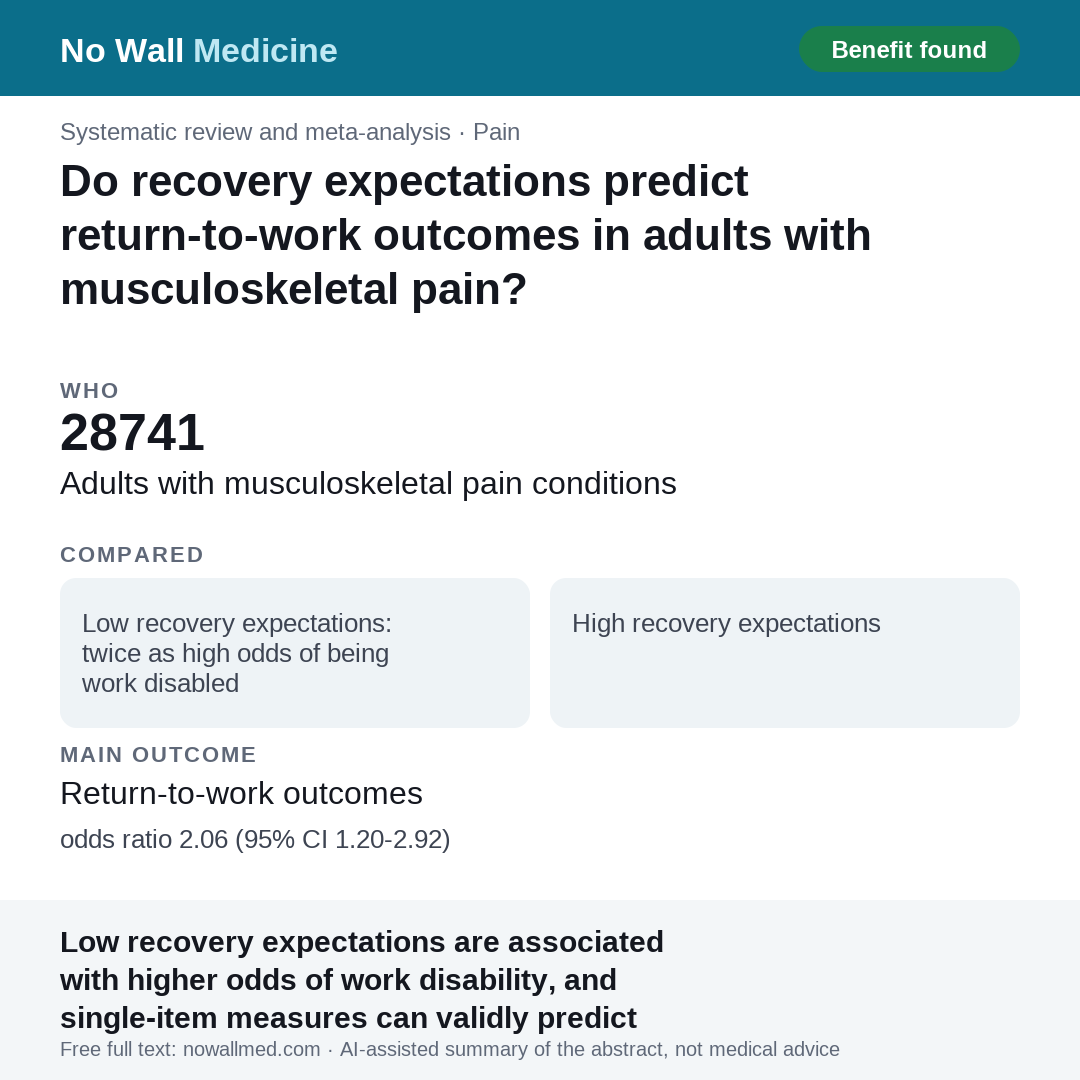
Clinical question: Do recovery expectations predict return-to-work outcomes in adults with musculoskeletal pain?
Abstract
The objective of this systematic review is to quantify the association between recovery expectations and return-to-work outcomes in adults with musculoskeletal pain conditions. In addition, this review has the second objective to compare the predictive utility of single-item and multi-item recovery expectation scales on return-to-work outcomes. Relevant articles were selected from Embase, PsycINFO, PubMed, Cochrane, and manual searches. Studies that assessed recovery expectations as predictors of return-to-work outcomes in adults with musculoskeletal pain conditions were eligible. Data were extracted on study characteristics, recovery expectations, return-to-work outcomes, and the quantitative association between recovery expectations and return-to-work outcomes. Risk of bias was assessed using the Effective Public Health Practice Project. Odds ratios were pooled to examine the effects of recovery expectations on return-to-work outcomes. Chi-square analyses compared the predictive utility of single-item and multi-item recovery expectation scales on return-to-work outcomes. Thirty studies on a total of 28,741 individuals with musculoskeletal pain conditions were included in this review. The odds of being work disabled at follow-up were twice as high in individuals with low recovery expectations (OR = 2.06 [95% CI 1.20-2.92] P < 0.001). Analyses also revealed no significant differences in the predictive value of validated and nonvalidated single-item measures of recovery expectations on work disability (χ 2 = 1.68, P = 0.19). There is strong evidence that recovery expectations are associated with return-to-work outcomes. The results suggest that single-item measures of recovery expectations can validly be used to predict return-to-work outcomes in individuals with musculoskeletal pain conditions.
Subject terms
Cite this article
Carrière JS, Donayre Pimentel S, Bou Saba S, Boehme B, Berbiche D, Coutu MF. Recovery expectations can be assessed with single-item measures: findings of a systematic review and meta-analysis on the role of recovery expectations on return-to-work outcomes after musculoskeletal pain conditions. Pain. 2022. doi:10.1097/j.pain.0000000000002789
Spotted a mistake? Suggest a correction
Top studies every Monday
The week’s key trials and guidelines in your specialties, plus any topics you follow. By email, free.
Get the weekly digest