Digital guided self-help videos were associated with lower anxiety and self-harm in personality disorder patients
Recovery-focused self-help intervention using vodcasts for patients with personality disorder: feasibility randomised controlled trial
Single-blind feasibility randomized controlled trialBenefit found
Is a digital guided self-help intervention feasible and impactful for personality disorder patients?
Who
43
Patients with a personality disorder
Compared
Guided self-help: significant reduction in anxiety at follow-up (P = 0.003, d = 0.25)
Treatment as usual
Main outcome
Anxiety, emotion dysregulation, self-harm behaviours and decentring ability
Bottom line: Personalised digital guided self-help may reduce anxiety and self-harm behaviours in patients with personality disorders.
BJPsych Open · 2024-01-17Download image
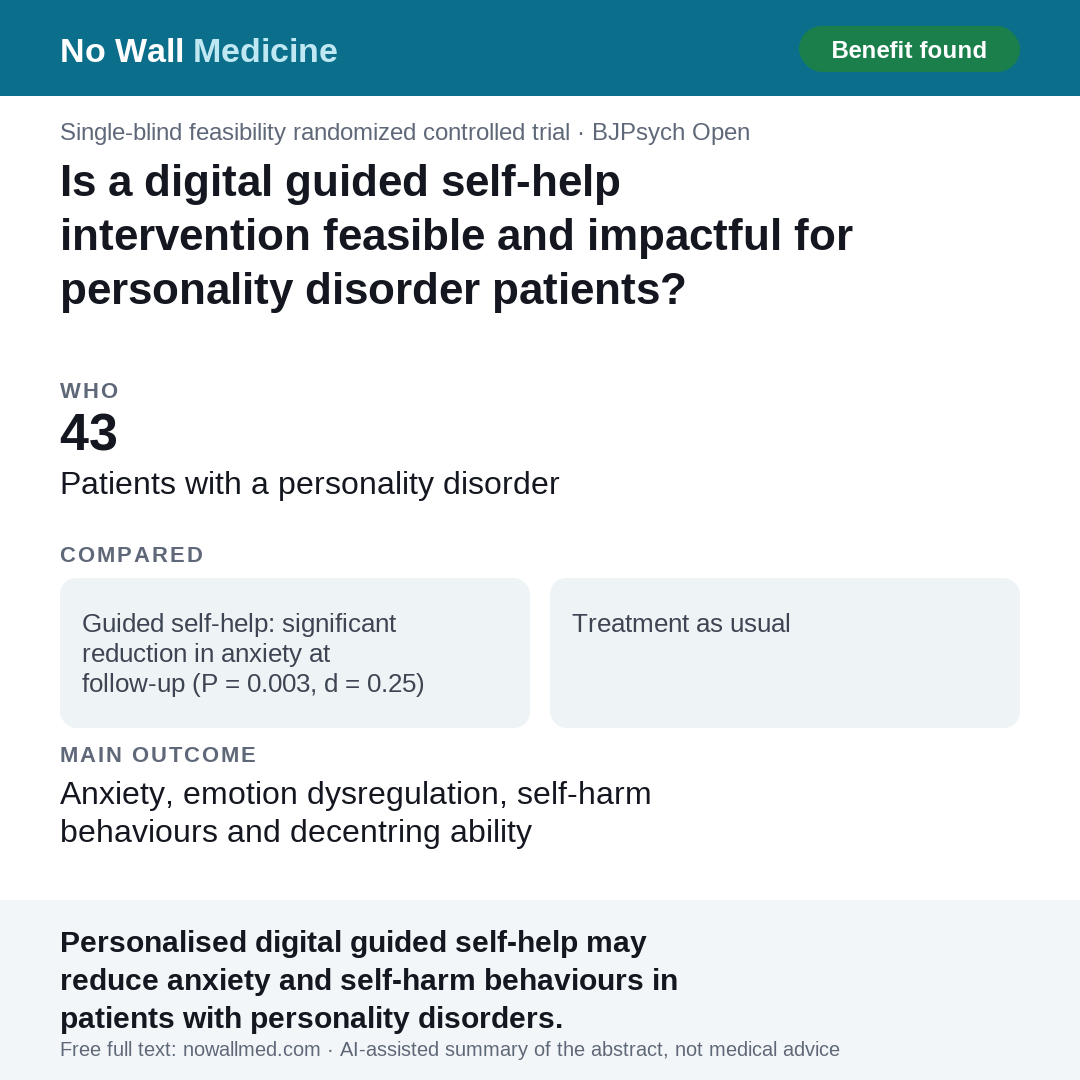
Clinical question: Is a digital guided self-help intervention feasible and impactful for personality disorder patients?
Why it matters: Long-term psychological interventions for personality disorders are often limited by high intensity and high costs.
Key points
- Researchers conducted a single-blind feasibility trial with 43 patients with personality disorder assigned to either digital guided self-help or treatment as usual.
- The guided self-help group showed a significant reduction in anxiety at follow-up (P = 0.003, d = 0.25) and a continued decrease in self-harm behaviours (P = 0.02, d = 0.57).
- Patients using the digital intervention also showed an increase in decentring ability, which is the ability to observe thoughts as temporary mental events, at the end of the intervention (P = 0.007, d = -0.65).
Headline and key points written with AI from the paper’s abstract, with every number checked against it. Read the paper before relying on them.
Cite this article
Kim YR, An Z, Han SW, Ko JK, Hwa Kwag K. Recovery-focused self-help intervention using vodcasts for patients with personality disorder: feasibility randomised controlled trial. BJPsych Open. 2024. doi:10.1192/bjo.2023.647
Spotted a mistake? Suggest a correction
Top studies every Monday
The week’s key trials and guidelines in your specialties, plus any topics you follow. By email, free.
Get the weekly digest