Varied definitions of recovery in children with chronic fatigue syndrome limit study comparisons
Recovery from chronic fatigue syndrome: a systematic review-heterogeneity of definition limits study comparison
Key points
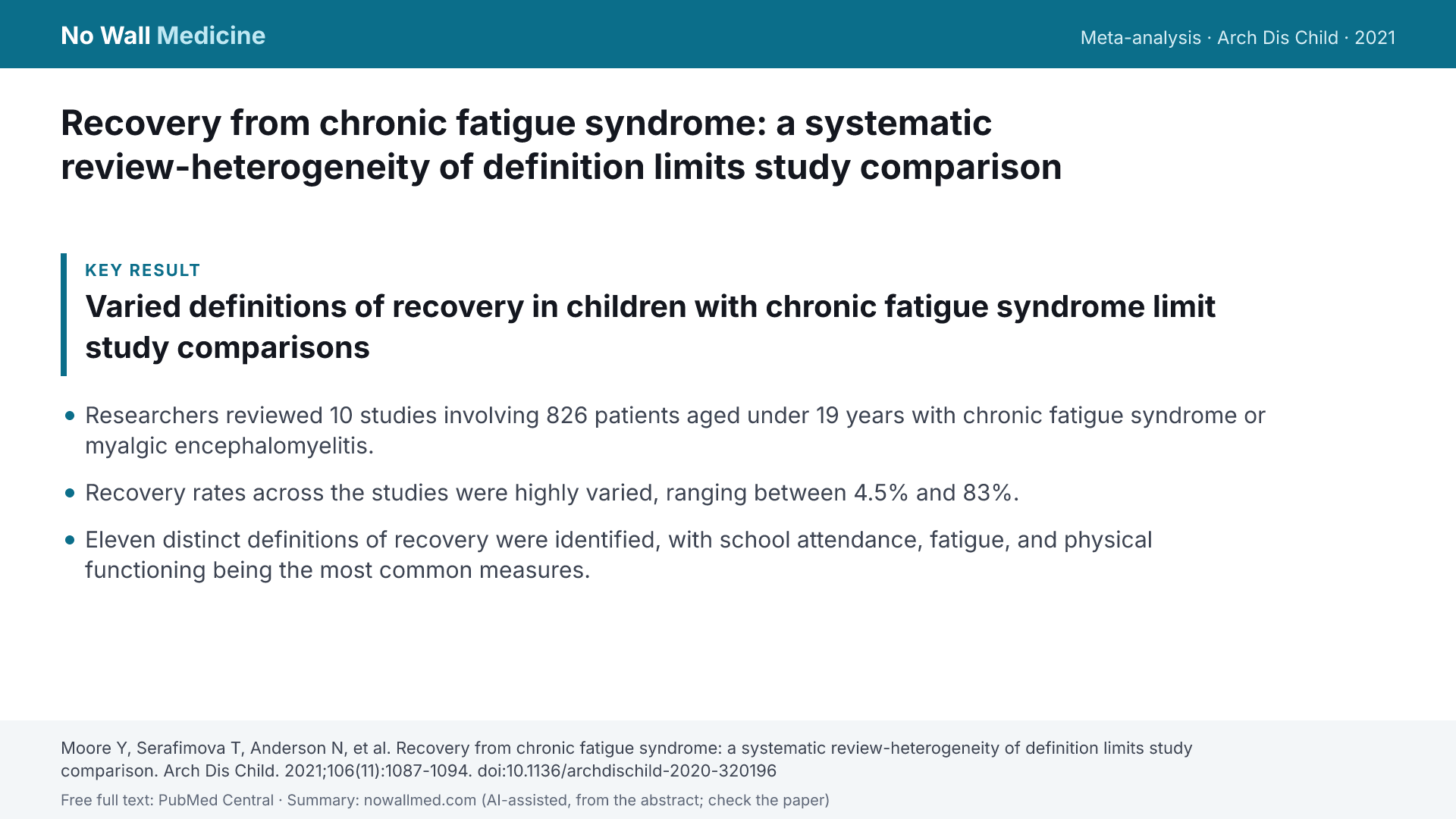
- Researchers reviewed 10 studies involving 826 patients aged under 19 years with chronic fatigue syndrome or myalgic encephalomyelitis.
- Recovery rates across the studies were highly varied, ranging between 4.5% and 83%.
- Eleven distinct definitions of recovery were identified, with school attendance, fatigue, and physical functioning being the most common measures.
Limitation the authors note: Heterogeneous definitions of recovery limit meaningful comparison between studies.
Headline and key points written with AI from the paper’s abstract, with every number checked against it. Read the paper before relying on them.
Was this summary helpful?
Abstract
Background
Paediatric chronic fatigue syndrome or myalgic encephalomyelitis (CFS/ME) is a common illness with a major impact on quality of life. Recovery is poorly understood. Our aim was to describe definitions of recovery in paediatric CFS/ME, the rate of recovery and the time to recovery. Methods
This systematic review included a detailed search of MEDLINE, EMBASE, PsycInfo and Cochrane Library between 1994 and July 2018. Inclusion criteria were (1) clinical trials and observational studies, (2) participants aged <19 years with CFS/ME, (3) conducted in Western Healthcare systems and (4) studies including a measure of recovery and time taken to recover. Results
Twelve papers (10 studies) were identified, involving 826 patients (range 23-135). Recovery rates were highly varied, ranging between 4.5% and 83%.Eleven distinct definitions of recovery were used; six were composite outcomes while five used unidimensional outcomes. Outcome measures used to define recovery were highly heterogeneous. School attendance (n=8), fatigue (n=6) and physical functioning (n=4) were the most common outcomes included in definition of recovery. Only five definitions included a personal measure of recovery. Implications
Definitions of recovery are highly variable, likely secondary to differences in study design, outcomes used, follow-up and study populations. Heterogeneous definitions of recovery limit meaningful comparison between studies, highlighting the need for a consensus definition going forward. Recovery is probably best defined from the child's own perspective with a single self-reported measure. If composite measures are used for research, there should be agreement on the core outcome set used.
Abstract reproduced under the article’s CC BY licence.
Subject terms
Headline, design, result, key points, caveat and citation as plain text.
Cite this article
Moore Y, Serafimova T, Anderson N, et al. Recovery from chronic fatigue syndrome: a systematic review-heterogeneity of definition limits study comparison. Arch Dis Child. 2021;106(11):1087-1094. doi:10.1136/archdischild-2020-320196
Spotted a mistake? Suggest a correction