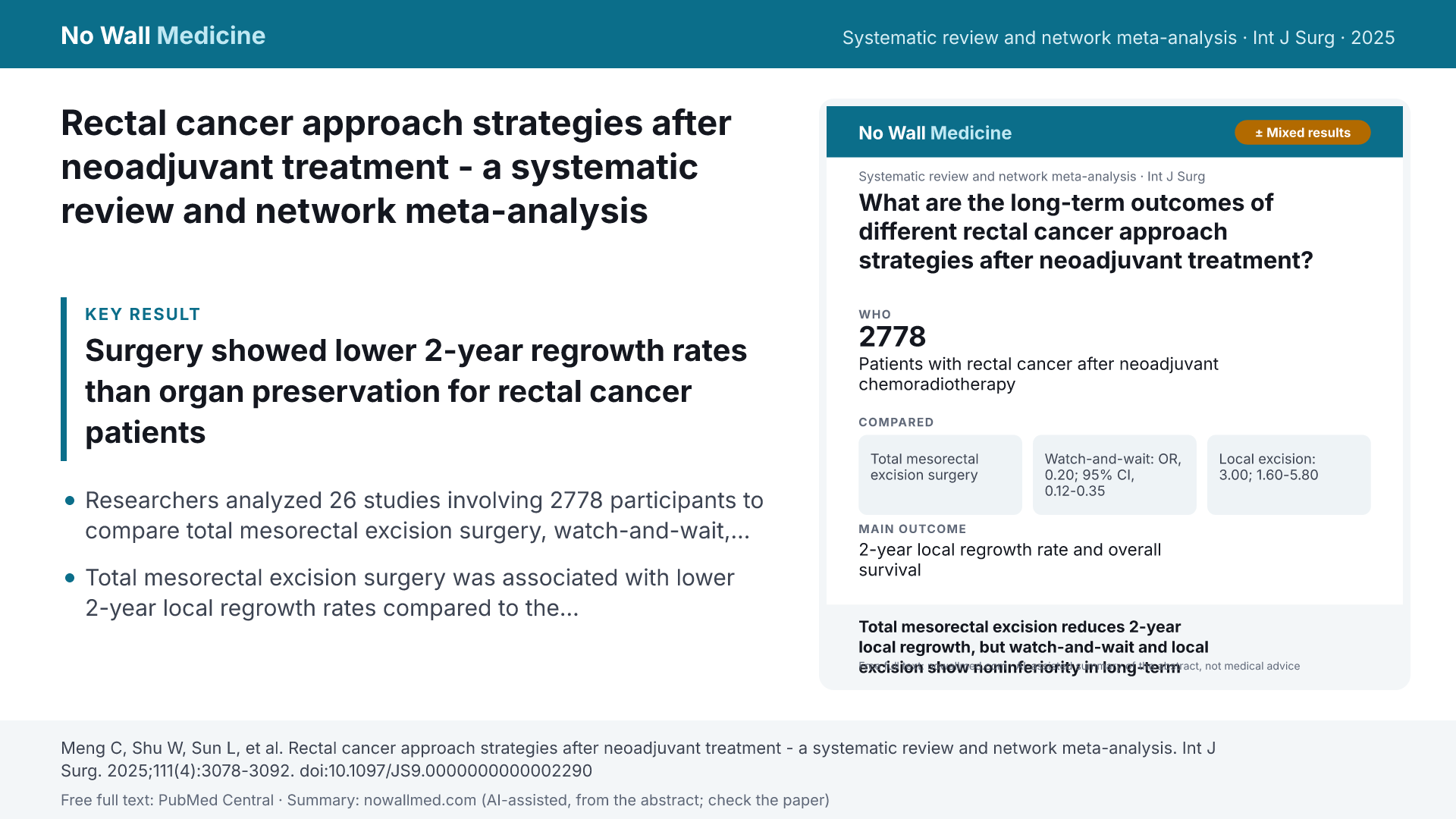
Surgery showed lower 2-year regrowth rates than organ preservation for rectal cancer patients
Rectal cancer approach strategies after neoadjuvant treatment - a systematic review and network meta-analysis
Systematic review and network meta-analysisMixed results
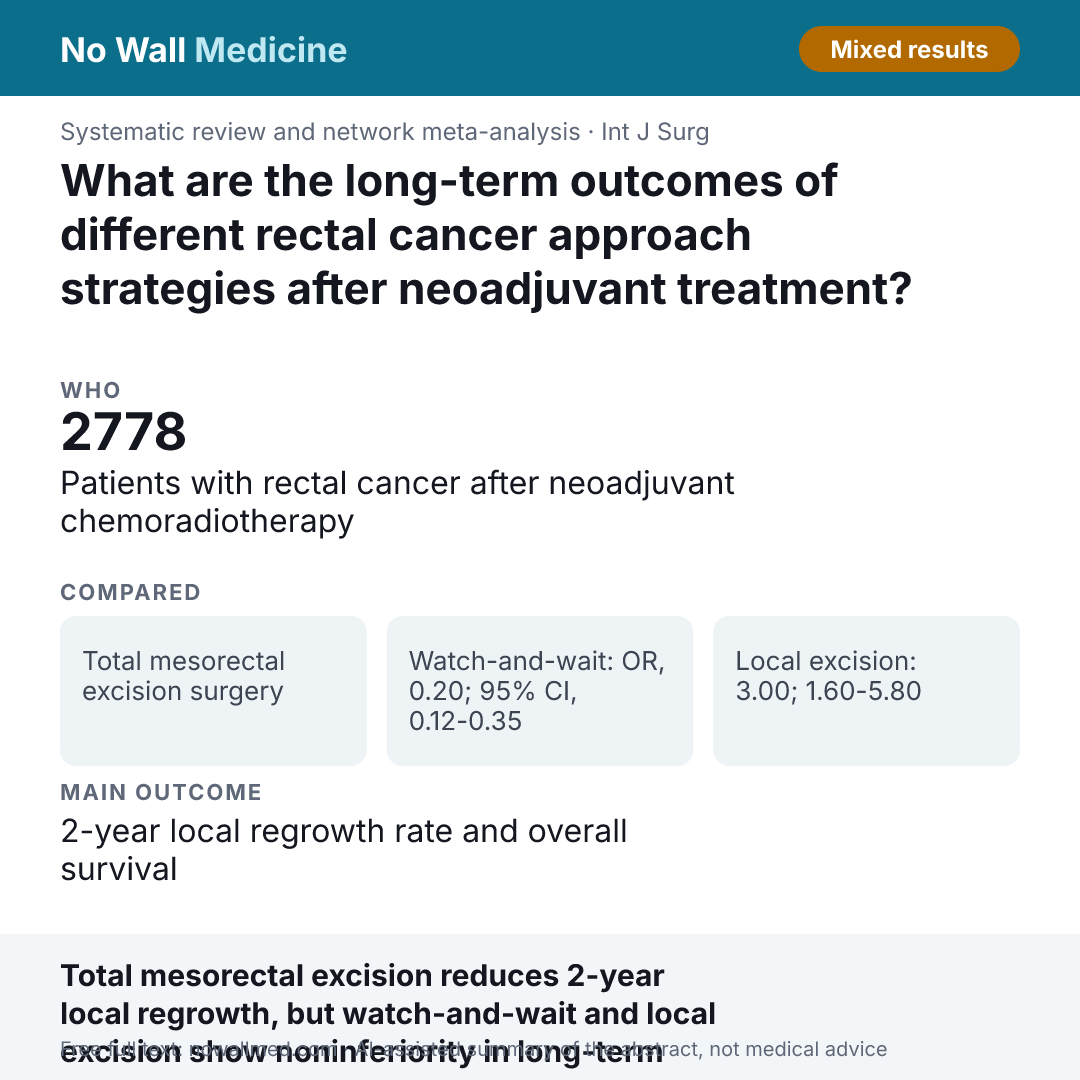
What are the long-term outcomes of different rectal cancer approach strategies after neoadjuvant treatment?
Who
2778
Patients with rectal cancer after neoadjuvant chemoradiotherapy
Compared
Total mesorectal excision surgery
Watch-and-wait: OR, 0.20; 95% CI, 0.12-0.35
Local excision: 3.00; 1.60-5.80
Main outcome
2-year local regrowth rate and overall survival
Result: OR, 0.37; 95% CI, 0.09-0.95
Bottom line: Total mesorectal excision reduces 2-year local regrowth, but watch-and-wait and local excision show noninferiority in long-term survival.
Limitation: Low-certainty evidence for 2-year local regrowth rate
Int J Surg · 2025-04-01 · Save PNG
Clinical question: What are the long-term outcomes of different rectal cancer approach strategies after neoadjuvant treatment?
Key points
- Researchers analyzed 26 studies involving 2778 participants to compare total mesorectal excision surgery, watch-and-wait, and local excision after chemoradiotherapy.
- Total mesorectal excision surgery was associated with lower 2-year local regrowth rates compared to the watch-and-wait group (OR, 0.20; 95% CI, 0.12-0.35) and the local excision group (OR, 3.00; 95% CI, 1.60-5.80).
- At 3 years, the watch-and-wait group was associated with higher overall survival than the surgery group (OR, 0.37; 95% CI, 0.09-0.95), but no significant difference in survival was found after 5 years.
Limitation the authors note: The evidence regarding 2-year local regrowth rates was of low certainty.
Headline and key points written with AI from the paper’s abstract, with every number checked against it. Read the paper before relying on them.
Was this summary helpful?
Subject terms
Headline, design, result, key points, caveat and citation as plain text.
Cite this article
Meng C, Shu W, Sun L, et al. Rectal cancer approach strategies after neoadjuvant treatment - a systematic review and network meta-analysis. Int J Surg. 2025;111(4):3078-3092. doi:10.1097/JS9.0000000000002290
Spotted a mistake? Suggest a correction