Higher dose intravenous iron was associated with fewer recurrent heart failure and death events
Recurrent event analyses in patients receiving maintenance dialysis and the effect of higher- versus lower-dose chronic intravenous iron therapy: A report focusing on heart failure events from the PIVOTAL trial
Randomized trialBenefit found
Does higher-dose versus lower-dose intravenous iron reduce recurrent cardiovascular events in haemodialysis patients?
Who
2141
Haemodialysis patients
Compared
Proactive maintenance dose of iron sucrose: 19.4/100 patient-years
Reactive treatment regimen: 24.6/100 patient-years
Main outcome
Primary recurrent events and cardiovascular death or heart failure hospitalizations
Result: rate ratio 0.77 (95% CI 0.66-0.92)
Bottom line: Higher-dose intravenous iron sucrose reduced the burden of recurrent cardiovascular events in haemodialysis patients.
Eur J Heart Fail · 2025-05-20Download image
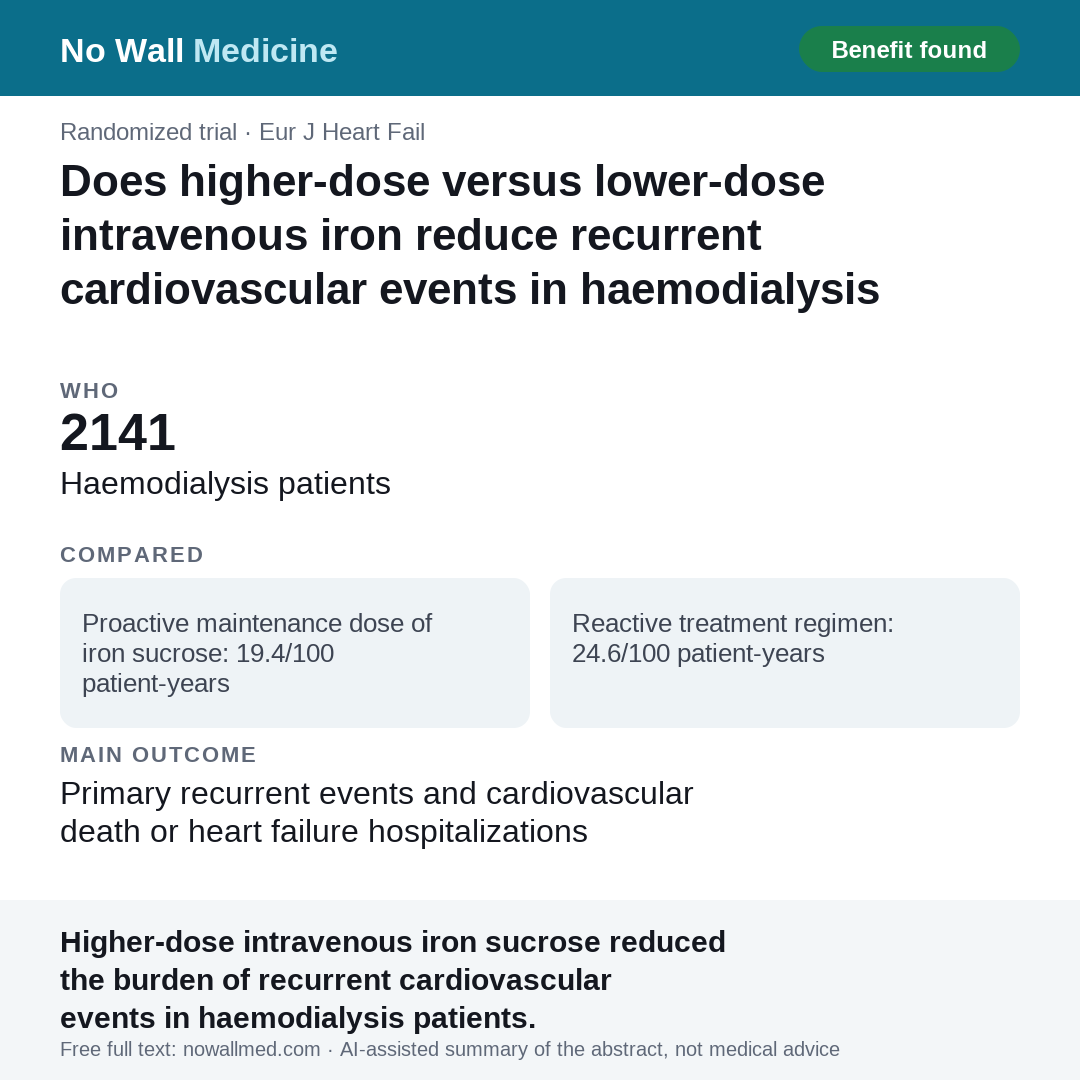
Clinical question: Does higher-dose versus lower-dose intravenous iron reduce recurrent cardiovascular events in haemodialysis patients?
Key points
- The study analyzed 2141 patients on maintenance dialysis who received either a proactive iron dose averaging 264 mg/month or a reactive dose averaging 145 mg/month.
- Using the Wei-Lin-Weissfeld method, the proactive group had 19.4/100 patient-years of primary events compared to 24.6/100 patient-years in the reactive group.
- The proactive regimen was associated with a lower rate of the composite endpoint of cardiovascular death or heart failure hospitalizations with a rate ratio of 0.73.
Headline and key points written with AI from the paper’s abstract, with every number checked against it. Read the paper before relying on them.
Topics
Cite this article
Anker SD, Robertson M, McMurray JJV, Jhund PS, White C, Reid C. Recurrent event analyses in patients receiving maintenance dialysis and the effect of higher- versus lower-dose chronic intravenous iron therapy: A report focusing on heart failure events from the PIVOTAL trial. Eur J Heart Fail. 2025. doi:10.1002/ejhf.3670
Spotted a mistake? Suggest a correction