Thrombophilia increases the risk of recurrent blood clots after stopping anticoagulant medication
Recurrent VTE in patients with thrombophilia after stopping anticoagulation: a systematic review and meta-analysis
Systematic review and meta-analysisHarm found
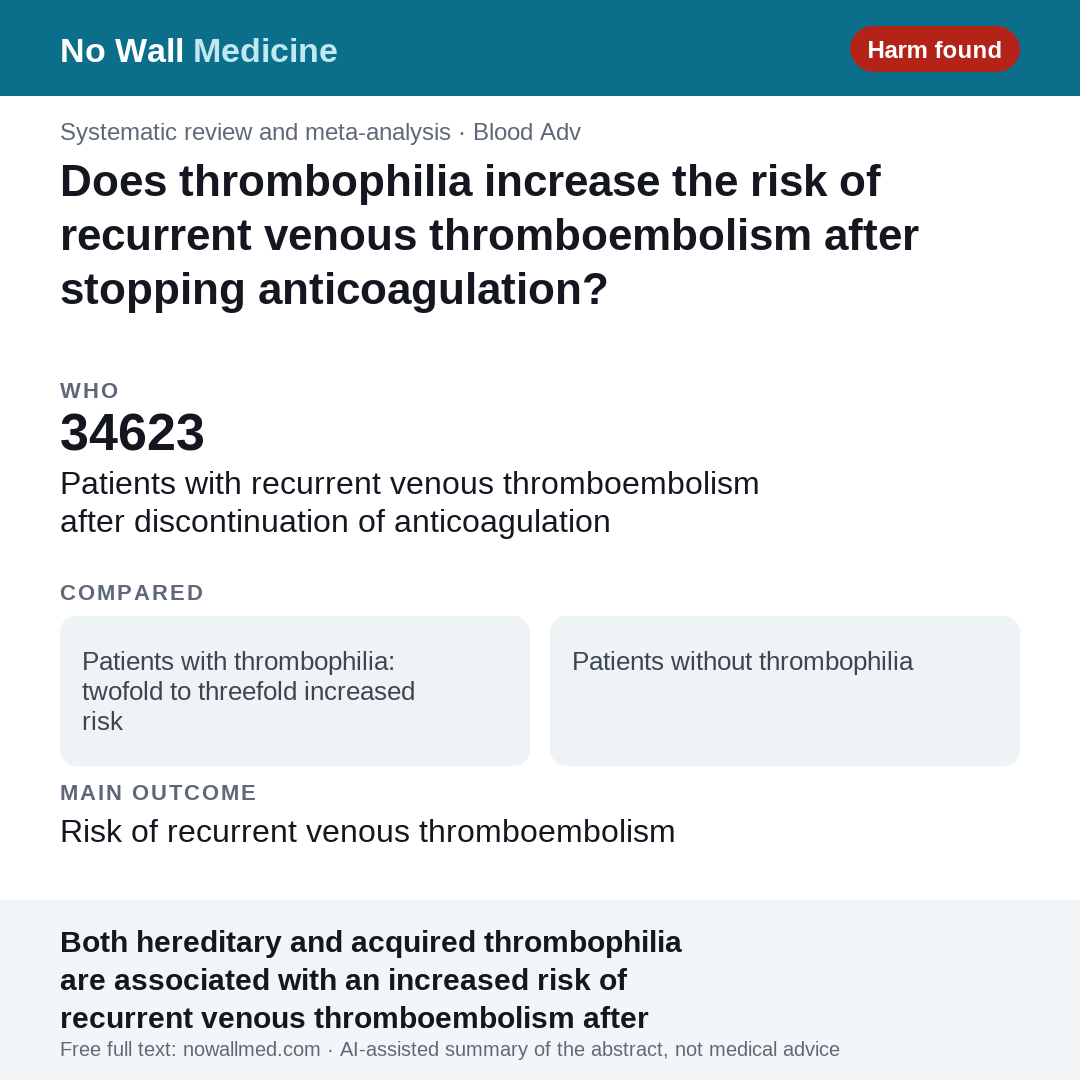
Does thrombophilia increase the risk of recurrent venous thromboembolism after stopping anticoagulation?
Who
34623
Patients with recurrent venous thromboembolism after discontinuation of anticoagulation
Compared
Patients with thrombophilia: twofold to threefold increased risk
Patients without thrombophilia
Main outcome
Risk of recurrent venous thromboembolism
Bottom line: Both hereditary and acquired thrombophilia are associated with an increased risk of recurrent venous thromboembolism after stopping anticoagulation.
Blood Adv · 2026-07-15Download image
Clinical question: Does thrombophilia increase the risk of recurrent venous thromboembolism after stopping anticoagulation?
Key points
- Researchers analyzed 51 studies involving 34,623 patients to evaluate how blood clotting disorders affect the risk of recurrent venous thromboembolism.
- Antiphospholipid antibody syndrome, antithrombin deficiency, and certain homozygous mutations increased the risk of recurrent clots by approximately twofold to threefold.
- Heterozygous factor V Leiden or prothrombin gene mutations were associated with a 1.5-fold increased risk of recurrent blood clots.
Headline and key points written with AI from the paper’s abstract, with every number checked against it. Read the paper before relying on them.
Abstract
The role of thrombophilia in clinical decision-making regarding secondary venous thromboembolism (VTE) prevention is still uncertain. Therefore, we aimed to investigate the association between hereditary and acquired thrombophilia and recurrent VTE after discontinuation of anticoagulation after initial VTE treatment. We conducted a systematic review and meta-analysis to evaluate the risk of recurrent VTE in patients with and without thrombophilia including factor V Leiden (FVL) mutation, prothrombin gene G20210A mutation (PTM), antithrombin deficiency (ATD), protein C deficiency (PCD), protein S deficiency (PSD), and antiphospholipid antibody syndrome (APS). Eligible studies included randomized trials and cohort studies reporting recurrent VTE after discontinuation of anticoagulation after completion of VTE treatment. Study-level incidence rates (IR) per 100 patient-years, IR ratios, and adjusted hazard ratio were calculated or extracted and pooled using random-effects models. Certainty of evidence was assessed using the Grading of Recommendations, Assessment, Development, and Evaluation approach. A total of 51 studies (n = 34 623 patients; 42.3% female; 33.5% with unprovoked index VTE) were included. Thrombophilias, including APS, ATD, homozygous FVL, and compound heterozygous FVL/PTM, were associated with an approximately twofold to threefold increased risk of recurrent VTE, whereas heterozygous FVL or PTM mutations were associated with a 1.5-fold increased risk. Heterogeneity and the certainty in the evidence were predominantly moderate. Evidence regarding PSD and PCD was inconclusive. Both hereditary and acquired thrombophilia are associated with an increased risk of recurrent VTE after discontinuation of anticoagulation.
Abstract reproduced under the article’s CC BY NC ND licence.
Topics
Cite this article
Vrotniakaite-Bajerciene K, Wang TF, Sabri E, Shorr R, Angelillo-Scherrer A, Le Gal G. Recurrent VTE in patients with thrombophilia after stopping anticoagulation: a systematic review and meta-analysis. Blood Adv. 2026. doi:10.1182/bloodadvances.2026020623
Spotted a mistake? Suggest a correction