Red light photodynamic therapy with BF-200 ALA cleared more actinic keratosis than a vehicle control
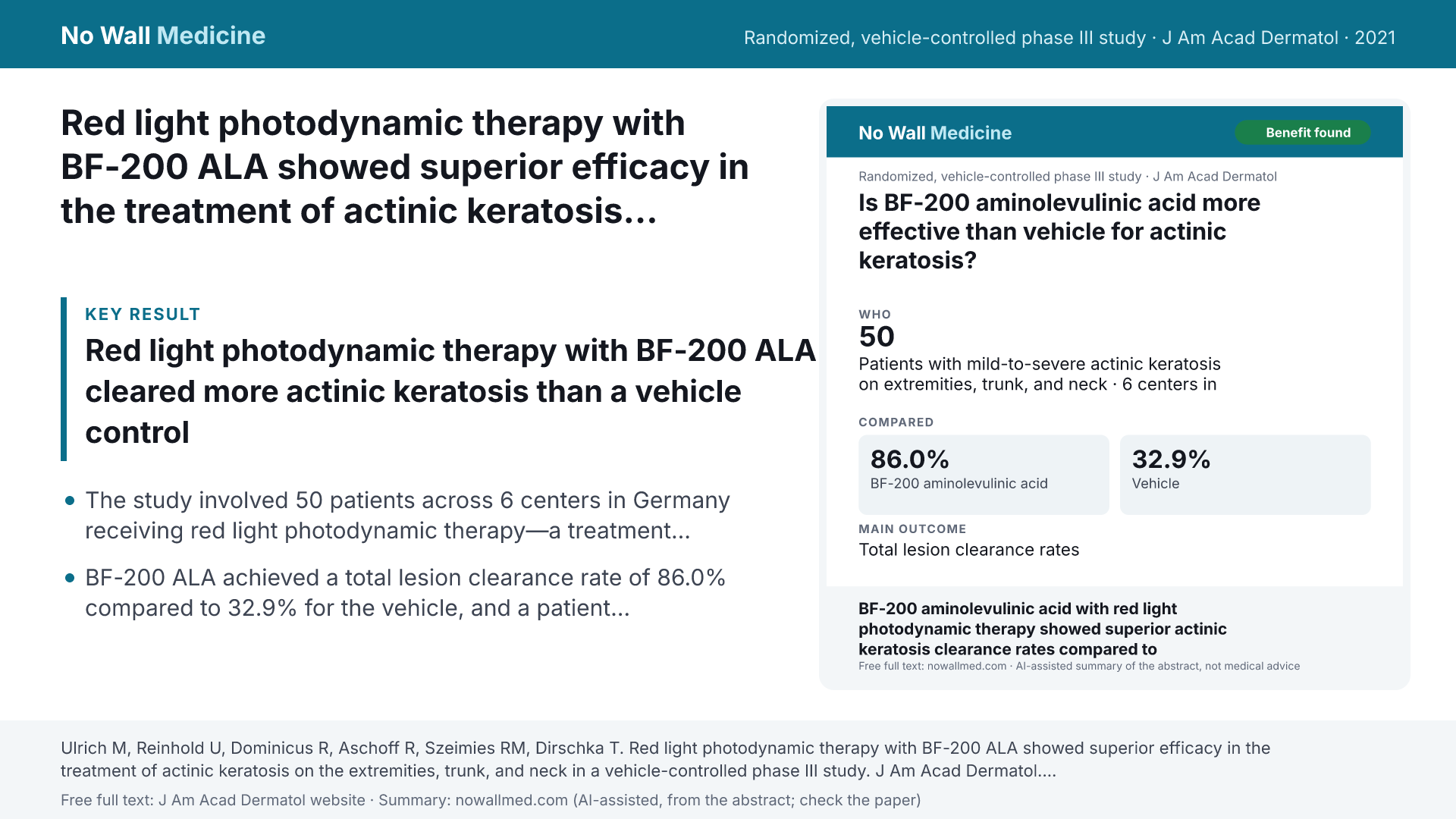
Red light photodynamic therapy with BF-200 ALA showed superior efficacy in the treatment of actinic keratosis on the extremities, trunk, and neck in a vehicle-controlled phase III study
Randomized, vehicle-controlled phase III studyBenefit found
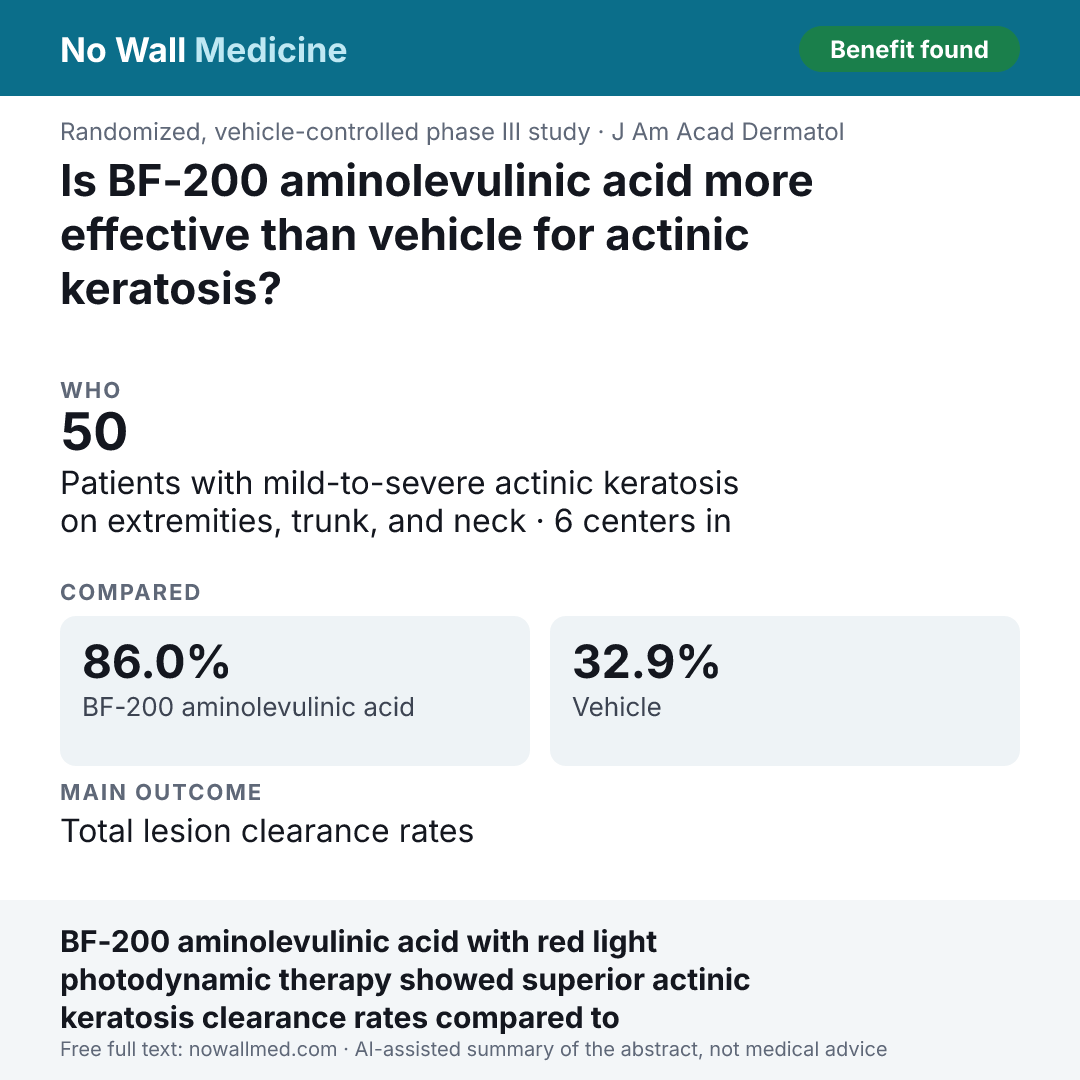
Is BF-200 aminolevulinic acid more effective than vehicle for actinic keratosis?
Who
50
Patients with mild-to-severe actinic keratosis on extremities, trunk, and neck · 6 centers in Germany
Compared
86.0%BF-200 aminolevulinic acid
32.9%Vehicle
Main outcome
Total lesion clearance rates
Bottom line: BF-200 aminolevulinic acid with red light photodynamic therapy showed superior actinic keratosis clearance rates compared to vehicle.
Limitation: Small number of severe lesions and limited sample size.
J Am Acad Dermatol · 2021-03-17 · Save PNG
Clinical question: Is BF-200 aminolevulinic acid more effective than vehicle for actinic keratosis?
Why it matters: Actinic keratoses located on the body outside of the head area are generally more resistant to treatment than those on the face.
Key points
- The study involved 50 patients across 6 centers in Germany receiving red light photodynamic therapy—a treatment using light to activate a drug—for actinic keratosis on the neck, trunk, and extremities.
- BF-200 ALA achieved a total lesion clearance rate of 86.0% compared to 32.9% for the vehicle, and a patient complete clearance rate of 67.3% compared to 12.2%.
- The one-year overall lesion recurrence rate was 14.1% for BF-200 ALA versus 27.4% for the vehicle.
Limitation the authors note: The authors noted a limited sample size, a small number of severe lesions, and an unbalanced but representative distribution of actinic keratoses.
Headline and key points written with AI from the paper’s abstract, with every number checked against it. Read the paper before relying on them.
Was this summary helpful?
Subject terms
Headline, design, result, key points, caveat and citation as plain text.
Cite this article
Ulrich M, Reinhold U, Dominicus R, Aschoff R, Szeimies RM, Dirschka T. Red light photodynamic therapy with BF-200 ALA showed superior efficacy in the treatment of actinic keratosis on the extremities, trunk, and neck in a vehicle-controlled phase III study. J Am Acad Dermatol. 2021. doi:10.1016/j.jaad.2021.03.031
Spotted a mistake? Suggest a correction