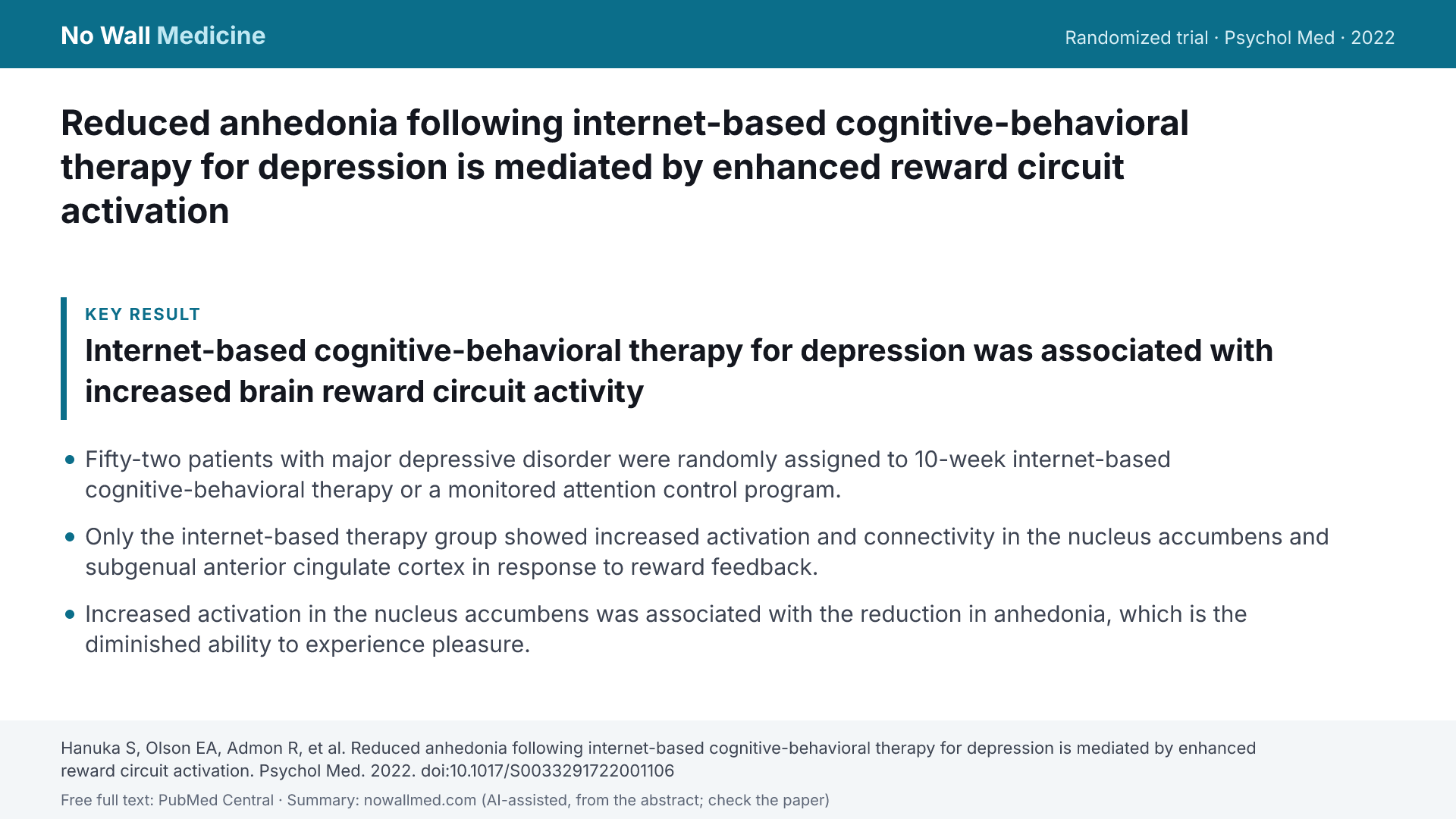
Reduced anhedonia following internet-based cognitive-behavioral therapy for depression is mediated by enhanced reward circuit activation
Key result: Internet-based cognitive-behavioral therapy for depression was associated with increased brain reward circuit activity
Key points
- Fifty-two patients with major depressive disorder were randomly assigned to 10-week internet-based cognitive-behavioral therapy or a monitored attention control program.
- Only the internet-based therapy group showed increased activation and connectivity in the nucleus accumbens and subgenual anterior cingulate cortex in response to reward feedback.
- Increased activation in the nucleus accumbens was associated with the reduction in anhedonia, which is the diminished ability to experience pleasure.
Why it matters: It was unknown if internet-based cognitive-behavioral therapy could reduce anhedonia severity and if these changes were accompanied by increased reactivity in neural reward circuits.
Discussion prompts
- Would these patients look like yours? Who was left out?
- Is the main outcome one that matters to patients?
- Is the difference large enough to change what you do?
Cite: Hanuka S, Olson EA, Admon R, Webb CA, Killgore WDS, Rauch SL. Reduced anhedonia following internet-based cognitive-behavioral therapy for depression is mediated by enhanced reward circuit activation. Psychol Med. 2022. doi:10.1017/S0033291722001106
Free full text: PubMed Central · Summary and visual abstract: nowallmed.com/a/reduced-anhedonia-following-internet-based-cognitive-behavioral-1bwxsgm/ (AI-assisted from the abstract; check the paper before relying on it).