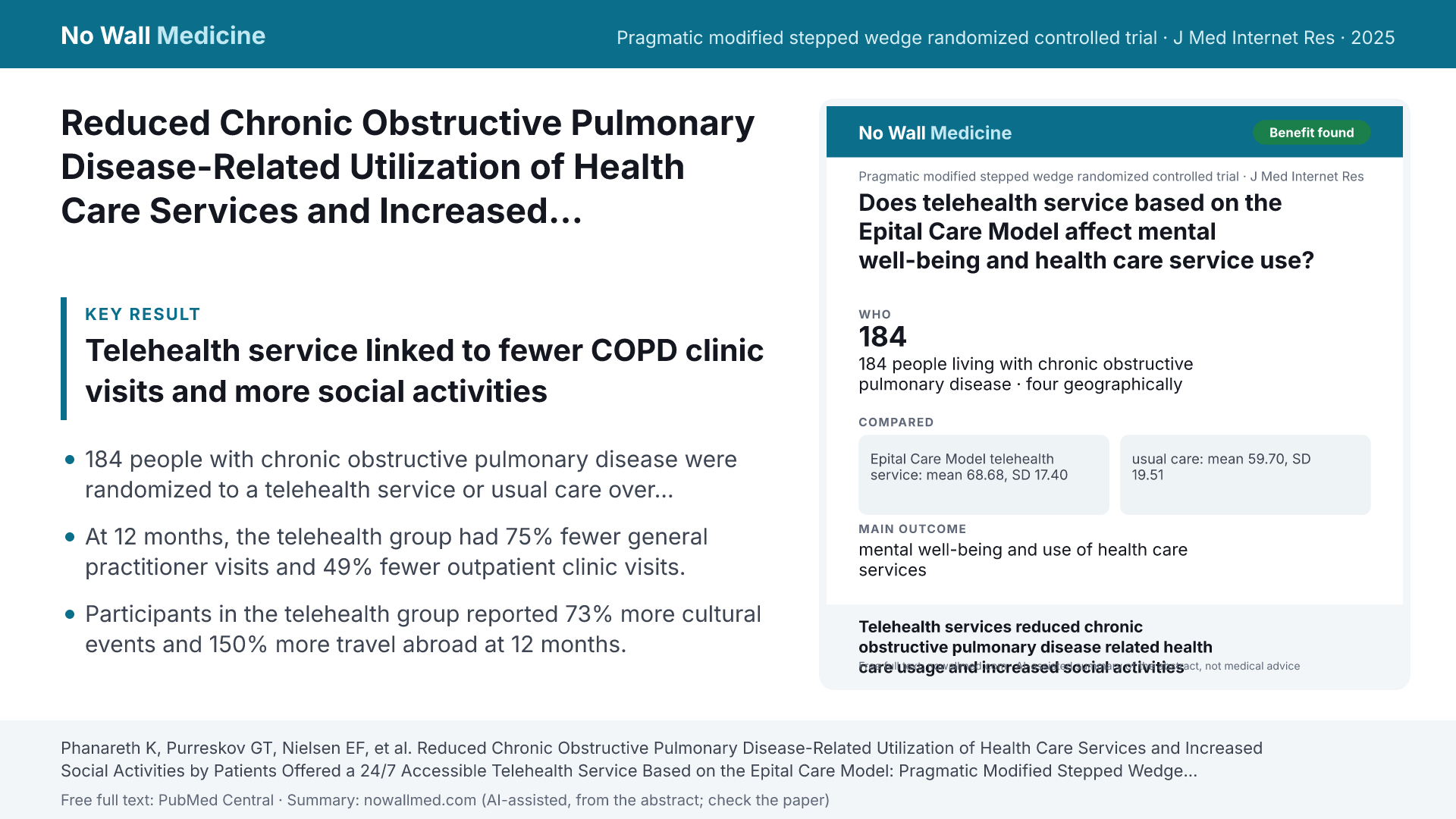
Reduced Chronic Obstructive Pulmonary Disease-Related Utilization of Health Care Services and Increased Social Activities by Patients Offered a 24/7 Accessible Telehealth Service Based on the Epital Care Model: Pragmatic Modified Stepped Wedge Randomized Controlled Trial
Pragmatic modified stepped wedge randomized controlled trialBenefit found
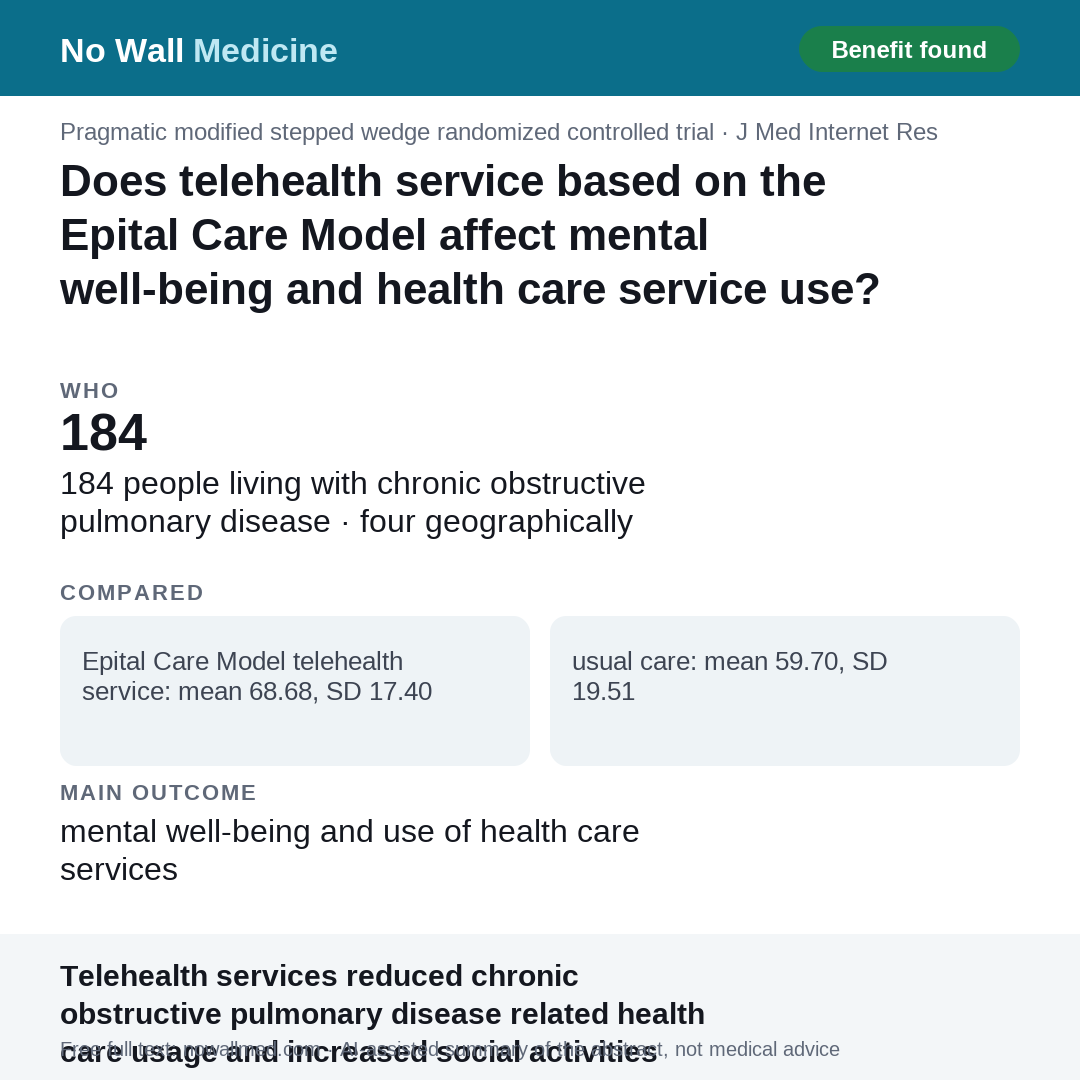
Does telehealth service based on the Epital Care Model affect mental well-being and health care service use?
Who
184
184 people living with chronic obstructive pulmonary disease · four geographically distinct locations
Compared
Epital Care Model telehealth service: mean 68.68, SD 17.40
usual care: mean 59.70, SD 19.51
Main outcome
mental well-being and use of health care services
Bottom line: Telehealth services reduced chronic obstructive pulmonary disease related health care usage and increased social activities and mobility.
J Med Internet Res · 2025-10-22Download image
Clinical question: Does telehealth service based on the Epital Care Model affect mental well-being and health care service use?
Abstract
Background
An escalating prevalence of older adults living longer with chronic conditions challenges the health care workforce. Innovative web-based services, such as those based on the Epital Care Model (ECM), may help address these challenges, though their effects remain undocumented. Objective
The objectives of this study are to investigate whether telehealth services provided by an ECM response and coordination center, complementary to usual care provided by general practitioners (GPs), affect the participants' mental well-being and use of health care services as primary outcomes, and social activities and mobility as a secondary outcome. Methods
Using a pragmatic, modified, stepped wedged, nonblinded design, 184 people living with chronic obstructive pulmonary disease, diagnosed in accordance with the GOLD (Global Initiative for Chronic Obstructive Lung Disease) guidelines, were, for logistic and resource reasons, randomized over a period of 10 months, within blocks of up to ten participants and at four geographically distinct locations, into either an ECM-based complementary telehealth service (ECTHS), manned by certified nonprofessional staff, or usual care provided by GPs and other health care services. All baseline parameters were collected in person, whereas all follow-up data were based on data from the participants' health records and telephone interviews at 8 months (T1) and 12 months (T2). Mental well-being was assessed by the World Health Organization-5 Well-Being Index (WHO-5), using an independent 2-sample t test for comparison between groups and a dependent 2-sample t test for comparison between T0 and T1 and T2, respectively, within the two groups. Health care service usage and participants' social activity and mobility were assessed and compared using Poisson regression. Results
In an intention-to-treat analysis, there were no differences in WHO-5 score within or between groups, whereas a difference was found at T2 in a per protocol analysis (mean 68.68, SD 17.40 in ECTHS vs 59.70, SD 19.51 in usual care; P=.01). Estimates of the Poisson regression were for chronic obstructive pulmonary disease related contacts to health care services at T2 for hospital admissions (0.51; P=.04), out-of-office services (0.49; P=.09), outpatient clinics (0.49; P=.02), and visits at GP (0.25; P<.001), demonstrating a reduction in usage between 49% and 75% after adjustment for age, GOLD risk score, risk time and comorbidities. In addition, at both T1 and T2, there was an increase in participation in cultural events and travel activities abroad, with T2 estimates of 1.73 (P<.001) and 2.50 (P=.002), respectively, demonstrating an increase of 73% and 150%, respectively. Conclusions
These results contribute to a new perspective on how health care services can be organized to reduce health care usage and increase social activity and mobility based on an ECTHS manned with nonprofessional certified staff. Trial registration
ClinicalTrials.gov NCT06988566, https://clinicaltrials.gov/study/NCT06988566 (retrospectively registered).
Subject terms
Cite this article
Phanareth K, Purreskov GT, Nielsen EF, Bentsen AT, Schou L, Newman S. Reduced Chronic Obstructive Pulmonary Disease-Related Utilization of Health Care Services and Increased Social Activities by Patients Offered a 24/7 Accessible Telehealth Service Based on the Epital Care Model: Pragmatic Modified Stepped Wedge Randomized Controlled Trial. J Med Internet Res. 2025. doi:10.2196/65300
Spotted a mistake? Suggest a correction