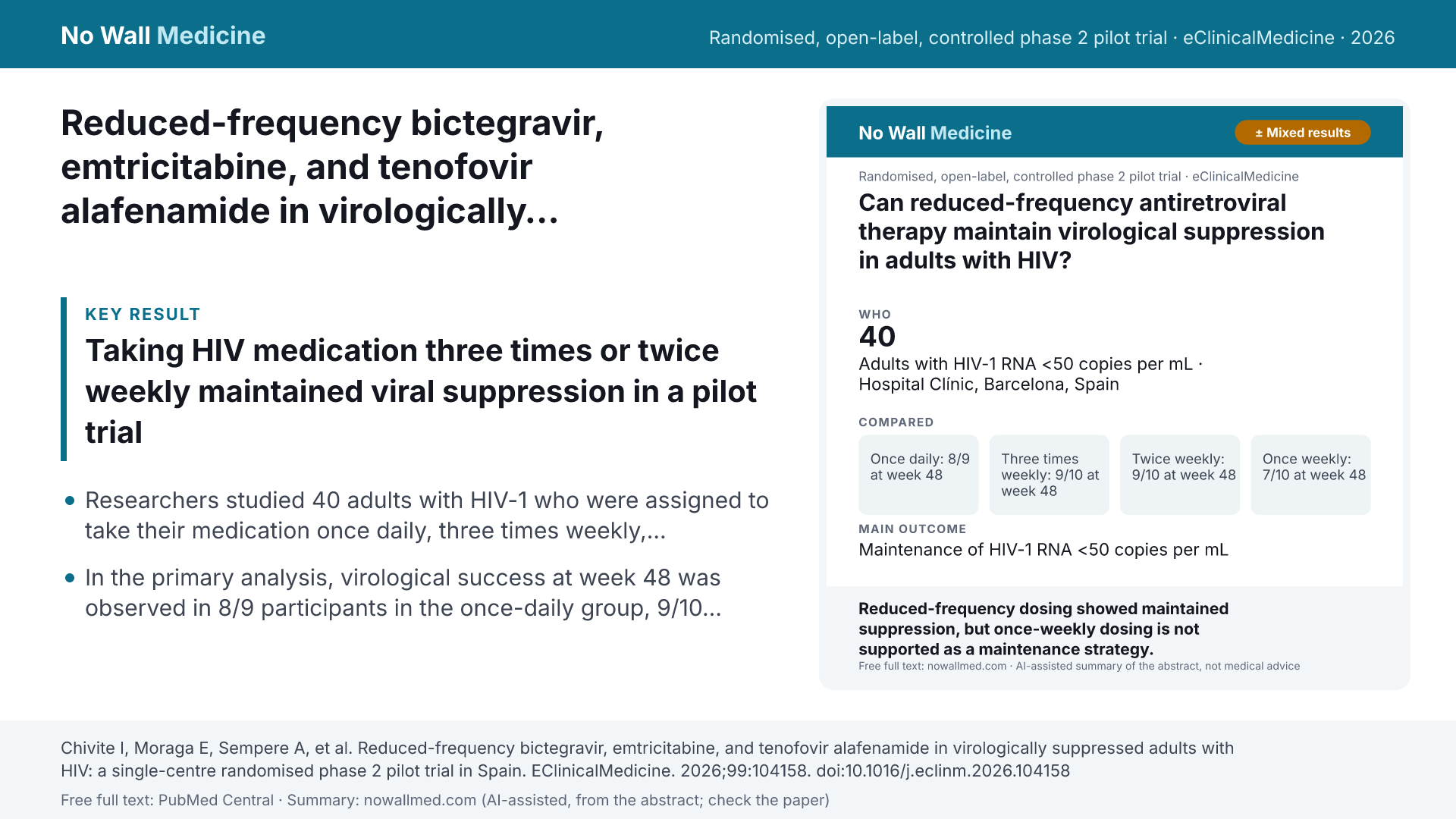
Taking HIV medication three times or twice weekly maintained viral suppression in a pilot trial
Reduced-frequency bictegravir, emtricitabine, and tenofovir alafenamide in virologically suppressed adults with HIV: a single-centre randomised phase 2 pilot trial in Spain
Randomised, open-label, controlled phase 2 pilot trialMixed results
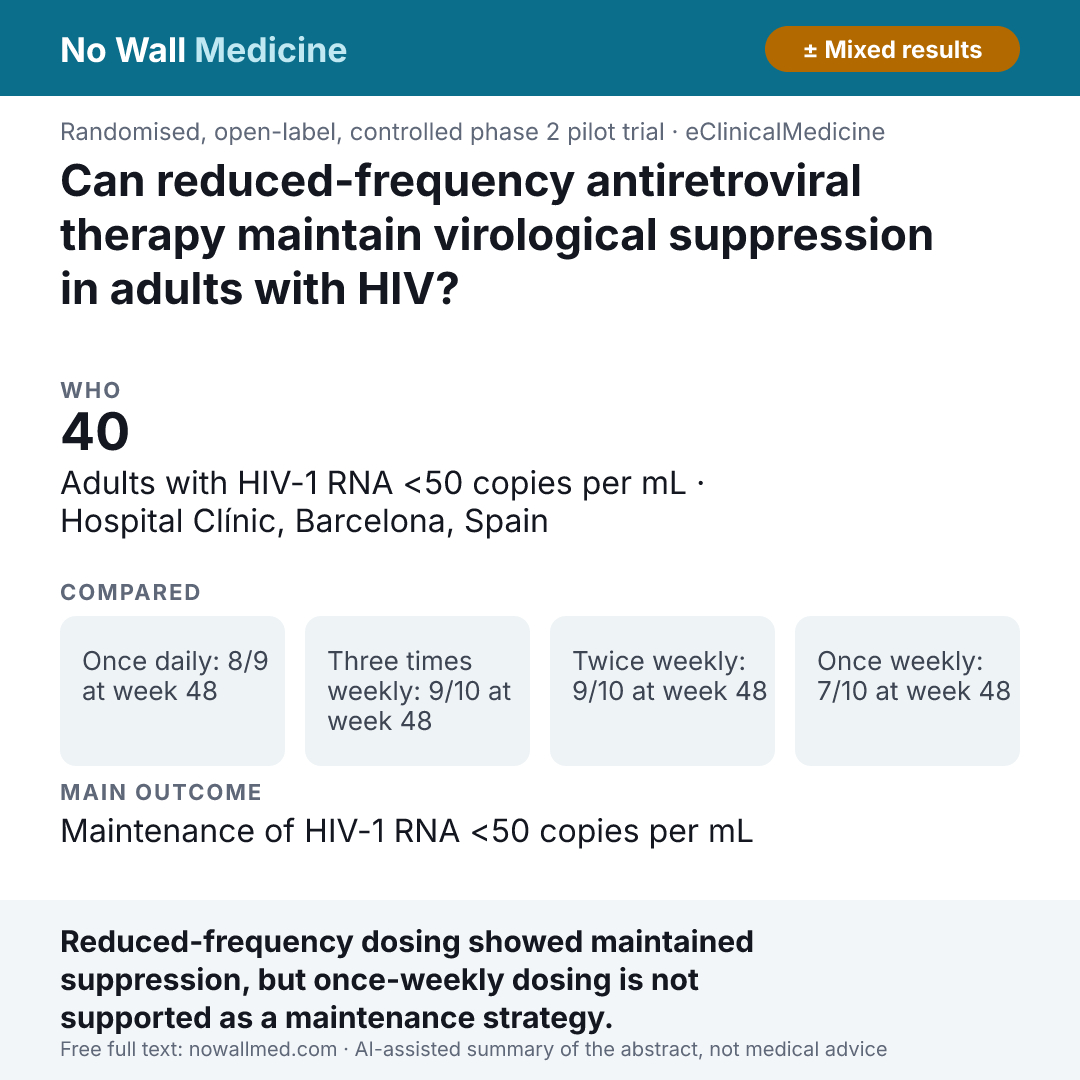
Can reduced-frequency antiretroviral therapy maintain virological suppression in adults with HIV?
Who
40
Adults with HIV-1 RNA <50 copies per mL · Hospital Clínic, Barcelona, Spain
Compared
Once daily: 8/9 at week 48
Three times weekly: 9/10 at week 48
Twice weekly: 9/10 at week 48
Once weekly: 7/10 at week 48
Main outcome
Maintenance of HIV-1 RNA <50 copies per mL
Bottom line: Reduced-frequency dosing showed maintained suppression, but once-weekly dosing is not supported as a maintenance strategy.
Funded by: Instituto de Salud Carlos
eClinicalMedicine · 2026-08-23 · Save PNG
Clinical question: Can reduced-frequency antiretroviral therapy maintain virological suppression in adults with HIV?
Why it matters: The exposure thresholds required to maintain viral suppression using reduced-frequency antiretroviral therapy remain undefined.
Key points
- Researchers studied 40 adults with HIV-1 who were assigned to take their medication once daily, three times weekly, twice weekly, or once weekly for 48 weeks.
- In the primary analysis, virological success at week 48 was observed in 8/9 participants in the once-daily group, 9/10 in the three-times-weekly group, 9/10 in the twice-weekly group, and 7/10 in the once-weekly group.
- Three participants experienced confirmed virological failure but regained suppression after returning to once-daily therapy without developing drug resistance.
Limitation the authors note: The trial was not powered for formal between-arm comparisons and was a single-centre pilot trial.
Headline and key points written with AI from the paper’s abstract, with every number checked against it. Read the paper before relying on them.
Was this summary helpful?
Headline, design, result, key points, caveat and citation as plain text.
Cite this article
Chivite I, Moraga E, Sempere A, et al. Reduced-frequency bictegravir, emtricitabine, and tenofovir alafenamide in virologically suppressed adults with HIV: a single-centre randomised phase 2 pilot trial in Spain. EClinicalMedicine. 2026;99:104158. doi:10.1016/j.eclinm.2026.104158
Spotted a mistake? Suggest a correction