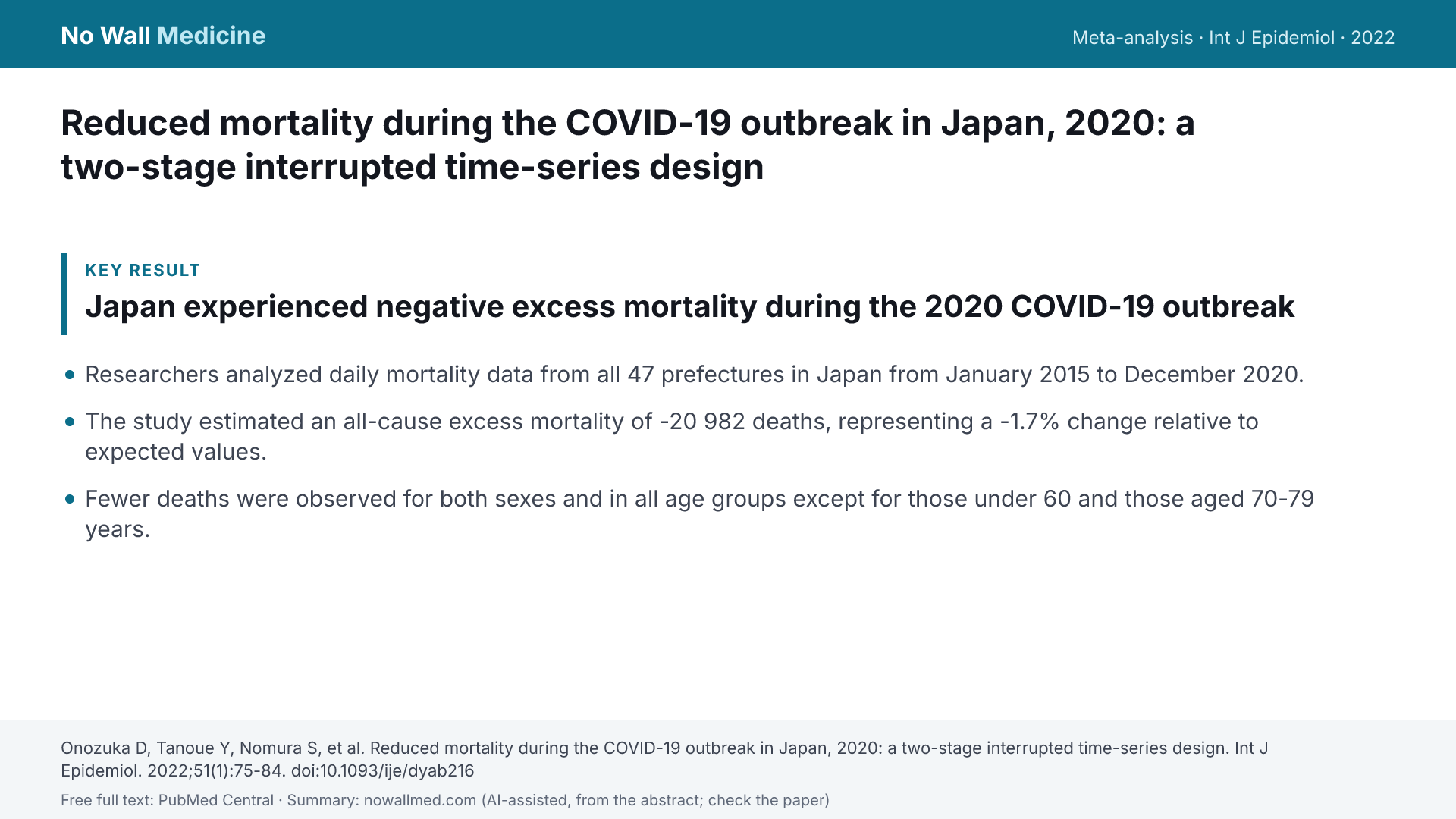
Japan experienced negative excess mortality during the 2020 COVID-19 outbreak
Reduced mortality during the COVID-19 outbreak in Japan, 2020: a two-stage interrupted time-series design
Key points
- Researchers analyzed daily mortality data from all 47 prefectures in Japan from January 2015 to December 2020.
- The study estimated an all-cause excess mortality of -20 982 deaths, representing a -1.7% change relative to expected values.
- Fewer deaths were observed for both sexes and in all age groups except for those under 60 and those aged 70-79 years.
Headline and key points written with AI from the paper’s abstract, with every number checked against it. Read the paper before relying on them.
Was this summary helpful?
Abstract
Background
Coronavirus disease 2019 (COVID-19) continues to be a major global health burden. This study aims to estimate the all-cause excess mortality occurring in the COVID-19 outbreak in Japan, 2020, by sex and age group. Methods
Daily time series of mortality for the period January 2015-December 2020 in all 47 prefectures of Japan were obtained from the Ministry of Health, Labour and Welfare, Japan. A two-stage interrupted time-series design was used to calculate excess mortality. In the first stage, we estimated excess mortality by prefecture using quasi-Poisson regression models in combination with distributed lag non-linear models, adjusting for seasonal and long-term variations, weather conditions and influenza activity. In the second stage, we used a random-effects multivariate meta-analysis to synthesize prefecture-specific estimates at the nationwide level. Results
In 2020, we estimated an all-cause excess mortality of -20 982 deaths [95% empirical confidence intervals (eCI): -38 367 to -5472] in Japan, which corresponded to a percentage excess of -1.7% (95% eCI: -3.1 to -0.5) relative to the expected value. Reduced deaths were observed for both sexes and in all age groups except those aged <60 and 70-79 years. Conclusions
All-cause mortality during the COVID-19 outbreak in Japan in 2020 was decreased compared with a historical baseline. Further evaluation of cause-specific excess mortality is warranted.
Abstract reproduced under the article’s CC BY licence.
Subject terms
Headline, design, result, key points, caveat and citation as plain text.
Cite this article
Onozuka D, Tanoue Y, Nomura S, et al. Reduced mortality during the COVID-19 outbreak in Japan, 2020: a two-stage interrupted time-series design. Int J Epidemiol. 2022;51(1):75-84. doi:10.1093/ije/dyab216
Spotted a mistake? Suggest a correction