Low nicotine cigarettes were associated with fewer cigarettes smoked and more smoke-free days
Reduced nicotine in cigarettes in a marketplace with alternative nicotine systems: randomized clinical trial
Open-label, parallel-arm randomized clinical trialBenefit found
Do reduced-nicotine cigarettes affect consumption when alternative nicotine systems are available?
Who
438
Smokers with access to non-combusted alternative nicotine delivery systems · United States, six sites
Compared
0.4 mg nicotine cigarettes: 7.05 [SD, 7.88] cigarettes per day
15.8 mg nicotine cigarettes: 12.95 [SD, 9.07] cigarettes per day
Main outcome
cigarettes per day and number of smoke-free days
Result: adjusted mean difference, -6.21 [95% CI, -7.66 to -4.75]
Bottom line: Reduced-nicotine cigarettes decreased daily consumption and increased smoke-free days when alternative nicotine products were available.
Funded by: U.S. NIH/FDA
Lancet Reg Health Am · 2024-06-03 · Save PNG
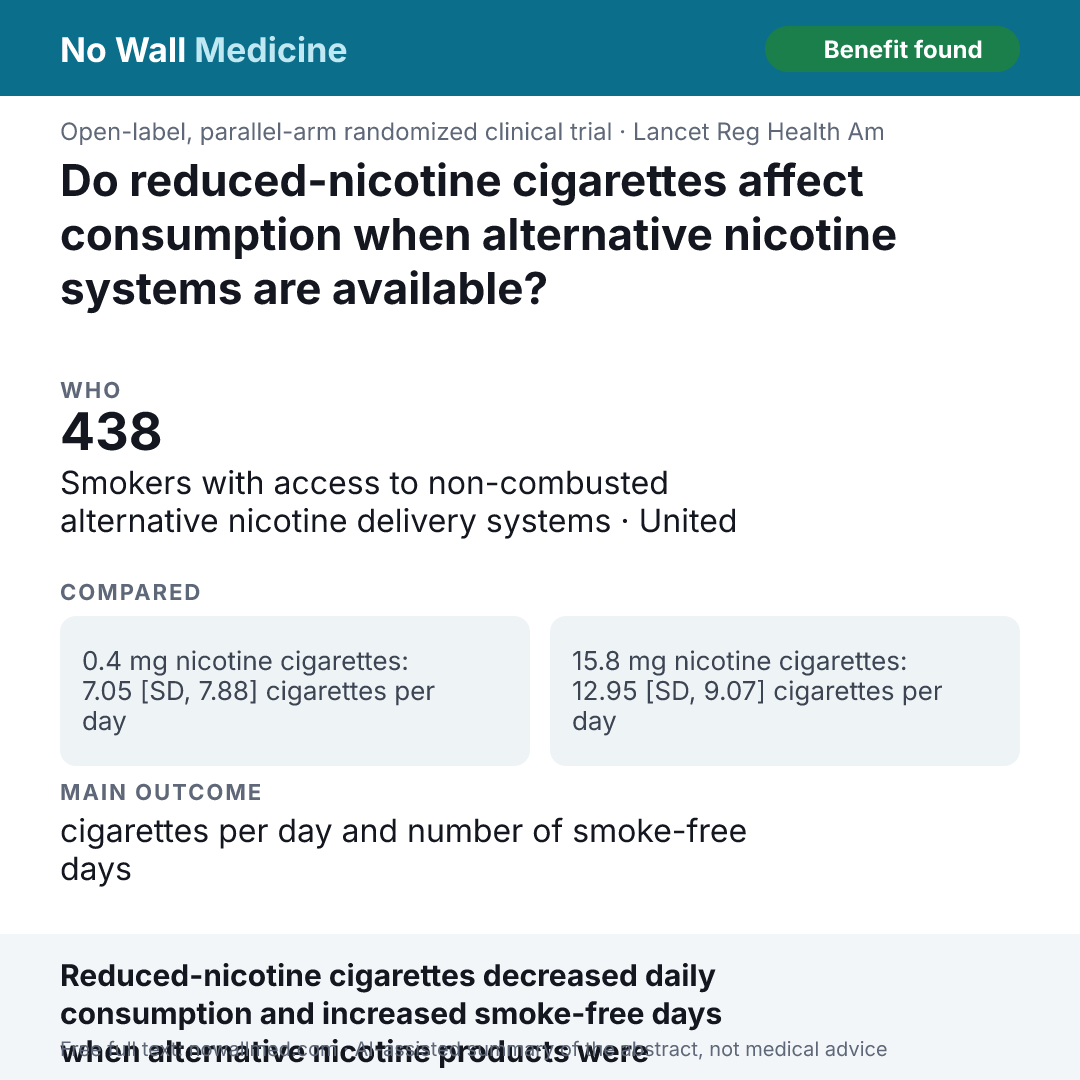
Clinical question: Do reduced-nicotine cigarettes affect consumption when alternative nicotine systems are available?
Key points
- Researchers randomized 438 smokers to an experimental marketplace containing either 0.4 mg or 15.8 mg of nicotine per gram of tobacco for twelve weeks.
- Participants in the 0.4 mg nicotine group smoked a mean of 7.05 cigarettes per day compared to 12.95 cigarettes per day in the 15.8 mg group.
- The 0.4 mg nicotine group had a mean of 18.59 smoke-free days compared to 5.06 smoke-free days in the 15.8 mg group.
Headline and key points written with AI from the paper’s abstract, with every number checked against it. Read the paper before relying on them.
Was this summary helpful?
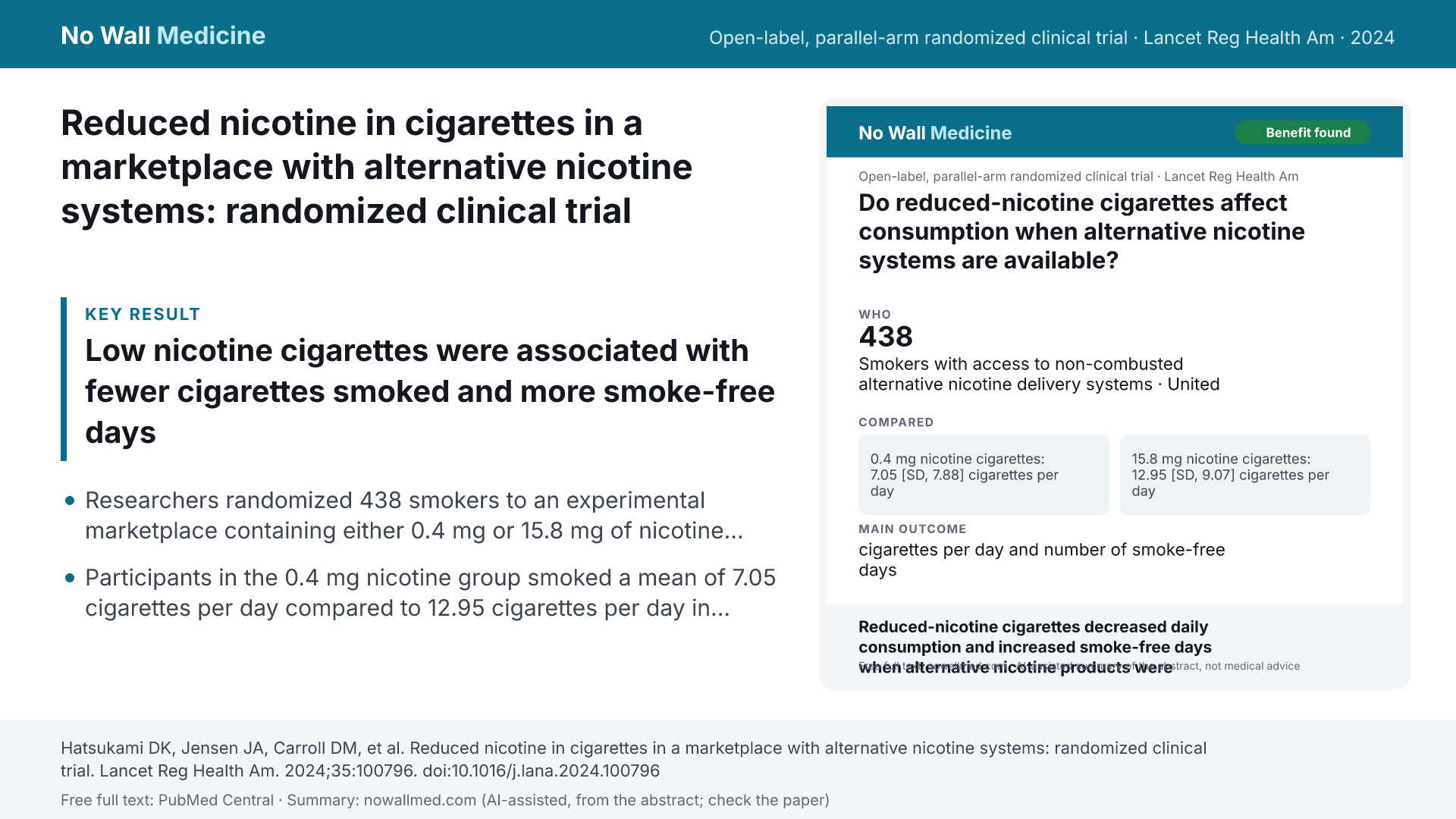
Headline, design, result, key points, caveat and citation as plain text.
Cite this article
Hatsukami DK, Jensen JA, Carroll DM, et al. Reduced nicotine in cigarettes in a marketplace with alternative nicotine systems: randomized clinical trial. Lancet Reg Health Am. 2024;35:100796. doi:10.1016/j.lana.2024.100796
Spotted a mistake? Suggest a correction