Decreased brain connectivity in reward and default mode networks was found in recurrent depression
Reduced nucleus accumbens functional connectivity in reward network and default mode network in patients with recurrent major depressive disorder
Meta-analysis and mega-analysisHarm found
Are there functional connectivity alterations in the nucleus accumbens in recurrent major depressive disorder?
Who
Patients with recurrent major depressive disorder and healthy controls
Compared
Recurrent major depressive disorder: Decreased functional connectivity within the reward system
Healthy controls
Main outcome
Nucleus accumbens functional connectivity
Bottom line: Recurrent major depressive disorder is characterized by decreased nucleus accumbens functional connectivity within reward and default mode networks.
Transl Psychiatry · 2022-06-06Download image
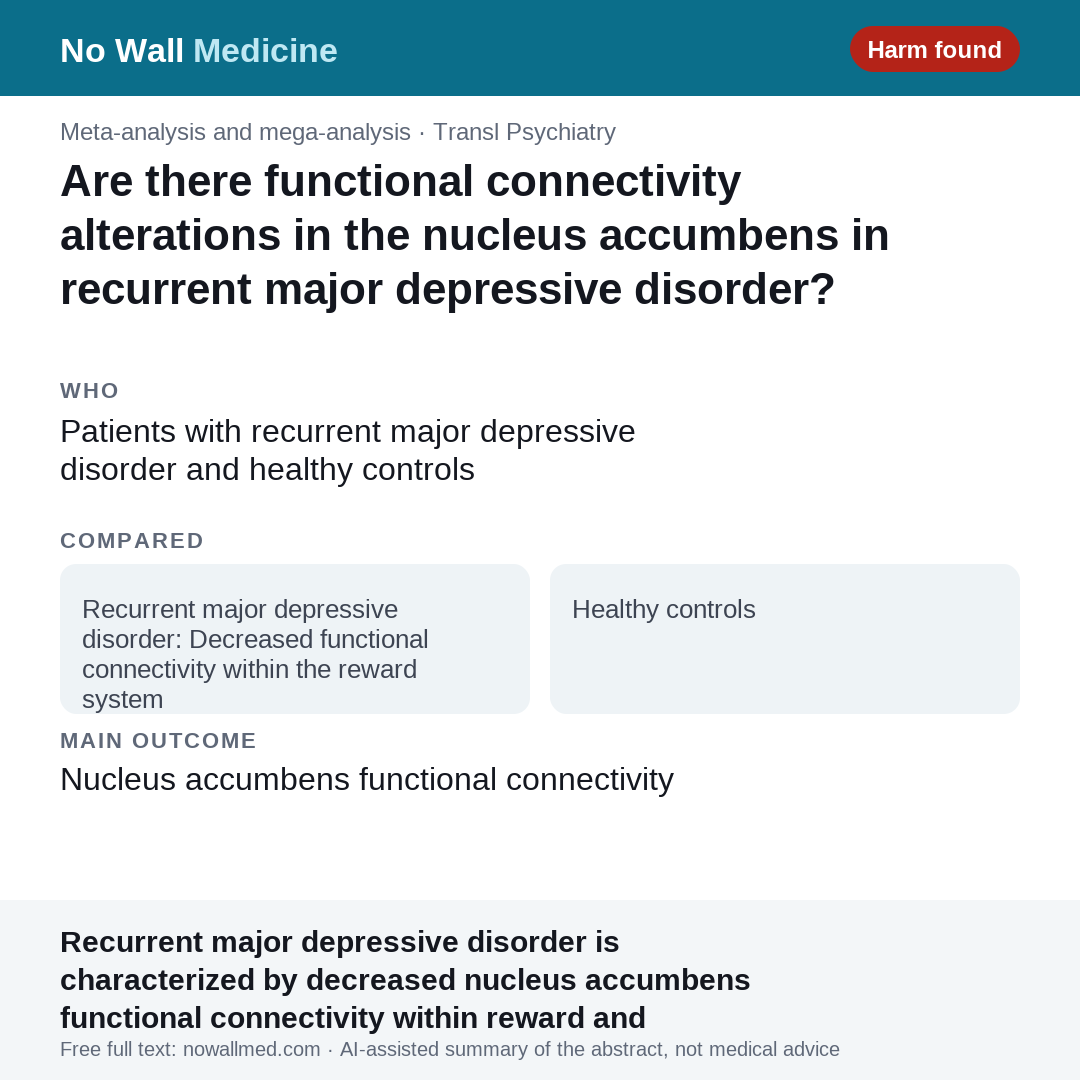
Clinical question: Are there functional connectivity alterations in the nucleus accumbens in recurrent major depressive disorder?
Why it matters: Results have been inconsistent in studies using resting-state functional magnetic resonance imaging to examine reward network-focused brain activity in major depressive disorder.
Key points
- Researchers performed a meta-analysis of resting-state functional magnetic resonance imaging studies and tested results using a database of 186 patients with recurrent major depressive disorder and 465 healthy controls.
- Patients with recurrent major depressive disorder showed decreased functional connectivity within the reward system and disrupted connectivity between the nucleus accumbens and the default mode network.
- The combination of disrupted connectivity within the reward network could distinguish patients from healthy controls with an accuracy of 74.7%.
Headline and key points written with AI from the paper’s abstract, with every number checked against it. Read the paper before relying on them.
Was this summary helpful?
Subject terms
Cite this article
Ding YD, Chen X, Chen ZB, Li L, Li XY, Castellanos FX. Reduced nucleus accumbens functional connectivity in reward network and default mode network in patients with recurrent major depressive disorder. Transl Psychiatry. 2022. doi:10.1038/s41398-022-01995-x
Spotted a mistake? Suggest a correction
Top studies every Monday
The week’s key trials and guidelines in your specialties, plus any topics you follow. By email, free.
Get the weekly digest