Alcohol taxation and minimum unit pricing were associated with a 10% reduction in consumption
Reducing alcohol use through alcohol control policies in the general population and population subgroups: a systematic review and meta-analysis
Systematic review and meta-analysisBenefit found
How do alcohol taxation, minimum unit pricing, and restricted availability affect alcohol consumption?
Who
General population and population subgroups
Compared
Doubling alcohol taxes: reduced consumption by 10% (95% prediction intervals: -18.5%, -1.2%)
Minimum unit pricing: reduced consumption by 10% (95% prediction intervals: -28.2%, 5.8%)
Restricting alcohol sales one day a week: reduced consumption by 3.6% (95% prediction intervals: -7.2%, -0.1%)
Main outcome
Overall alcohol consumption
Bottom line: Taxation, minimum unit pricing, and restricted availability reduce alcohol consumption, with pricing policies impacting low-income users more.
Limitation: Substantial between-study heterogeneity contributes to high levels of uncertainty.
Funded by: National Institute on Alcohol Abuse and Alcoholism
eClinicalMedicine · 2023-05-10Download image
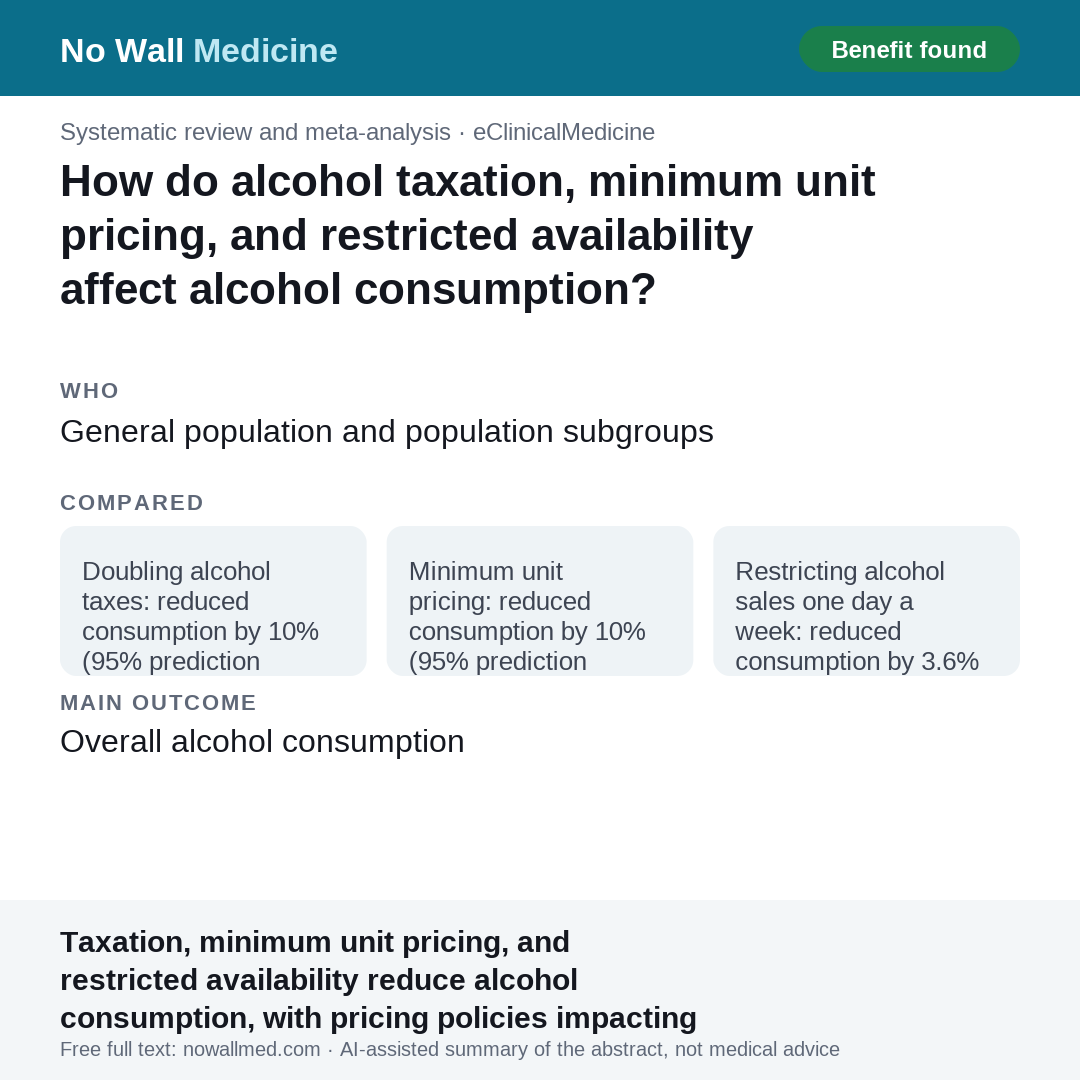
Clinical question: How do alcohol taxation, minimum unit pricing, and restricted availability affect alcohol consumption?
Why it matters: It is unknown how alcohol taxation, minimum unit pricing, and restricted availability impact consumption across different sociodemographic groups.
Key points
- Researchers performed a meta-analysis of 36 eligible reports published between 2000 and 2022 regarding alcohol control policies.
- Doubling alcohol taxes or introducing minimum unit pricing (the lowest legal price for a standard drink) was associated with a 10% reduction in consumption.
- Restricting alcohol sales by one day per week was associated with a 3.6% reduction in consumption.
Limitation the authors note: Substantial between-study heterogeneity contributes to high levels of uncertainty.
Headline and key points written with AI from the paper’s abstract, with every number checked against it. Read the paper before relying on them.
Was this summary helpful?
Cite this article
Kilian C, Lemp JM, Llamosas-Falcón L, Carr T, Ye Y, Kerr WC. Reducing alcohol use through alcohol control policies in the general population and population subgroups: a systematic review and meta-analysis. eClinicalMedicine. 2023. doi:10.1016/j.eclinm.2023.101996
Spotted a mistake? Suggest a correction
Top studies every Monday
The week’s key trials and guidelines in your specialties, plus any topics you follow. By email, free.
Get the weekly digest