Deprescribing central nervous system medications did not reduce medically treated falls in older adults
Reducing Central Nervous System-Active Medications to Prevent Falls and Injuries Among Older Adults: A Cluster Randomized Clinical Trial
Cluster randomized, parallel-group, clinical trialNo clear difference
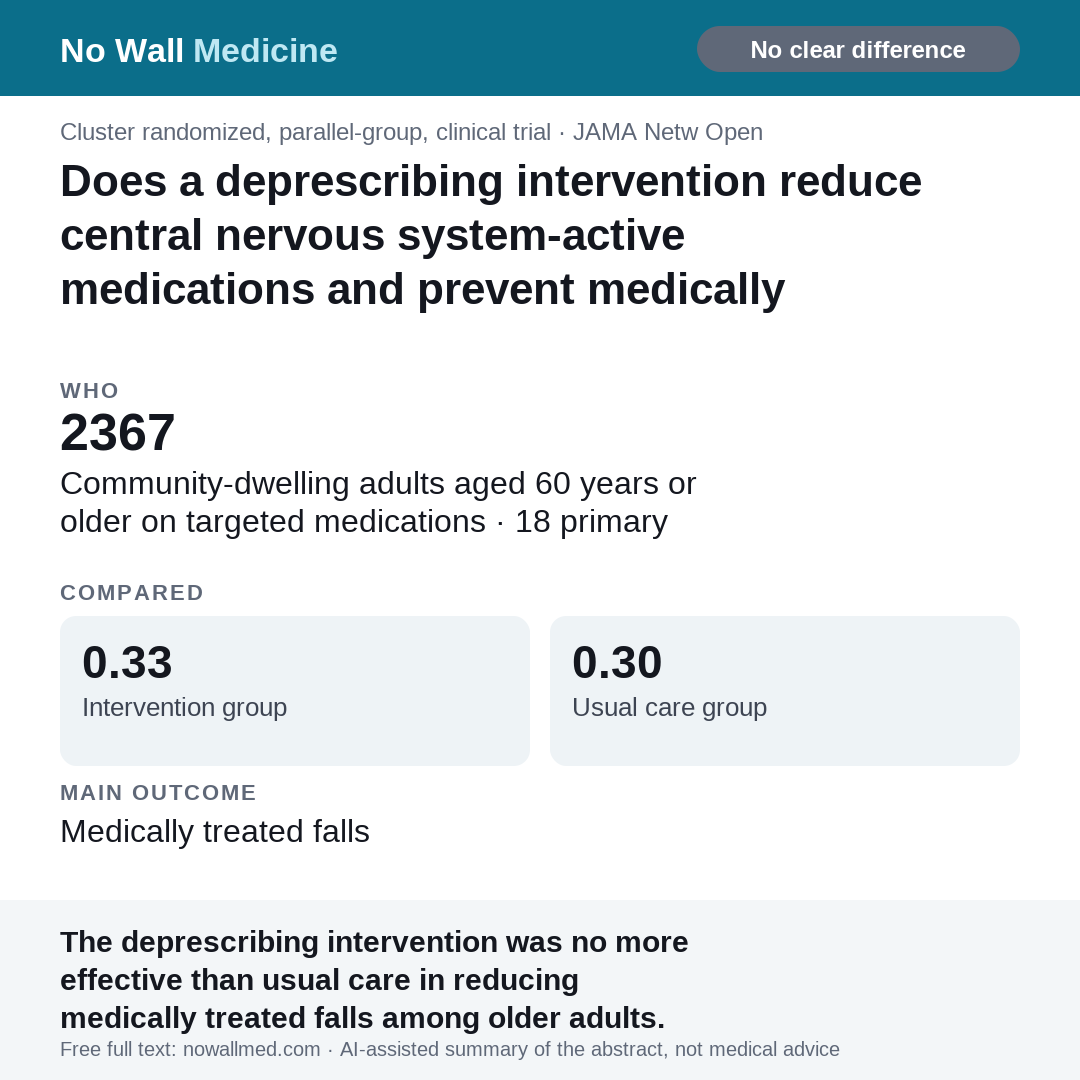
Does a deprescribing intervention reduce central nervous system-active medications and prevent medically treated falls?
Who
2367
Community-dwelling adults aged 60 years or older on targeted medications · 18 primary care practices in Washington state
Compared
0.33Intervention group (95% CI, 0.29-0.37)
0.30Usual care group (95% CI, 0.27-0.34)
Main outcome
Medically treated falls
Result: hazard ratio 1.11 (95% CI, 0.94-1.31)
Bottom line: The deprescribing intervention was no more effective than usual care in reducing medically treated falls among older adults.
JAMA Netw Open · 2024-07-01Download image
Clinical question: Does a deprescribing intervention reduce central nervous system-active medications and prevent medically treated falls?
Why it matters: It is unknown if interventions designed to reduce the use of central nervous system-active drugs actually prevent medically treated falls in older adults.
Key points
- Researchers studied 2367 community-dwelling adults aged 60 years or older across 18 primary care practices to compare a deprescribing intervention against usual care.
- The intervention was no more effective than usual care in reducing medically treated falls, with an adjusted cumulative incidence rate of 0.33 in the intervention group versus 0.30 in the control group.
- The intervention was associated with higher rates of discontinuation and dose reduction for tricyclic antidepressants, which are medications used for depression and pain.
Headline and key points written with AI from the paper’s abstract, with every number checked against it. Read the paper before relying on them.
Was this summary helpful?
Subject terms
Cite this article
Phelan EA, Williamson BD, Balderson BH, Cook AJ, Piccorelli AV, Fujii MM. Reducing Central Nervous System-Active Medications to Prevent Falls and Injuries Among Older Adults: A Cluster Randomized Clinical Trial. JAMA Netw Open. 2024. doi:10.1001/jamanetworkopen.2024.24234
Spotted a mistake? Suggest a correction
Top studies every Monday
The week’s key trials and guidelines in your specialties, plus any topics you follow. By email, free.
Get the weekly digest