
Reducing exacerbations in children and adults with primary ciliary dyskinesia using erdosteine and/or azithromycin therapy (REPEAT trial): study protocol for a multicentre, double-blind, double-dummy, 2×2 partial factorial, randomised controlled trial
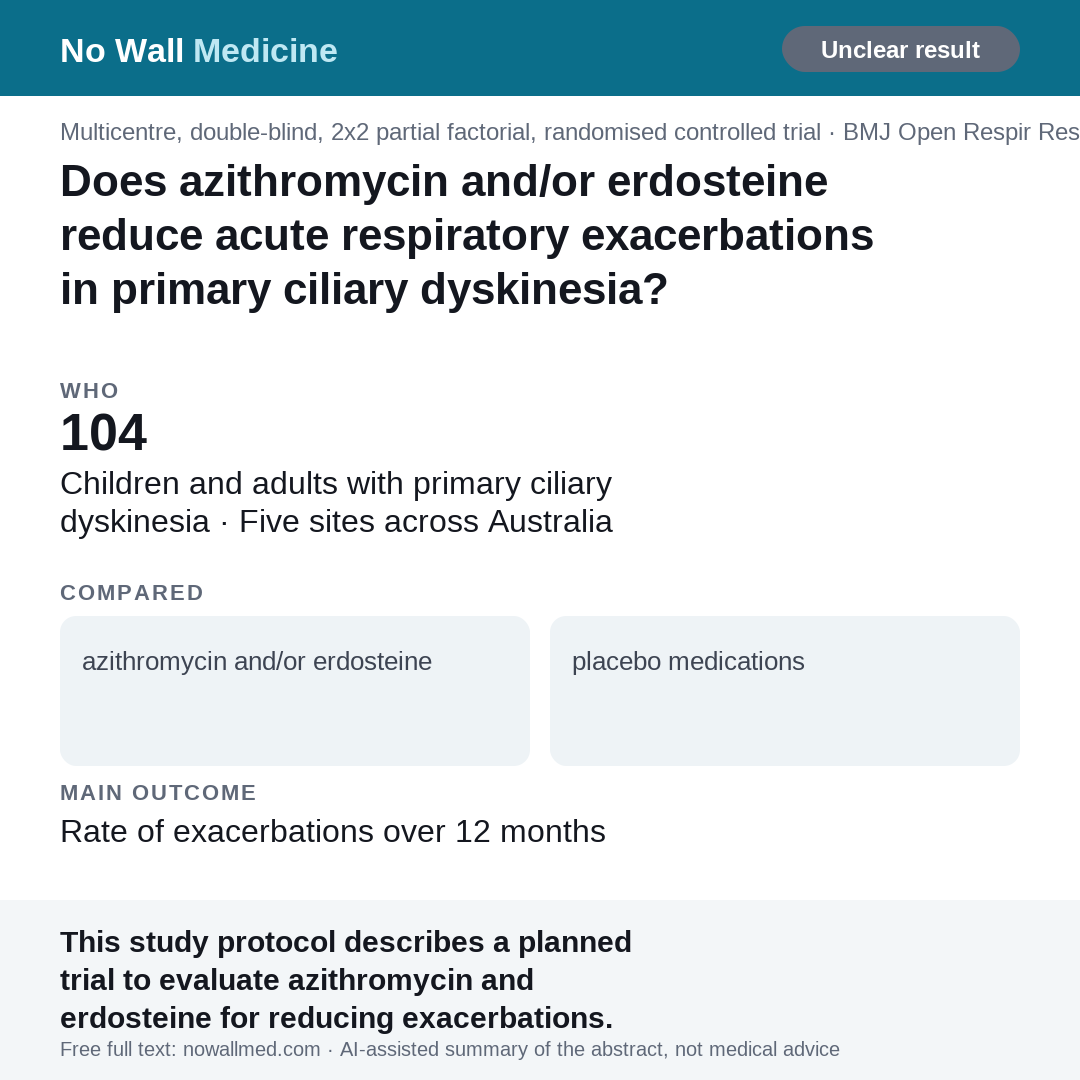
Key result: Trial protocol describes study of azithromycin and erdosteine for reducing respiratory exacerbations in PCD
Key points
- Researchers plan to recruit 104 children and adults with primary ciliary dyskinesia, a rare inherited disorder affecting the tiny hairs in the airways, for a multicentre trial.
- The study will compare the effects of 12 months of oral azithromycin, an antibiotic, and erdosteine, a mucolytic agent that thins mucus, against placebos.
- Secondary outcomes include measuring lung function, quality of life, hospitalizations, and the presence of antibiotic-resistant bacteria in the nose and throat.
Why it matters: Evidence for treatments in primary ciliary dyskinesia is often extrapolated from cystic fibrosis patients because there are few randomized controlled trials for this specific condition.
Discussion prompts
- Would these patients look like yours? Who was left out?
- Is the main outcome one that matters to patients?
- Is the difference large enough to change what you do?
Cite: Chang AB, Morgan LC, Duncan EL, Chatfield MD, Schultz A, Leo PJ. Reducing exacerbations in children and adults with primary ciliary dyskinesia using erdosteine and/or azithromycin therapy (REPEAT trial): study protocol for a multicentre, double-blind, double-dummy, 2×2 partial factorial, randomised controlled trial. BMJ Open Respir Res. 2022. doi:10.1136/bmjresp-2022-001236
Free full text: PubMed Central · Summary and visual abstract: nowallmed.com/a/reducing-exacerbations-in-children-and-adults-with-primary-ciliary-1e193dn/ (AI-assisted from the abstract; check the paper before relying on it).