Reducing learning and psychosocial disparities in Latino children with cancer: a randomized intervention trial
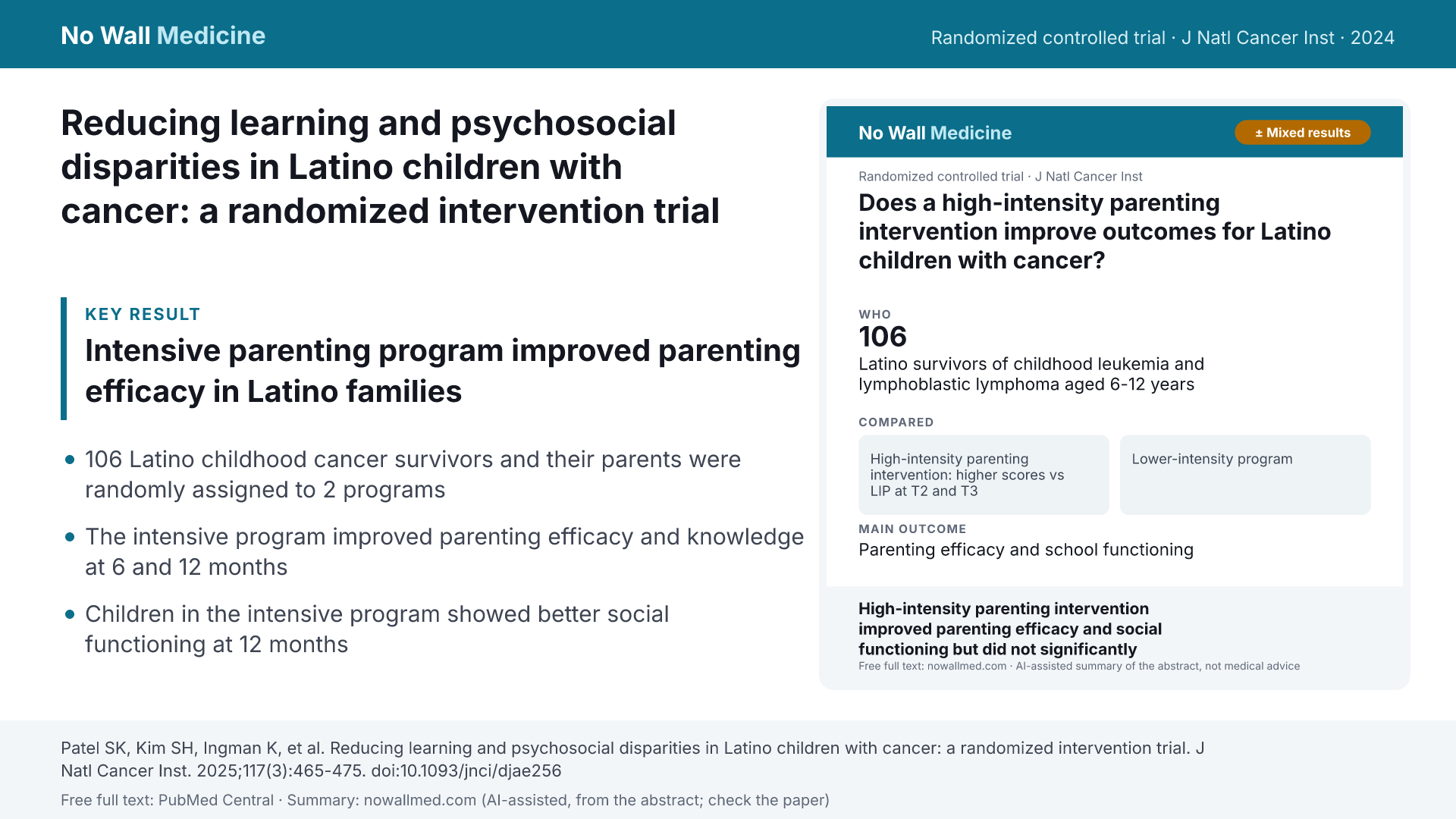
Key result: Intensive parenting program improved parenting efficacy in Latino families
Randomized controlled trialMixed results
Does a high-intensity parenting intervention improve outcomes for Latino children with cancer?
Who
106
Latino survivors of childhood leukemia and lymphoblastic lymphoma aged 6-12 years
Compared
High-intensity parenting intervention: higher scores vs LIP at T2 and T3
Lower-intensity program
Main outcome
Parenting efficacy and school functioning
Bottom line: High-intensity parenting intervention improved parenting efficacy and social functioning but did not significantly improve school functioning.
Limitation: Adherence challenges were observed, with only 61% completing the intervention.
J Natl Cancer Inst · 2024-10-16
Key points
- 106 Latino childhood cancer survivors and their parents were randomly assigned to 2 programs.
- The intensive program improved parenting efficacy and knowledge at 6 and 12 months.
- Children in the intensive program showed better social functioning at 12 months.
Discussion prompts
- Would these patients look like yours? Who was left out?
- Is the main outcome one that matters to patients?
- Is the difference large enough to change what you do?
Cite: Patel SK, Kim SH, Ingman K, et al. Reducing learning and psychosocial disparities in Latino children with cancer: a randomized intervention trial. J Natl Cancer Inst. 2025;117(3):465-475. doi:10.1093/jnci/djae256
Free full text: PubMed Central · Summary and visual abstract: nowallmed.com/a/reducing-learning-and-psychosocial-disparities-in-latino-children-1tocm1m/ (AI-assisted from the abstract; check the paper before relying on it).