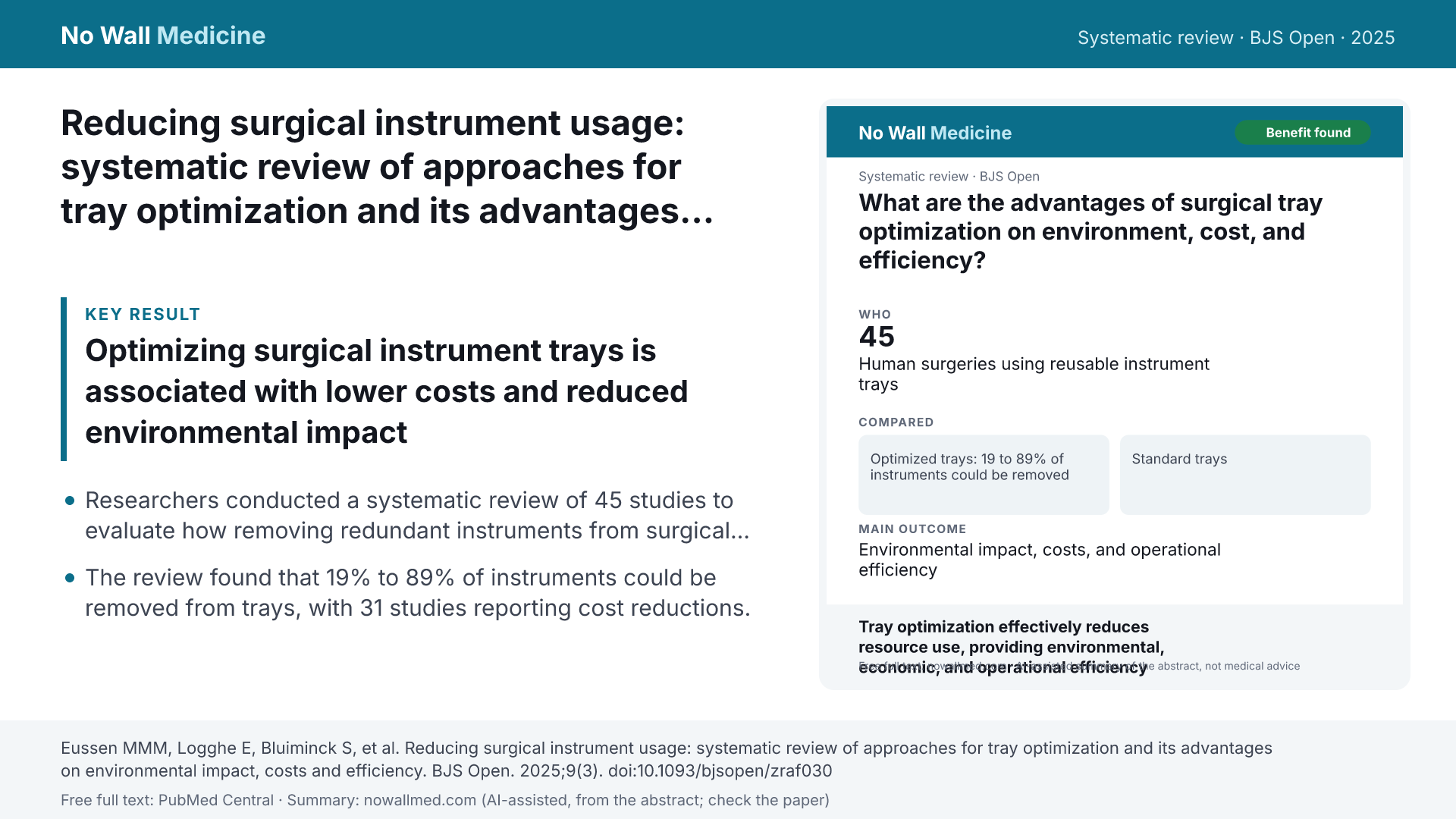
Optimizing surgical instrument trays is associated with lower costs and reduced environmental impact
Reducing surgical instrument usage: systematic review of approaches for tray optimization and its advantages on environmental impact, costs and efficiency
Systematic reviewBenefit found
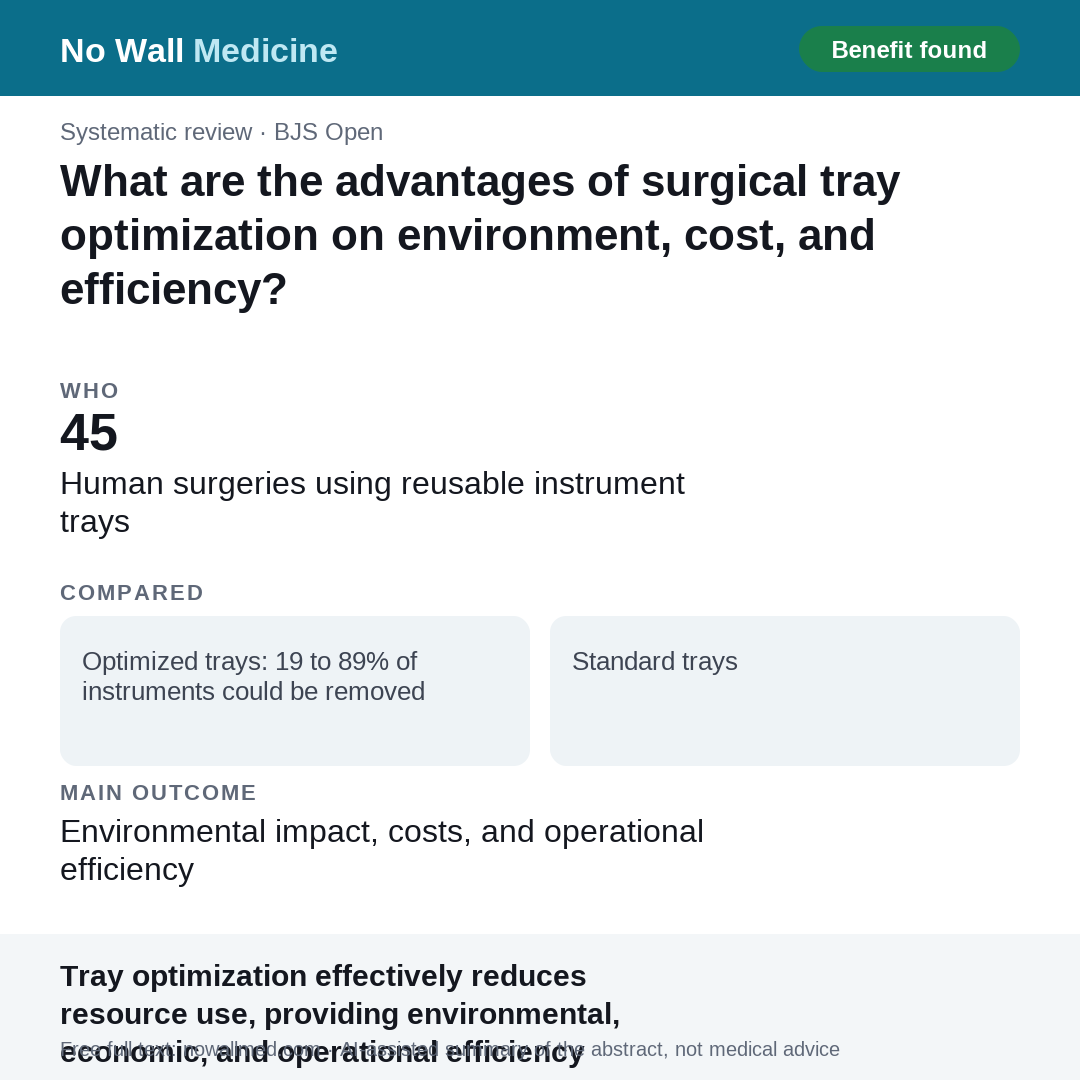
What are the advantages of surgical tray optimization on environment, cost, and efficiency?
Who
45
Human surgeries using reusable instrument trays
Compared
Optimized trays: 19 to 89% of instruments could be removed
Standard trays
Main outcome
Environmental impact, costs, and operational efficiency
Bottom line: Tray optimization effectively reduces resource use, providing environmental, economic, and operational efficiency benefits.
Limitation: Half of the included studies showed a serious risk of bias.
BJS Open · 2025-05-17Download image
Clinical question: What are the advantages of surgical tray optimization on environment, cost, and efficiency?
Why it matters: Operating rooms generate substantial waste and budget expenditure due to extensive material usage from reusable instrument trays that accumulate tools over time.
Key points
- Researchers conducted a systematic review of 45 studies to evaluate how removing redundant instruments from surgical trays affects costs, efficiency, and the environment.
- The review found that 19% to 89% of instruments could be removed from trays, with 31 studies reporting cost reductions.
- The analysis identified that 17 studies demonstrated improved operational efficiency through these optimization strategies.
Limitation the authors note: Half of the included studies showed a serious risk of bias, while the rest had a moderate risk.
Headline and key points written with AI from the paper’s abstract, with every number checked against it. Read the paper before relying on them.
Was this summary helpful?
Subject terms
Cite this article
Eussen MMM, Logghe E, Bluiminck S, et al. Reducing surgical instrument usage: systematic review of approaches for tray optimization and its advantages on environmental impact, costs and efficiency. BJS Open. 2025. doi:10.1093/bjsopen/zraf030
Spotted a mistake? Suggest a correction