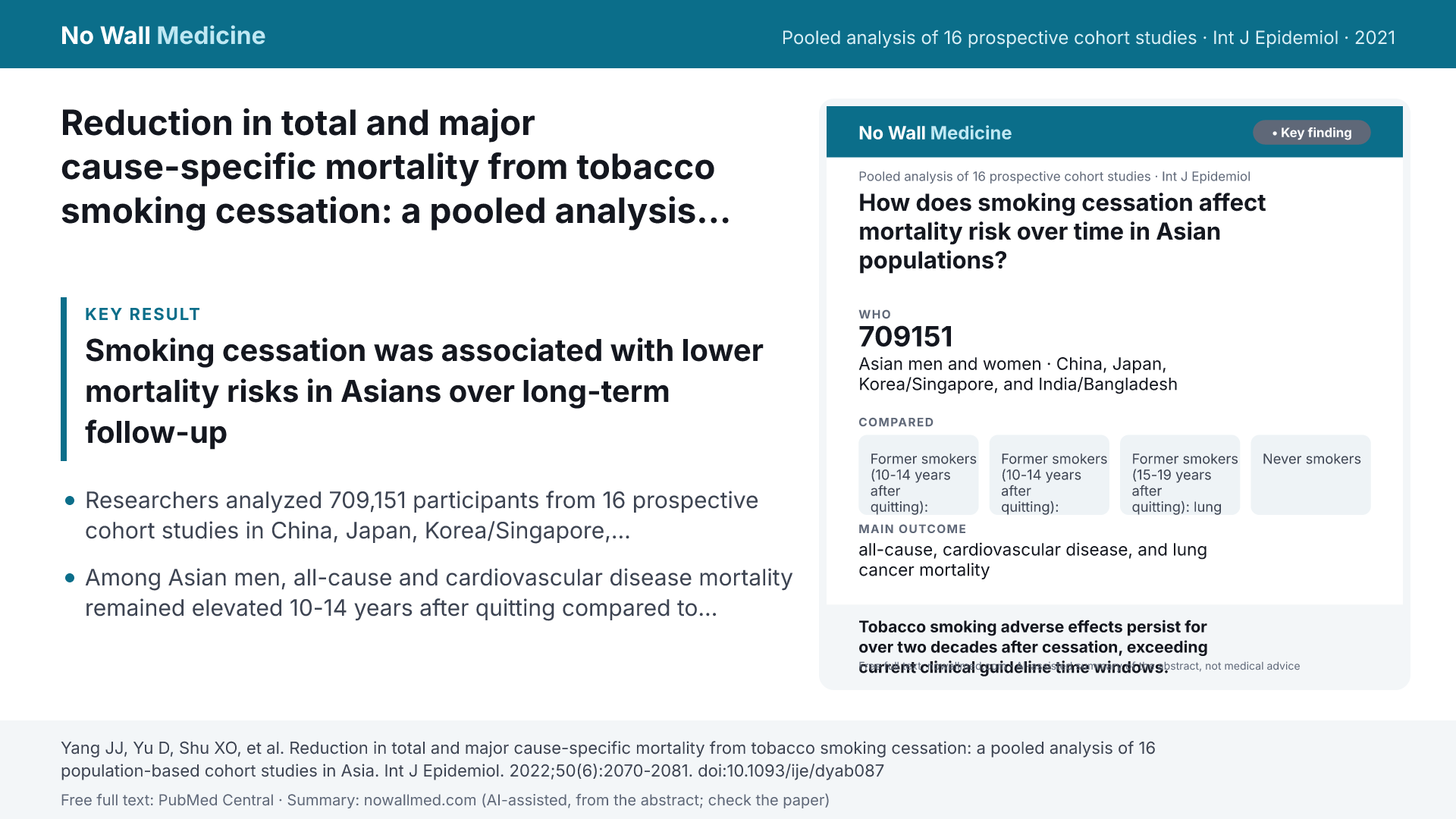
Smoking cessation was associated with lower mortality risks in Asians over long-term follow-up
Reduction in total and major cause-specific mortality from tobacco smoking cessation: a pooled analysis of 16 population-based cohort studies in Asia
Pooled analysis of 16 prospective cohort studiesKey finding
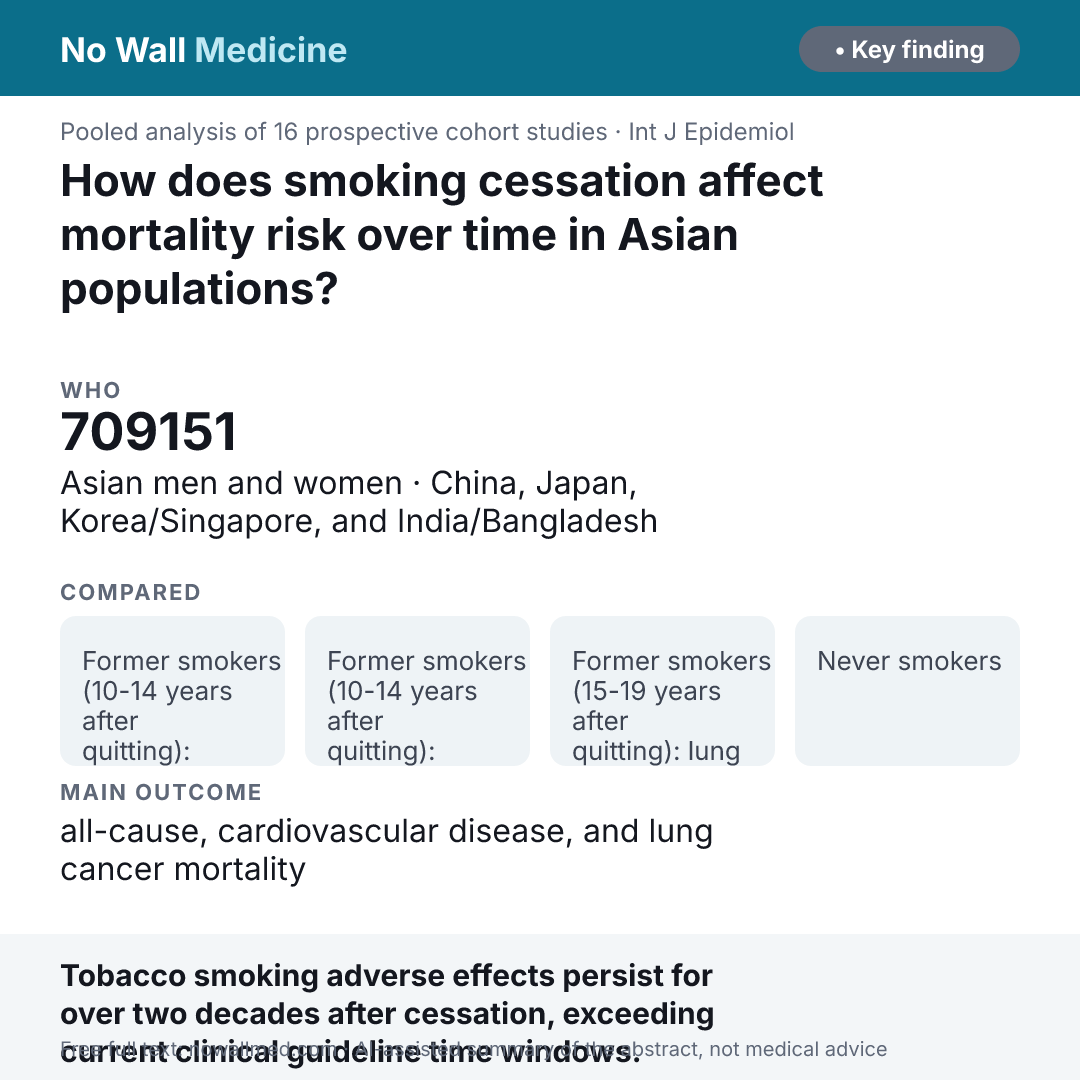
How does smoking cessation affect mortality risk over time in Asian populations?
Who
709151
Asian men and women · China, Japan, Korea/Singapore, and India/Bangladesh
Compared
Former smokers (10-14 years after quitting): all-cause mortality hazard ratio 1.25 (95% CI 1.13-1.37)
Former smokers (10-14 years after quitting): cardiovascular disease mortality hazard ratio 1.20 (95% CI 1.02-1.41)
Former smokers (15-19 years after quitting): lung cancer mortality hazard ratio 1.97 (95% CI 1.41-2.73)
Never smokers
Main outcome
all-cause, cardiovascular disease, and lung cancer mortality
Bottom line: Tobacco smoking adverse effects persist for over two decades after cessation, exceeding current clinical guideline time windows.
Int J Epidemiol · 2021-02-05
Headline and visual abstract written with AI from the paper’s abstract, with every number checked against it. Read the paper before relying on them.
Was this summary helpful?
Subject terms
Cite this article
Yang JJ, Yu D, Shu XO, et al. Reduction in total and major cause-specific mortality from tobacco smoking cessation: a pooled analysis of 16 population-based cohort studies in Asia. Int J Epidemiol. 2022;50(6):2070-2081. doi:10.1093/ije/dyab087
Spotted a mistake? Suggest a correction