Parallel processing and sugammadex use was associated with shorter nonoperative time in surgery
Reduction of Nonoperative Time Using the Induction Room, Parallel Processing, and Sugammadex: A Randomized Clinical Trial
Prospective, randomized studyBenefit found
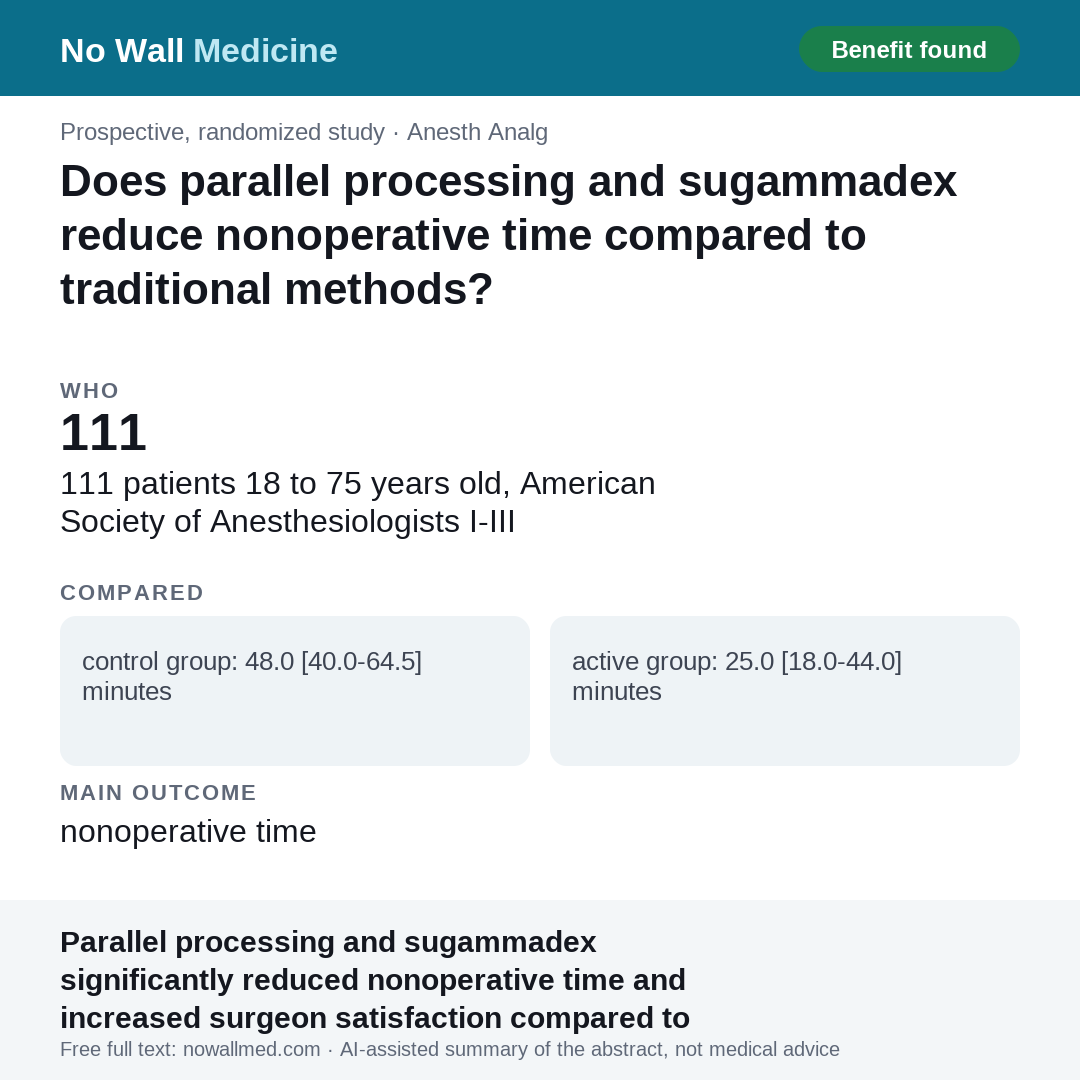
Does parallel processing and sugammadex reduce nonoperative time compared to traditional methods?
Who
111
111 patients 18 to 75 years old, American Society of Anesthesiologists I-III
Compared
control group: 48.0 [40.0-64.5] minutes
active group: 25.0 [18.0-44.0] minutes
Main outcome
nonoperative time
Bottom line: Parallel processing and sugammadex significantly reduced nonoperative time and increased surgeon satisfaction compared to traditional linear processing.
Anesth Analg · 2022-06-03Download image
Clinical question: Does parallel processing and sugammadex reduce nonoperative time compared to traditional methods?
Why it matters: Mismanagement of nonoperative time can result in financial losses and delays in the operating room schedule.
Key points
- Researchers studied 111 patients aged 18 to 75 undergoing surgery requiring general anesthesia and muscle relaxation.
- The active group using parallel processing and sugammadex had a nonoperative time of 25.0 [18.0-44.0] minutes compared to 48.0 [40.0-64.5] minutes in the control group.
- Surgeon satisfaction scores were significantly higher in the active group, while patient satisfaction scores showed no significant difference between the two groups.
Headline and key points written with AI from the paper’s abstract, with every number checked against it. Read the paper before relying on them.
Was this summary helpful?
Subject terms
Cite this article
Kaddoum R, Tarraf S, Shebbo FM, Bou Ali A, Karam C, Abi Shadid C. Reduction of Nonoperative Time Using the Induction Room, Parallel Processing, and Sugammadex: A Randomized Clinical Trial. Anesth Analg. 2022. doi:10.1213/ANE.0000000000006102
Spotted a mistake? Suggest a correction
Top studies every Monday
The week’s key trials and guidelines in your specialties, plus any topics you follow. By email, free.
Get the weekly digest