Regional anaesthesia reduces the incidence of chronic postsurgical pain for up to 12 months
Regional anaesthesia and chronic postsurgical pain: a systematic review and network meta-analysis
Systematic review and network meta-analysisBenefit found
Does regional anaesthesia reduce chronic postsurgical pain and long-term opioid use?
Who
18794
18,794 subjects in randomised controlled trials
Compared
Regional anaesthesia: risk ratio 0.73
No block
Main outcome
Incidence of chronic postsurgical pain
Result: risk ratio 0.73 (95% CI 0.67-0.80)
Bottom line: Regional anaesthesia reduces the incidence of chronic postsurgical pain for up to 12 months after surgery.
Br J Anaesth · 2026-07-09Download image
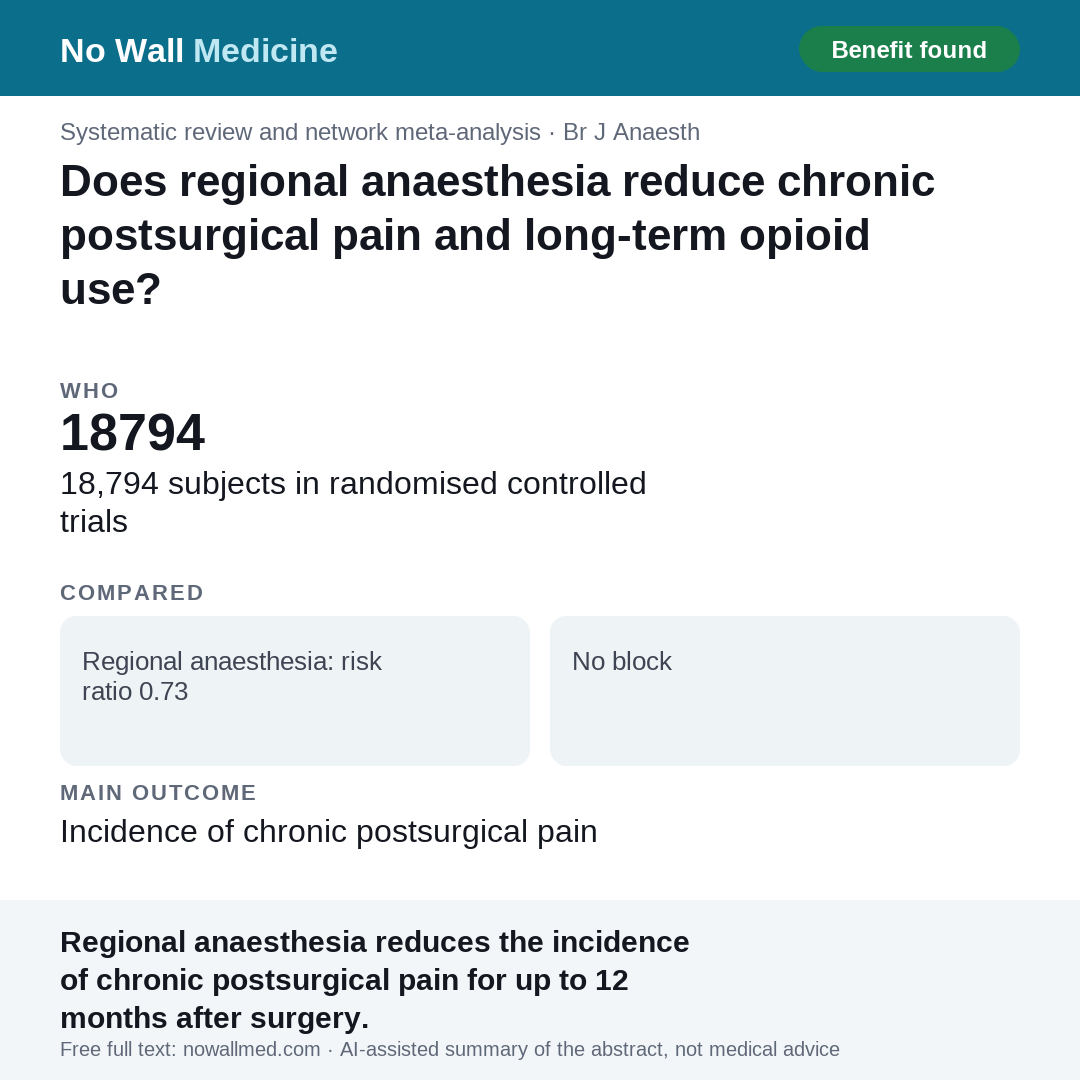
Clinical question: Does regional anaesthesia reduce chronic postsurgical pain and long-term opioid use?
Why it matters: Preventing chronic postsurgical pain, which is pain lasting beyond 3 months after surgery, is a research priority.
Key points
- Researchers analyzed 158 randomized controlled trials involving 18,794 subjects to compare regional anaesthesia against no block.
- Regional anaesthesia reduced the risk of chronic postsurgical pain with a risk ratio of 0.73, though opioid use showed no statistically significant difference.
- Neuraxial techniques, such as those involving the spine, appeared more effective than peripheral nerve blocks for certain chest surgeries.
Headline and key points written with AI from the paper’s abstract, with every number checked against it. Read the paper before relying on them.
Topics
Cite this article
Taylor-Rowan M, Mactier I, Nevill C, Said R, Fisher E, Bidar SS. Regional anaesthesia and chronic postsurgical pain: a systematic review and network meta-analysis. Br J Anaesth. 2026. doi:10.1016/j.bja.2026.04.082
Spotted a mistake? Suggest a correction