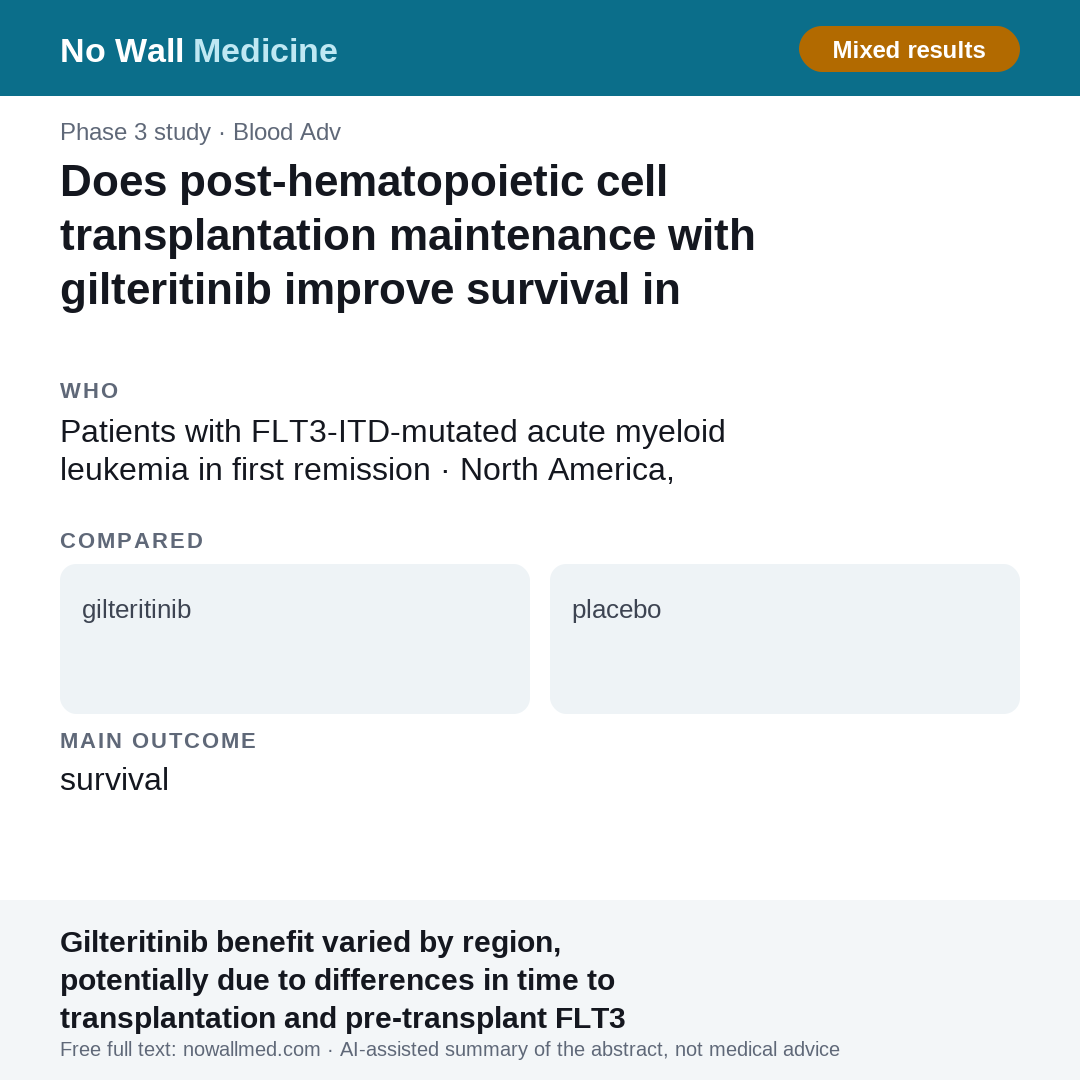
Clinical question: Does post-hematopoietic cell transplantation maintenance with gilteritinib improve survival in FLT3-ITD mutated acute myeloid leukemia?
Why it matters: It was unclear why the benefits of post-transplant gilteritinib maintenance varied significantly between different geographic regions.
Key points
Researchers analyzed a phase 3 study of patients with FLT3-ITD-mutated acute myeloid leukemia in first remission receiving gilteritinib or a placebo after hematopoietic cell transplantation.
Gilteritinib showed significant benefit in North America, but no benefit was observed for participants located in Europe or Asia.
Patients transplanted within 120 days of diagnosis or those treated with FLT3 inhibitors before transplantation were more likely to have improved survival with gilteritinib.
Headline and key points written with AI from the paper’s abstract, with every number checked against it. Read the paper before relying on them.
BMT CTN 1506 (MORPHO) was a phase 3 study of post-hematopoietic cell transplantation (HCT) maintenance with gilteritinib vs placebo for patients with FLT3-ITD-mutated acute myeloid leukemia (AML) in first remission. Subgroup analysis indicated a significant benefit of post-HCT gilteritinib for participants in North America but no benefit for those in Europe or Asia. We conducted a post hoc analysis of the data focusing on the time from AML diagnosis to HCT, pre-HCT FLT3 inhibitor use, and FLT3-ITD measurable residual disease (MRD). Participants who underwent transplantation <120 days from AML diagnosis and/or those treated with FLT3 inhibition before HCT were more likely to have improved survival from post-HCT gilteritinib. Pre-HCT MRD levels were higher (P = .001) in participants who underwent transplantation within 120 days from diagnosis and in those treated with an FLT3 inhibitor before HCT and underwent transplantation within 120 days (P = .008). Pre-HCT MRD was dependent on both FLT3 inhibitor use and time to HCT, because participants treated with successive courses of chemotherapy + FLT3 inhibition had successively lower MRD by the time of HCT. Time from AML diagnosis to HCT and pre-HCT FLT3 inhibitor use both appeared to affect MRD levels immediately before HCT, and geographic differences in these 2 practice patterns likely accounted for the observed regional differences in benefit from post-HCT gilteritinib. Increasing the number of courses of treatment before HCT may lower MRD sufficiently to eliminate the need for post-HCT inhibition, but with a presumed risk of some patients experiencing early progression. This trial was registered at www.clinicaltrials.gov as #NCT02997202.
Abstract reproduced under the article’s CC BY NC ND licence.
Reduced intensity hematopoietic cell transplant using best available donor and post-transplant cyclophosphamide is safe and curative for transfusion-dependent thalassemia