Regularly scheduled acetaminophen did not significantly reduce pain for residents in long-term care
Regularly Scheduled Acetaminophen for Pain in Long-Term Care: Systematic Review and Meta-Analysis
Systematic review and meta-analysisNo clear difference
Does regularly scheduled acetaminophen improve pain outcomes in long-term care residents?
Who
482
Long-term care residents with mild-to-moderate pain and moderate-to-severe dementia · United States and Europe
Compared
Regularly scheduled acetaminophen
Placebo or usual care
Main outcome
Pain
Result: standardized mean difference -0.14 (95% CI -0.39 to 0.11)
Bottom line: Regularly scheduled acetaminophen probably does not improve pain in long-term care residents with moderate-to-severe dementia.
Limitation: Incomplete reporting of study methods and outcomes
J Am Med Dir Assoc · 2026-10-07Download image
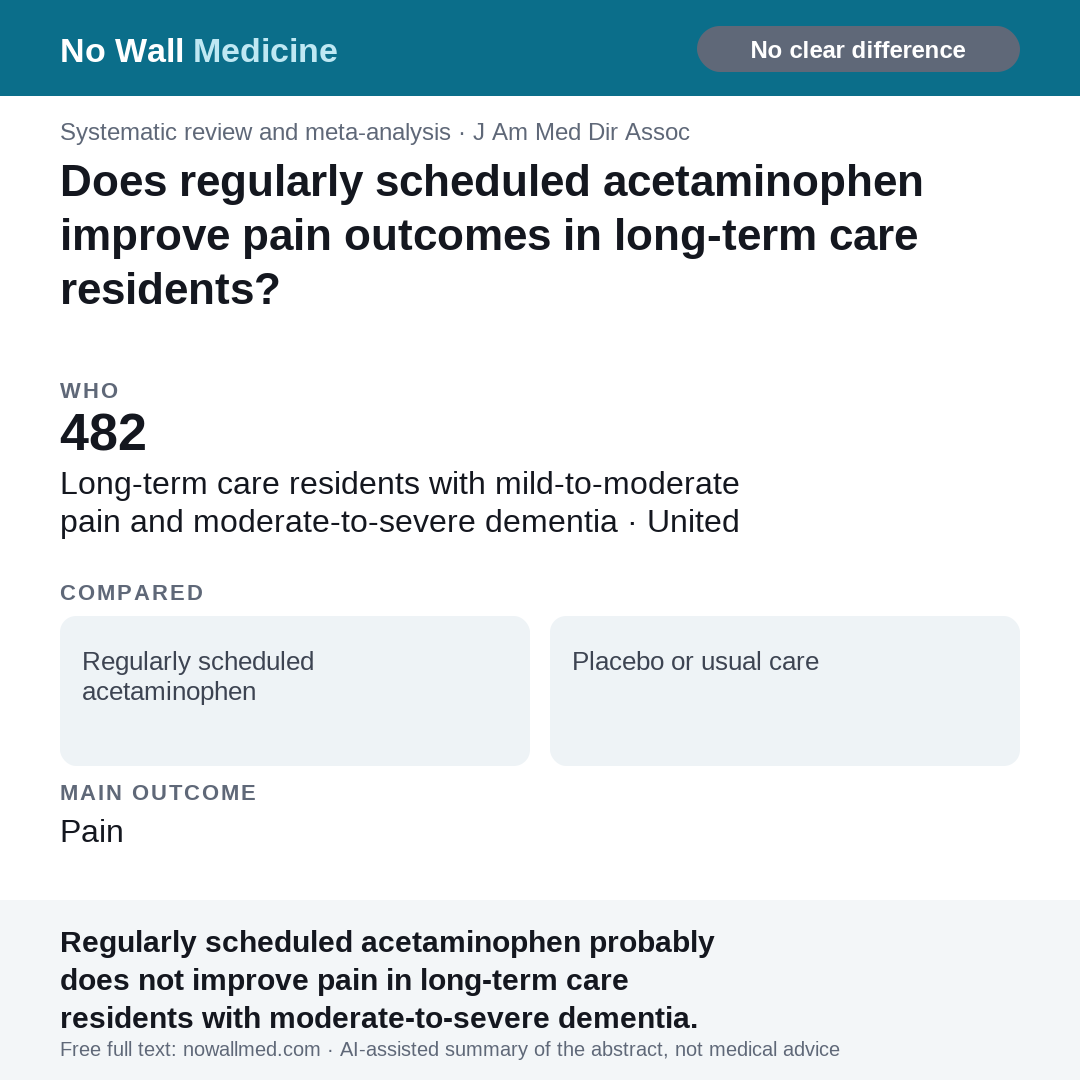
Clinical question: Does regularly scheduled acetaminophen improve pain outcomes in long-term care residents?
Why it matters: Acetaminophen is often recommended as a first-line therapy for pain, but evidence is needed on whether regularly scheduled doses improve outcomes for residents in long-term care.
Key points
- Researchers analyzed four randomized controlled trials involving 482 long-term care residents with mild-to-moderate pain and moderate-to-severe dementia.
- Regularly scheduled acetaminophen, given 3 to 4 times daily at doses of 2500 to 3000 mg, showed no statistically significant reduction in pain compared to placebo or usual care.
- One study found no statistically significant differences in quality of life between the groups, and reporting of adverse events was limited and inconsistent.
Limitation the authors note: The authors noted concerns regarding incomplete reporting of study methods and outcomes.
Headline and key points written with AI from the paper’s abstract, with every number checked against it. Read the paper before relying on them.
Topics
Cite this article
Jack K, Lui E, van Dam PH, Dennett L, Kraut RY. Regularly Scheduled Acetaminophen for Pain in Long-Term Care: Systematic Review and Meta-Analysis. J Am Med Dir Assoc. 2026. doi:10.1016/j.jamda.2026.106432
Spotted a mistake? Suggest a correction