Belimumab treatment increases regulatory B cells and reduces innate lymphoid cells in children with lupus nephritis
Regulatory B cell expansion and type 1 innate lymphoid cell suppression characterise immune modulation in paediatric lupus nephritis
Prospective, open-label randomised studyBenefit found
Does BAFF-pathway inhibition alter regulatory B cell and type 1 innate lymphoid cell balance?
Who
60
Paediatric patients with biopsy-confirmed class III/IV lupus nephritis
Compared
Standard therapy
Standard therapy plus belimumab: expanded memory B cells and IL-10-producing Bregs
Main outcome
Regulatory B cell expansion and type 1 innate lymphoid cell suppression
Bottom line: Belimumab rebalances immunity in paediatric lupus nephritis by enhancing regulatory B cell function and suppressing type 1 innate lymphoid cells.
RMD Open · 2026-05-13Download image
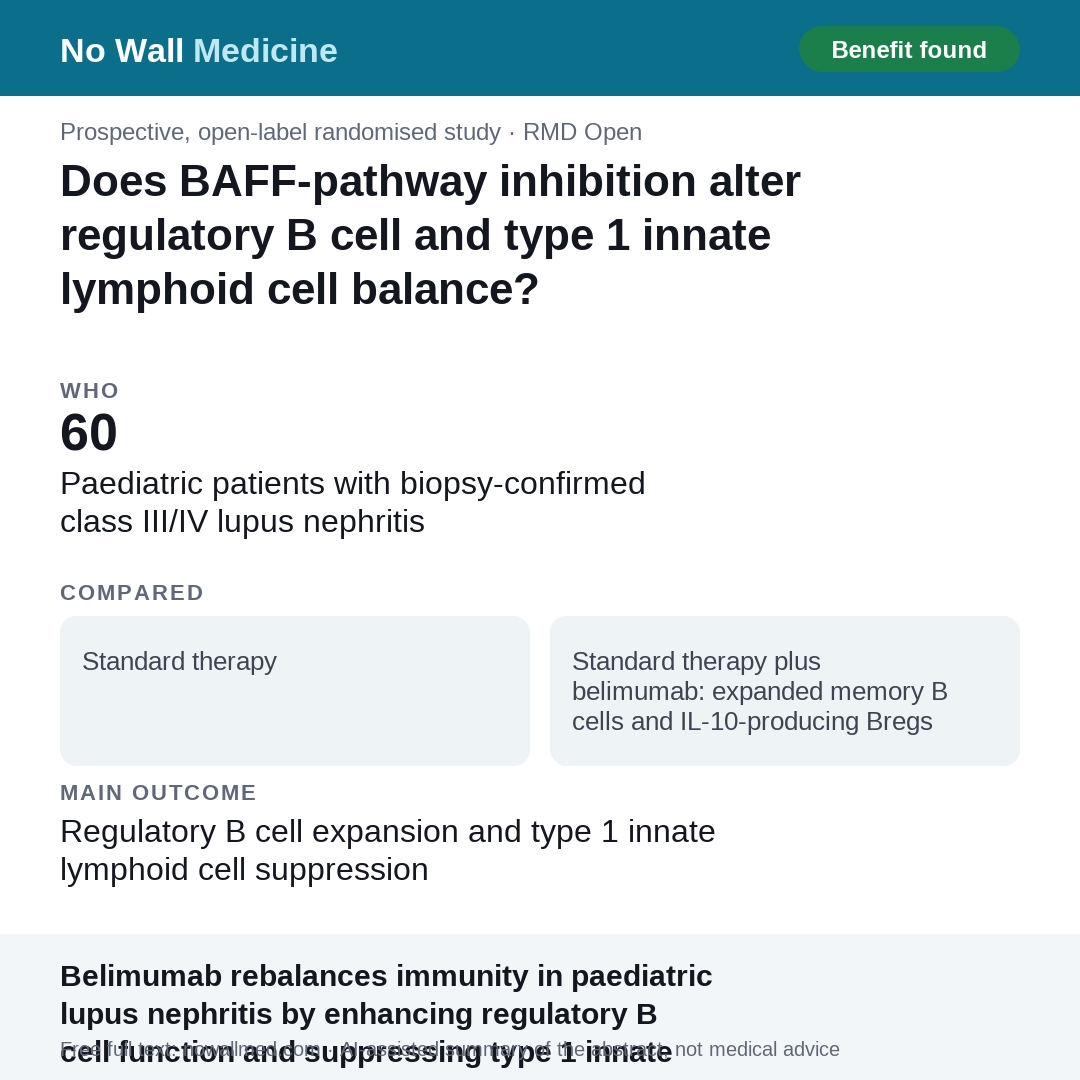
Clinical question: Does BAFF-pathway inhibition alter regulatory B cell and type 1 innate lymphoid cell balance?
Why it matters: The role of B-cell activating factor (BAFF) pathway inhibition in balancing regulatory B cells and type 1 innate lymphoid cells in paediatric lupus nephritis was unknown.
Key points
- Researchers studied 60 children with biopsy-confirmed class III/IV lupus nephritis, comparing standard therapy to standard therapy plus belimumab for 6 months.
- Belimumab treatment expanded memory B cells and interleukin-10-producing regulatory B cells while reducing circulating and kidney-based type 1 innate lymphoid cells.
- The treatment was associated with increased serum C3, lower anti-double-stranded DNA titres, decreased proteinuria, and improved disease activity scores.
Headline and key points written with AI from the paper’s abstract, with every number checked against it. Read the paper before relying on them.
Abstract
Objective
B-cell activating factor (BAFF) is essential for B-cell survival and innate immune activation, and its dysregulation contributes to the pathogenesis of lupus nephritis (LN). This study investigated whether BAFF-pathway inhibition alters the balance between regulatory B cells (Bregs) and type 1 innate lymphoid cells (ILC1s) in paediatric LN. Methods
In this prospective, open-label randomised study, 60 paediatric patients with biopsy-confirmed class III/IV LN were randomised to standard therapy (mycophenolate mofetil and corticosteroids; n=30) or standard therapy plus the belimumab (10 mg/kg intravenously every 4 weeks for 6 months; n=30). Ten healthy children and three patients with biopsy-confirmed minimal change disease served as controls. Flow cytometry quantified IL-10-producing Bregs and circulating ILC1s. Clinically indicated paired renal biopsies (n=3) underwent transcriptomic and immunofluorescence analyses. Results
Belimumab was associated with greater increases in serum C3, reductions in antidouble-stranded DNA titres, decreased proteinuria, improved Systemic Lupus Erythematosus Disease Activity Index 2000 scores and reduced corticosteroid exposure. Belimumab expanded memory B cells and IL-10-producing CD19+CD5+ and CD19+CD24hi+CD38hi+ Bregs, with enhanced suppression of CD4+ T cell proliferation. Treatment reduced circulating and renal ILC1s, downregulated interferon (IFN)-stimulated genes and modulated inflammatory pathways. Serum cytokine profiling showed decreased IFN-γ, interleukin (IL)-17A, IL-10 and BAFF levels, alongside increased IL-35. Phosphorylation of the aryl hydrocarbon receptor and signal transducer and activator of transcription 3 (STAT3) in Bregs was partially restored. Conclusions
BAFF inhibition in paediatric LN is associated with rebalancing of innate and adaptive immunity through enhancement of Breg function and suppression of ILC1-driven inflammation.
Abstract reproduced under the article’s CC BY NC licence.
Topics
Spotted a mistake? Suggest a correction