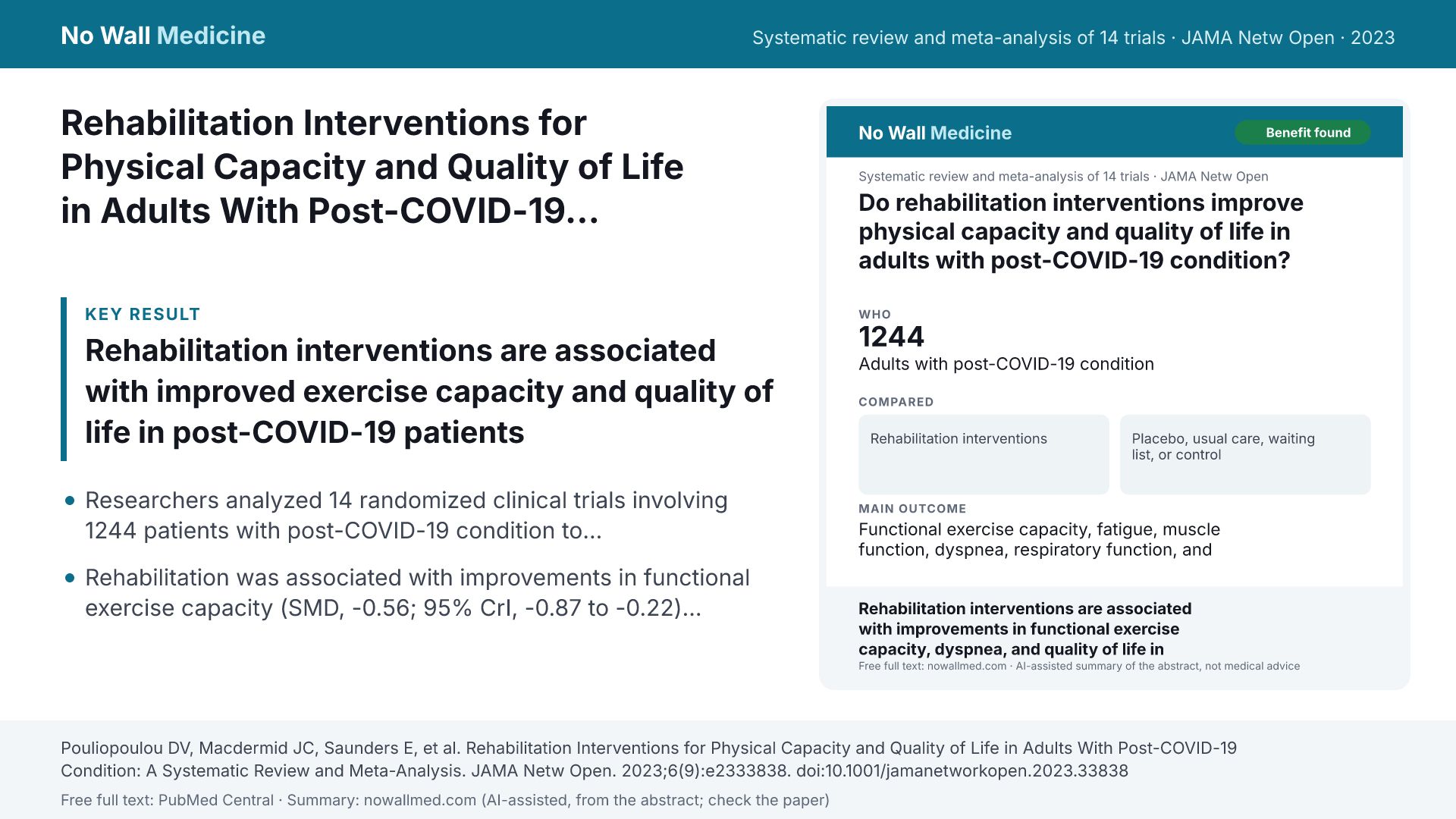
Rehabilitation interventions are associated with improved exercise capacity and quality of life in post-COVID-19 patients
Rehabilitation Interventions for Physical Capacity and Quality of Life in Adults With Post-COVID-19 Condition: A Systematic Review and Meta-Analysis
Systematic review and meta-analysis of 14 trialsBenefit found
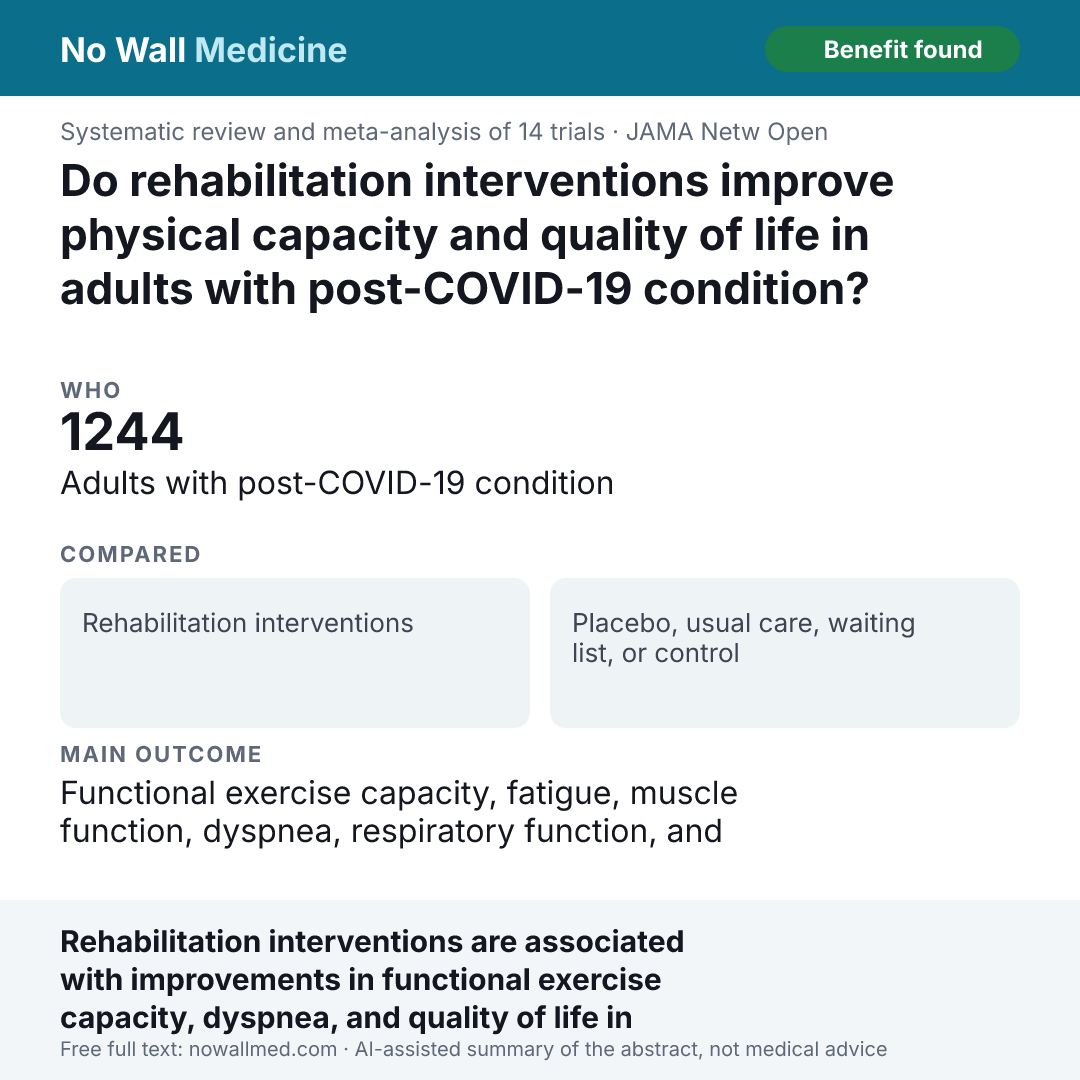
Do rehabilitation interventions improve physical capacity and quality of life in adults with post-COVID-19 condition?
Who
1244
Adults with post-COVID-19 condition
Compared
Rehabilitation interventions
Placebo, usual care, waiting list, or control
Main outcome
Functional exercise capacity, fatigue, muscle function, dyspnea, respiratory function, and quality of life
Result: SMD -0.56 (95% CrI -0.87 to -0.22)
Bottom line: Rehabilitation interventions are associated with improvements in functional exercise capacity, dyspnea, and quality of life in post-COVID-19 patients.
Limitation: Significant uncertainty and imprecision regarding the probability of experiencing exercise-induced adverse events.
JAMA Netw Open · 2023-09-05 · Save PNG
Clinical question: Do rehabilitation interventions improve physical capacity and quality of life in adults with post-COVID-19 condition?
Why it matters: Current rehabilitation guidelines for post-COVID-19 condition are primarily based on expert opinions and observational data rather than evidence-based interventions.
Key points
- Researchers analyzed 14 randomized clinical trials involving 1244 patients with post-COVID-19 condition to evaluate rehabilitation interventions.
- Rehabilitation was associated with improvements in functional exercise capacity (SMD, -0.56; 95% CrI, -0.87 to -0.22) and quality of life.
- There was significant uncertainty regarding the probability of patients experiencing exercise-induced adverse events (odds ratio, 1.68; 95% CrI, 0.32 to 9.94).
Limitation the authors note: There was significant uncertainty and imprecision regarding the probability of experiencing exercise-induced adverse events.
Headline and key points written with AI from the paper’s abstract, with every number checked against it. Read the paper before relying on them.
Was this summary helpful?
Subject terms
Headline, design, result, key points, caveat and citation as plain text.
Cite this article
Pouliopoulou DV, Macdermid JC, Saunders E, et al. Rehabilitation Interventions for Physical Capacity and Quality of Life in Adults With Post-COVID-19 Condition: A Systematic Review and Meta-Analysis. JAMA Netw Open. 2023;6(9):e2333838. doi:10.1001/jamanetworkopen.2023.33838
Spotted a mistake? Suggest a correction