Reintegration programmes for people with severe mental illness show mixed effectiveness in community transition
Reintegration programmes for people with severe mental illnesses released from correctional institutions: systematic review
Systematic reviewMixed results
Are reintegration programmes effective for people with severe mental illness leaving correctional facilities?
Who
Adults with severe mental illness transitioning from correctional facilities to community settings
Compared
Reintegration programmes
Control
Main outcome
Recidivism, homelessness, and mental health deterioration
Bottom line: Reintegration programmes show promise but demonstrate variable efficacy, requiring comprehensive and sustained support for success.
Limitation: Heterogeneity of methodologies and outcomes
BJPsych Open · 2026-07-08Download image
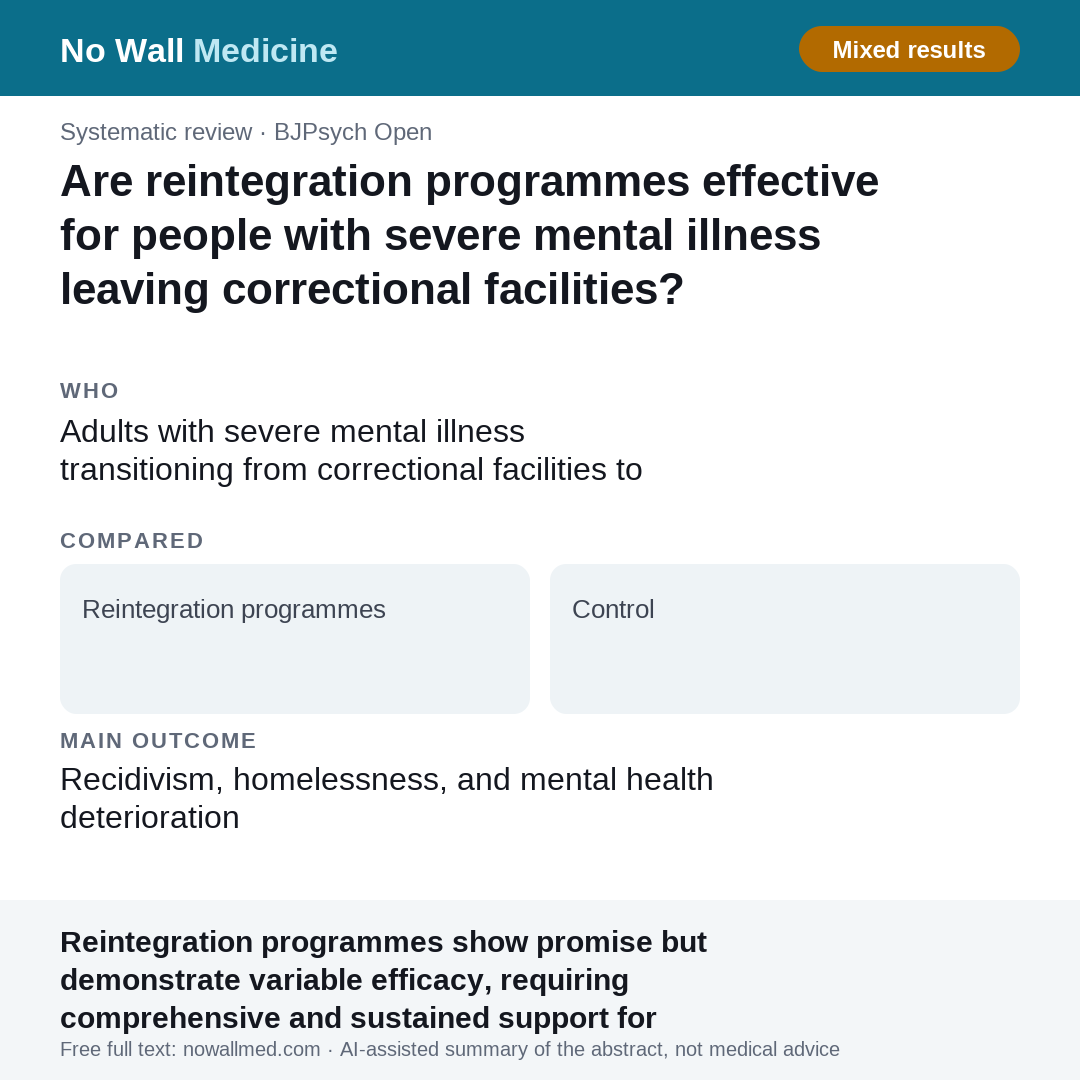
Clinical question: Are reintegration programmes effective for people with severe mental illness leaving correctional facilities?
Why it matters: The effectiveness of specialised reintegration programmes for people with severe mental illness remains unclear due to mixed findings in existing literature.
Key points
- Researchers reviewed 26 studies involving adults with severe mental illness transitioning from correctional facilities to community settings.
- The studies, which included a median of 207 participants, showed that some programmes reduced re-offending while others had minimal impact or increased re-imprisonment.
- Programmes generally achieved better outcomes when they included longer durations and comprehensive aftercare components.
Limitation the authors note: The review used a narrative analysis because of the heterogeneity of methodologies and outcomes across the included studies.
Headline and key points written with AI from the paper’s abstract, with every number checked against it. Read the paper before relying on them.
Spotted a mistake? Suggest a correction
More in Psychiatry & Mental Health
Depressive symptoms linked to stronger defensive response in panic disorder patients
Defensive reactivity to interoceptive perturbation in panic disorder: Depressive symptom burden and panic severity dimensions
Genes linked to mitochondria implicated in psychiatric disorders
Brain-derived multi-omics prioritization of mitochondria-related genes in schizophrenia, bipolar disorder, and major depressive disorder
Brain structure variations linked to alcohol use severity in large studies
A reproducible structural brain axis of alcohol use severity
Most animal psychedelic studies use stress-inducing methods and brief testing
Animal models in psychedelic research - Tripping over translation