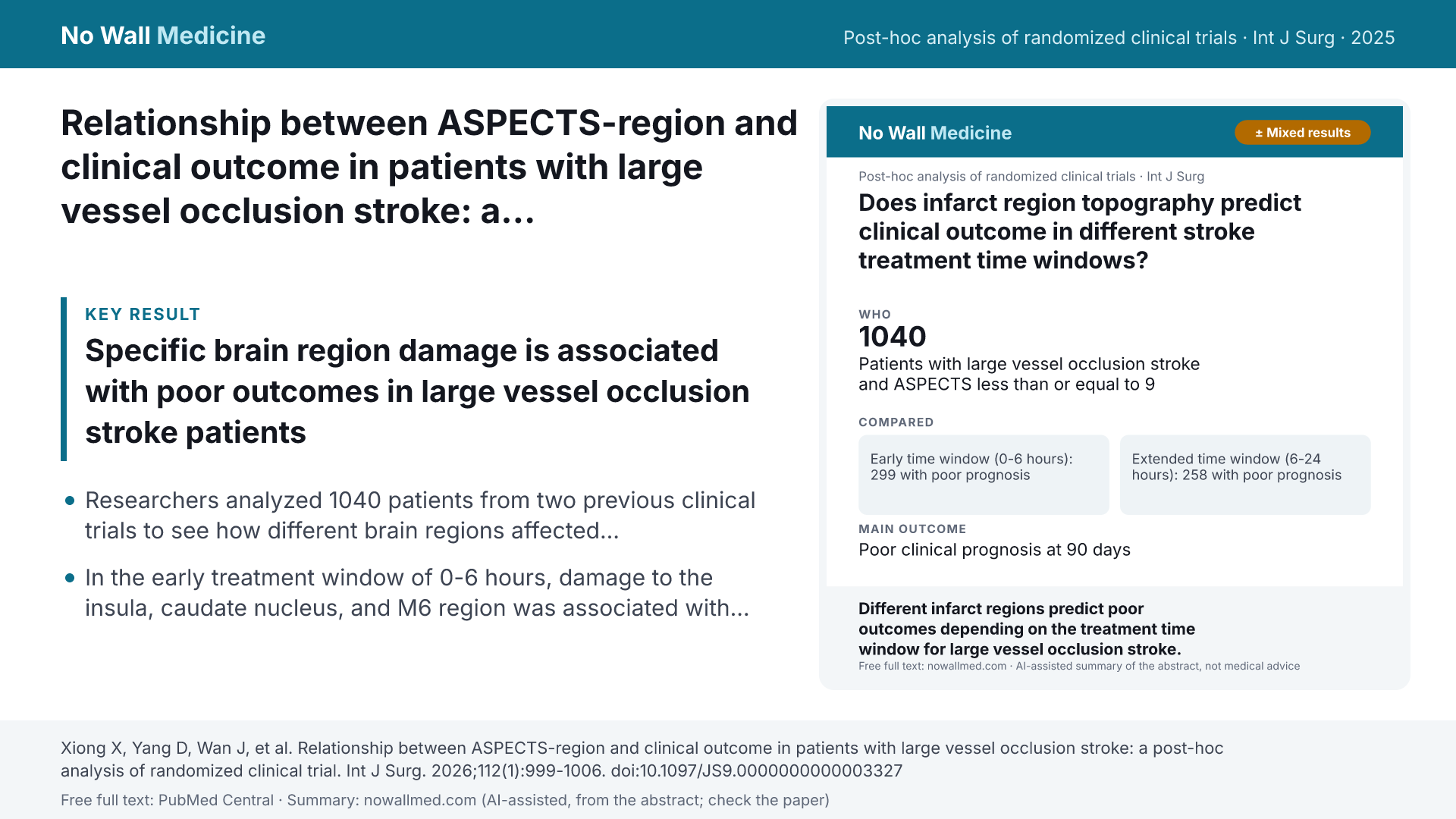
Relationship between ASPECTS-region and clinical outcome in patients with large vessel occlusion stroke: a post-hoc analysis of randomized clinical trial
Key result: Specific brain region damage is associated with poor outcomes in large vessel occlusion stroke patients
Post-hoc analysis of randomized clinical trialsMixed results
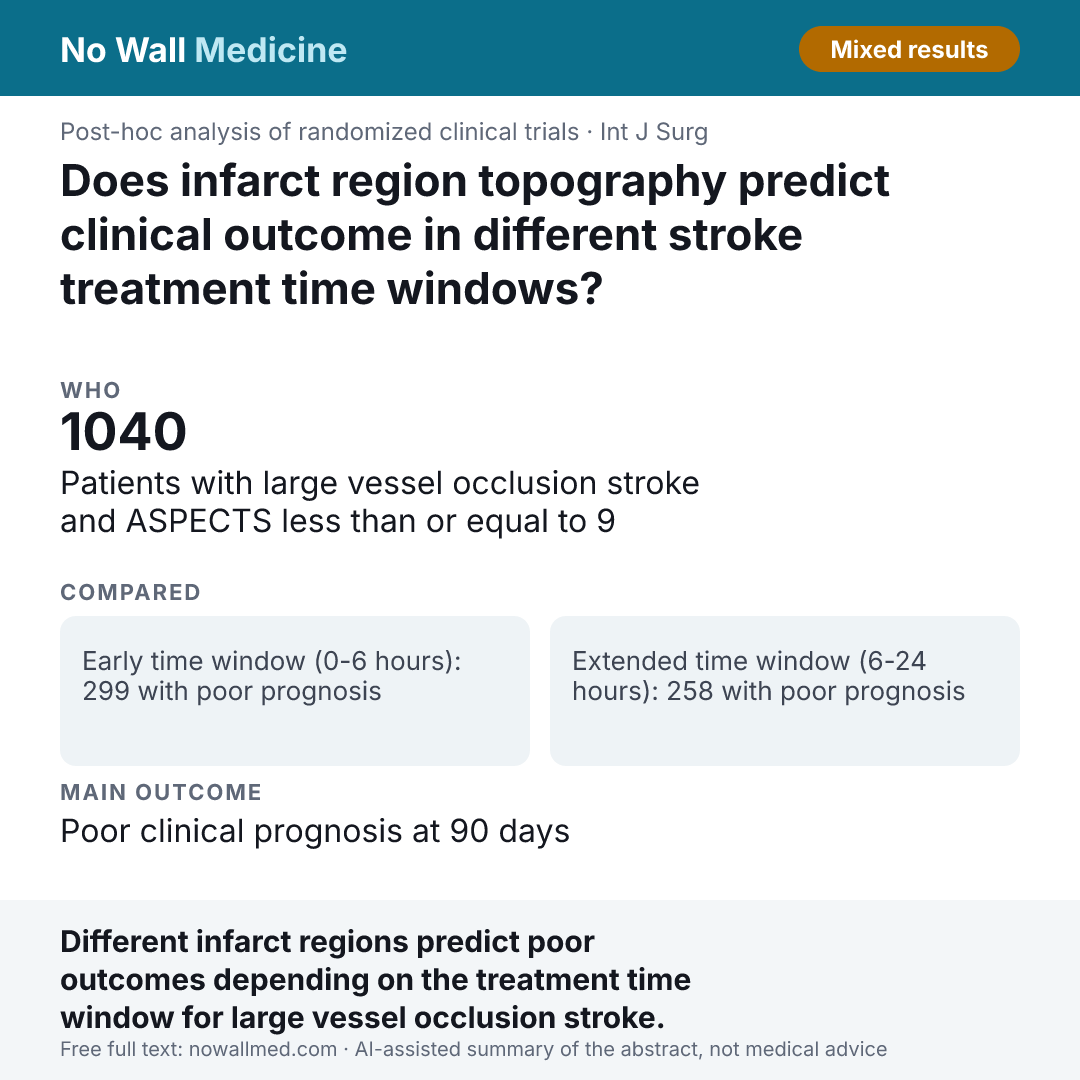
Does infarct region topography predict clinical outcome in different stroke treatment time windows?
Who
1040
Patients with large vessel occlusion stroke and ASPECTS less than or equal to 9
Compared
Early time window (0-6 hours): 299 with poor prognosis
Extended time window (6-24 hours): 258 with poor prognosis
Main outcome
Poor clinical prognosis at 90 days
Bottom line: Different infarct regions predict poor outcomes depending on the treatment time window for large vessel occlusion stroke.
Int J Surg · 2025-09-25 · Save PNG
Key points
- Researchers analyzed 1040 patients from two previous clinical trials to see how different brain regions affected prognosis after treatment for large vessel occlusion stroke.
- In the early treatment window of 0-6 hours, damage to the insula, caudate nucleus, and M6 region was associated with poor 90-day clinical outcomes.
- In the extended treatment window of 6-24 hours, damage to the M3 and M5 regions was associated with poor 90-day clinical outcomes.
Discussion prompts
- Would these patients look like yours? Who was left out?
- Is the main outcome one that matters to patients?
- Is the difference large enough to change what you do?
Cite: Xiong X, Yang D, Wan J, et al. Relationship between ASPECTS-region and clinical outcome in patients with large vessel occlusion stroke: a post-hoc analysis of randomized clinical trial. Int J Surg. 2026;112(1):999-1006. doi:10.1097/JS9.0000000000003327
Free full text: PubMed Central · Summary and visual abstract: nowallmed.com/a/relationship-between-aspects-region-and-clinical-outcome-in-patients-18ron5x/ (AI-assisted from the abstract; check the paper before relying on it).