Relationship between posaconazole concentrations and clinical outcomes in paediatric cancer and haematopoietic stem cell transplant recipients
Systematic reviewUnclear result
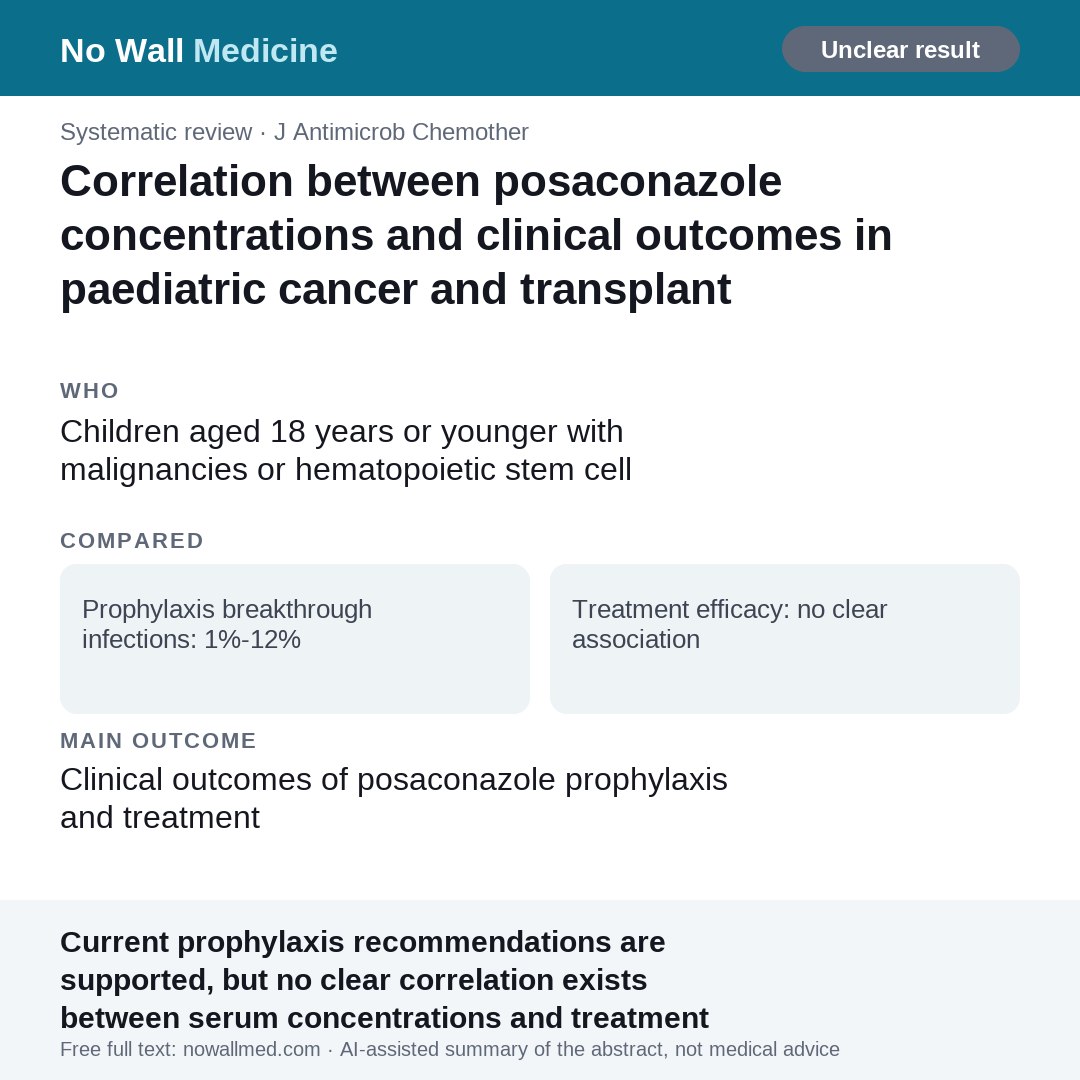
Correlation between posaconazole concentrations and clinical outcomes in paediatric cancer and transplant recipients
Who
Children aged 18 years or younger with malignancies or hematopoietic stem cell transplant
Compared
Prophylaxis breakthrough infections: 1%-12%
Treatment efficacy: no clear association
Main outcome
Clinical outcomes of posaconazole prophylaxis and treatment
Bottom line: Current prophylaxis recommendations are supported, but no clear correlation exists between serum concentrations and treatment efficacy.
Limitation: Quality of evidence was poor with medium to high risk of bias in 18 papers.
J Antimicrob Chemother · 2025-03-05Download image
Abstract
Background
Posaconazole is used to prevent and treat invasive fungal infections (IFIs) in immunocompromised children, including those undergoing cancer treatment or HSCT. Despite differences in pharmacokinetics and IFI epidemiology between children and adults, therapeutic targets established in adult studies are often applied to children. Objectives
This systematic review evaluated the correlation between serum posaconazole concentrations and clinical outcomes of IFI prophylaxis and treatment in children with malignancies or HSCT recipients. Methods
Four databases (Cochrane, Embase, MEDLINE and PubMed) were searched for studies involving children (≤18 years old) receiving cancer treatment or HSCT that reported posaconazole serum concentrations and treatment outcomes. Animal studies, those primarily in adult (>18 years old) populations, non-malignant conditions (excluding HSCT), case reports, letters, editorials, conference abstracts and narrative reviews were excluded. Bias was assessed using the Newcastle-Ottawa scale. Results
Nineteen studies were included: 12 reported outcomes of posaconazole prophylaxis; two of treatment; and five of both. For prophylaxis, breakthrough IFIs occurred in 1%-12% of children. All but one occurred with serum concentrations of ≤0.7 mg/L. For treatment, no clear association was observed between a trough concentration of >1.0 mg/L and treatment efficacy, with poor outcomes reported for serum concentrations ranging between 0.2 and 4.8 mg/L. Overall, quality of evidence was poor (medium to high risk of bias for 18 papers, low risk for 1 paper) and there was variation in IFI definitions across studies. Conclusions
This review supports current recommendations for posaconazole prophylaxis in paediatric oncology and HSCT recipients. The absence of a clear correlation found between serum trough concentrations and treatment efficacy highlights the need for further studies to determine optimal therapeutic targets for treatment.
Topics
Cite this article
Weerdenburg H, Walker H, Haeusler GM, Cole T, Curtis N, Duffull S. Relationship between posaconazole concentrations and clinical outcomes in paediatric cancer and haematopoietic stem cell transplant recipients. J Antimicrob Chemother. 2025. doi:10.1093/jac/dkae473
Spotted a mistake? Suggest a correction