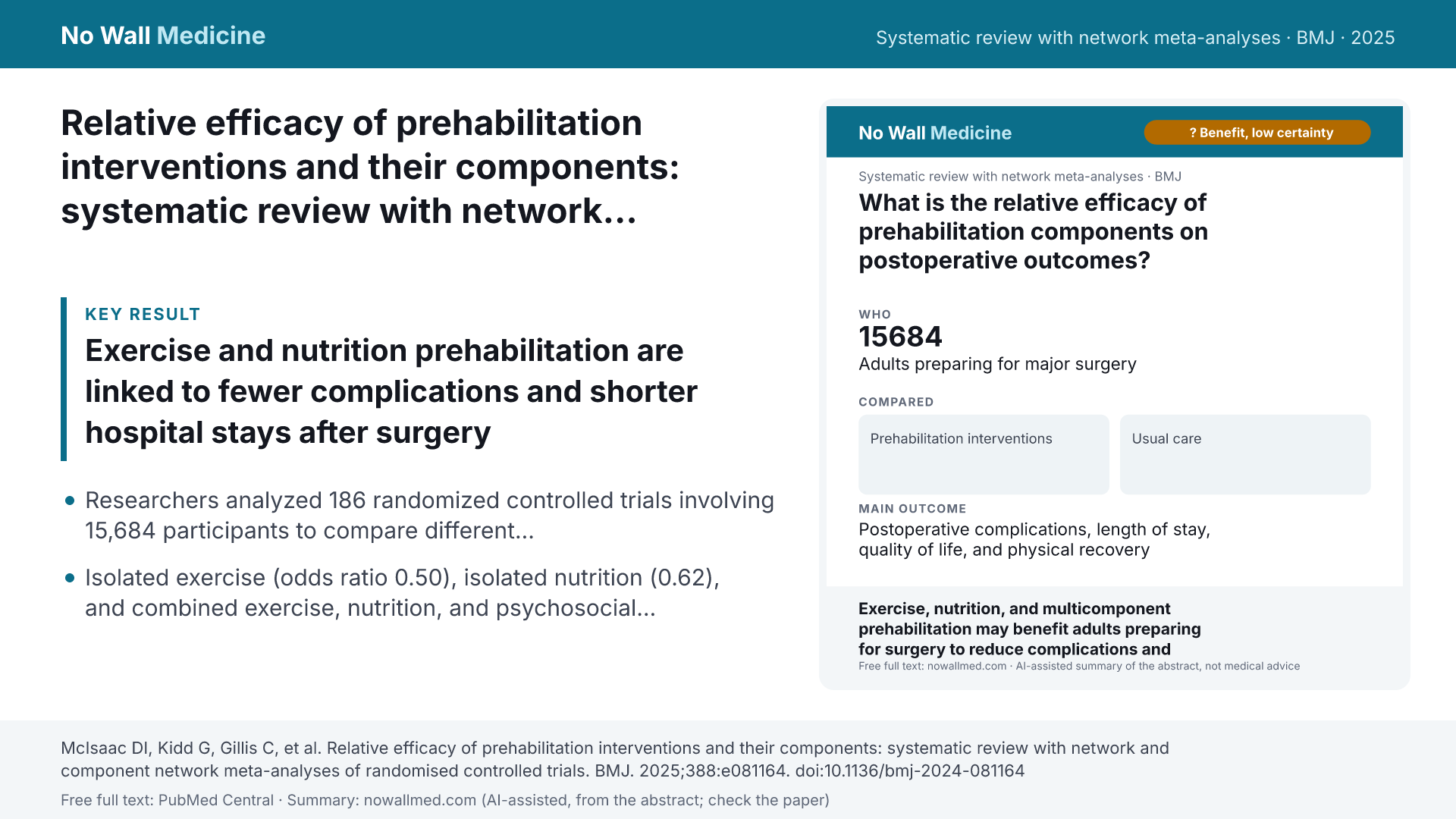
Exercise and nutrition prehabilitation are linked to fewer complications and shorter hospital stays after surgery
Relative efficacy of prehabilitation interventions and their components: systematic review with network and component network meta-analyses of randomised controlled trials
Systematic review with network meta-analysesBenefit found
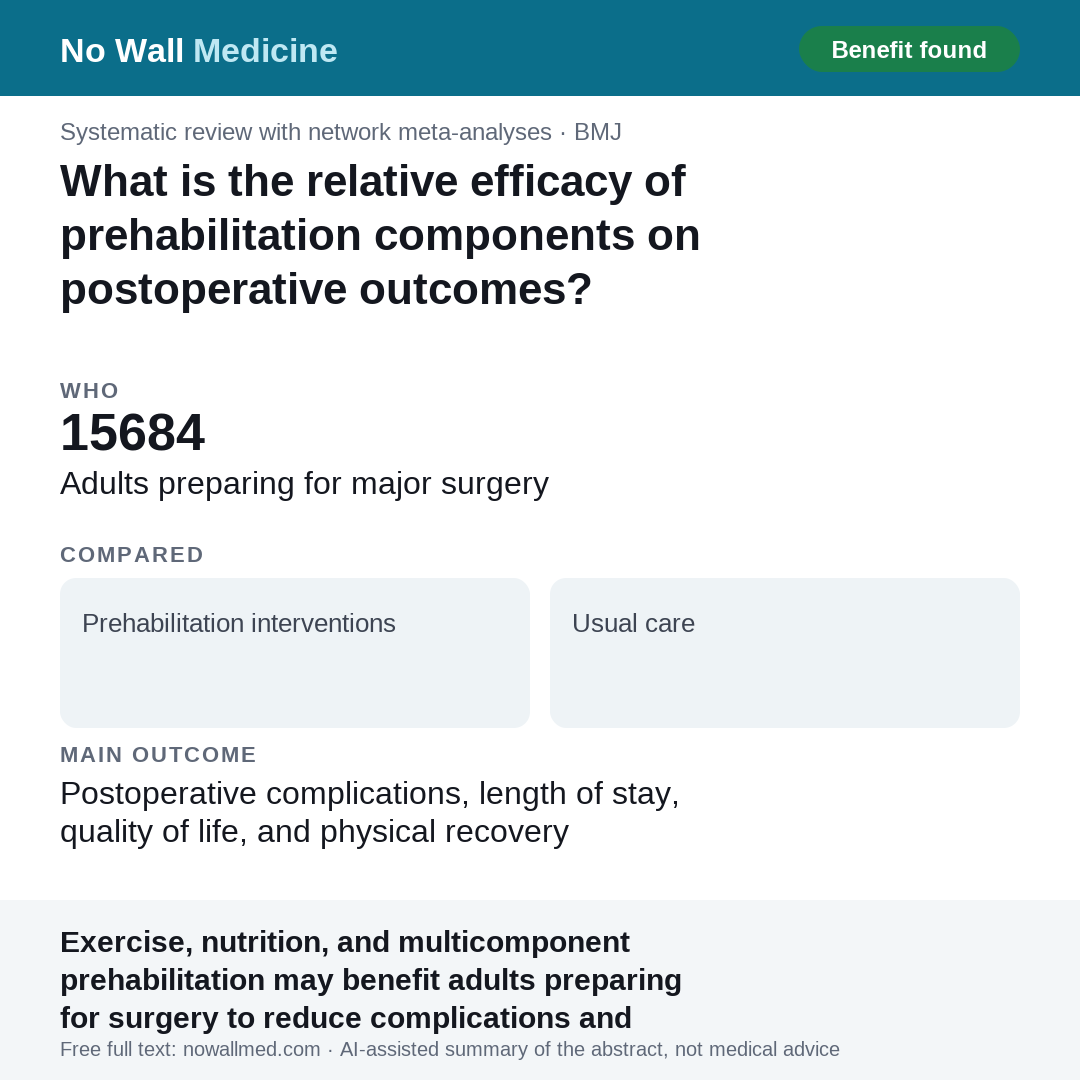
What is the relative efficacy of prehabilitation components on postoperative outcomes?
Who
15684
Adults preparing for major surgery
Compared
Prehabilitation interventions
Usual care
Main outcome
Postoperative complications, length of stay, quality of life, and physical recovery
Result: isolated exercise odds ratio 0.50 (95% CI 0.39 to 0.64)
Bottom line: Exercise, nutrition, and multicomponent prehabilitation may benefit adults preparing for surgery to reduce complications and improve recovery.
Limitation: Certainty was low to very low due to trial level risk of bias and imprecision.
BMJ · 2025-01-22Download image
Clinical question: What is the relative efficacy of prehabilitation components on postoperative outcomes?
Why it matters: It is unclear which specific combinations of exercise, nutrition, cognitive, and psychosocial components are most effective for improving surgical outcomes.
Key points
- Researchers analyzed 186 randomized controlled trials involving 15,684 participants to compare different prehabilitation components before major surgery.
- Isolated exercise (odds ratio 0.50), isolated nutrition (0.62), and combined exercise, nutrition, and psychosocial support (0.64) were most likely to reduce postoperative complications.
- Combined exercise and psychosocial support was associated with a decrease in length of stay by -2.44 days, while isolated exercise and nutrition also showed decreases.
Limitation the authors note: The certainty of evidence was generally low to very low due to trial level risk of bias and imprecision.
Headline and key points written with AI from the paper’s abstract, with every number checked against it. Read the paper before relying on them.
Was this summary helpful?
Abstract
Objective
To estimate the relative efficacy of individual and combinations of prehabilitation components (exercise, nutrition, cognitive, and psychosocial) on critical outcomes of postoperative complications, length of stay, health related quality of life, and physical recovery for adults who have received surgery. Design
Systematic review with network and component network meta-analyses of randomised controlled trials. Data sources
Medline, Embase, PsycINFO, CINAHL, Cochrane Library, and Web of Science were initially searched 1 March 2022, and updated on 25 October 2023. Certainty in findings were assessed using the Confidence in Network Meta-Analysis (CINeMA) approach. Main outcome measures
To compare treatments and to compare individual components informed by partnership with patients, clinicians, researchers, and health system leaders using an integrated knowledge translation framework. Eligible studies were any randomised controlled trial including adults preparing for major surgery who were allocated to prehabilitation interventions or usual care, and where critical outcomes were reported. Results
186 unique randomised controlled trials with 15 684 participants were included. When comparing treatments using random-effects network meta-analysis, isolated exercise (odds ratio 0.50 (95% confidence interval (CI) 0.39 to 0.64); very low certainty of evidence), isolated nutritional (0.62 (0.50 to 0.77); very low certainty of evidence), and combined exercise, nutrition, plus psychosocial (0.64 (0.45 to 0.92); very low certainty of evidence) prehabilitation were most likely to reduce complications compared with usual care. Combined exercise and psychosocial (-2.44 days (95% CI -3.85 to -1.04); very low certainty of evidence), combined exercise and nutrition (-1.22 days (-2.54 to 0.10); moderate certainty of evidence), isolated exercise (-0.93 days (-1.27 to -0.58); very low certainty of evidence), and isolated nutritional prehabilitation (-0.99 days (-1.49 to -0.48); very low certainty of evidence) were most likely to decrease length of stay. Combined exercise, nutrition, plus psychosocial prehabilitation was most likely to improve health related quality of life (mean difference on Short Form-36 physical component scale 3.48 (95% CI 0.82 to 6.14); very low certainty of evidence) and physical recovery (mean difference in meters on the six min walk test 43.43 (95% CI 5.96 to 80.91); very low certainty of evidence).When comparing individual components using component network meta-analysis, exercise and nutrition were the individual components most likely to improve all critical outcomes. The certainty of evidence for all comparisons across all outcomes was generally low to very low due to trial level risk of bias and imprecision; however, results for exercise and nutritional prehabilitation were robust with exclusion of high risk of bias trials. Conclusions
Consistent and potentially meaningful effect estimates suggest that exercise prehabilitation, nutritional prehabilitation, and multicomponent interventions including exercise may benefit adults preparing for surgery and could be considered in clinical care. However, multicentre trials that are appropriately powered for high priority outcomes and that have a low risk of bias are required to have greater certainty in prehabilitation's efficacy. Registration
International prospective registry of systematic reviews CRD42023353710.
Abstract reproduced under the article’s CC BY NC licence.
Subject terms
Cite this article
McIsaac DI, Kidd G, Gillis C, et al. Relative efficacy of prehabilitation interventions and their components: systematic review with network and component network meta-analyses of randomised controlled trials. BMJ. 2025. doi:10.1136/bmj-2024-081164
Spotted a mistake? Suggest a correction