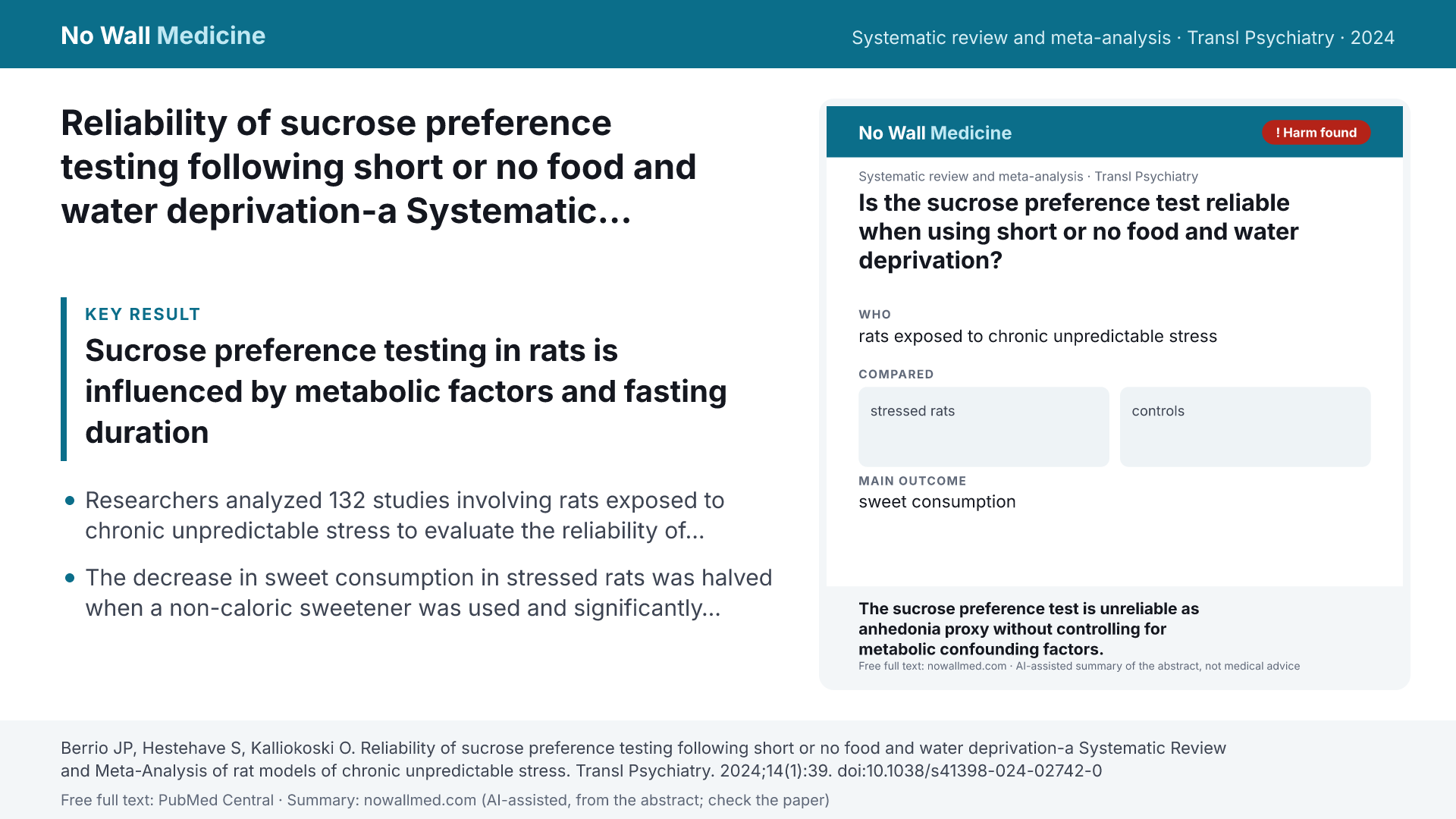
Sucrose preference testing in rats is influenced by metabolic factors and fasting duration
Reliability of sucrose preference testing following short or no food and water deprivation-a Systematic Review and Meta-Analysis of rat models of chronic unpredictable stress
Systematic review and meta-analysisHarm found
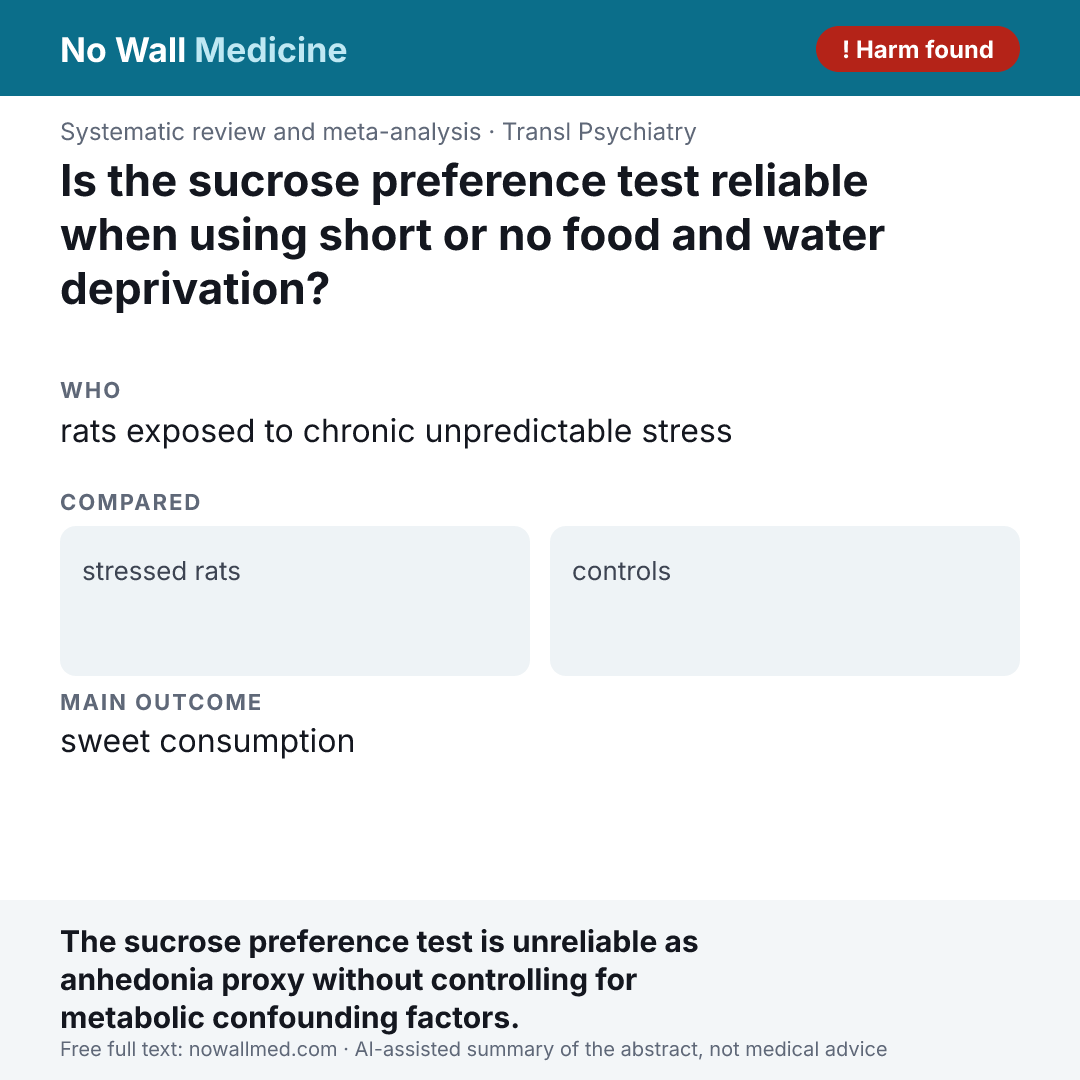
Is the sucrose preference test reliable when using short or no food and water deprivation?
Who
rats exposed to chronic unpredictable stress
Compared
stressed rats
controls
Main outcome
sweet consumption
Bottom line: The sucrose preference test is unreliable as anhedonia proxy without controlling for metabolic confounding factors.
Limitation: Methodological strategies to control bias and clear reporting of essential information were often missing.
Transl Psychiatry · 2024-01-19 · Save PNG
Clinical question: Is the sucrose preference test reliable when using short or no food and water deprivation?
Key points
- Researchers analyzed 132 studies involving rats exposed to chronic unpredictable stress to evaluate the reliability of the sucrose preference test, a measure for anhedonia (the inability to feel pleasure).
- The decrease in sweet consumption in stressed rats was halved when a non-caloric sweetener was used and significantly reduced when sucrose consumption was corrected for body weight.
- The length of food and water deprivation was found to confound the effect, and methodological strategies to control for bias were often missing in the reviewed studies.
Limitation the authors note: Methodological strategies to control for bias and clear, complete reporting of essential study information were often missing in the included studies.
Headline and key points written with AI from the paper’s abstract, with every number checked against it. Read the paper before relying on them.
Was this summary helpful?
Subject terms
Headline, design, result, key points, caveat and citation as plain text.
Cite this article
Berrio JP, Hestehave S, Kalliokoski O. Reliability of sucrose preference testing following short or no food and water deprivation-a Systematic Review and Meta-Analysis of rat models of chronic unpredictable stress. Transl Psychiatry. 2024;14(1):39. doi:10.1038/s41398-024-02742-0
Spotted a mistake? Suggest a correction