Remibrutinib reduced relapse rate compared to teriflunomide in multiple sclerosis trials
Remibrutinib versus teriflunomide in relapsing multiple sclerosis (REMODEL-1 and REMODEL-2): two randomised, phase 3 trials
Two randomised trialsBenefit found
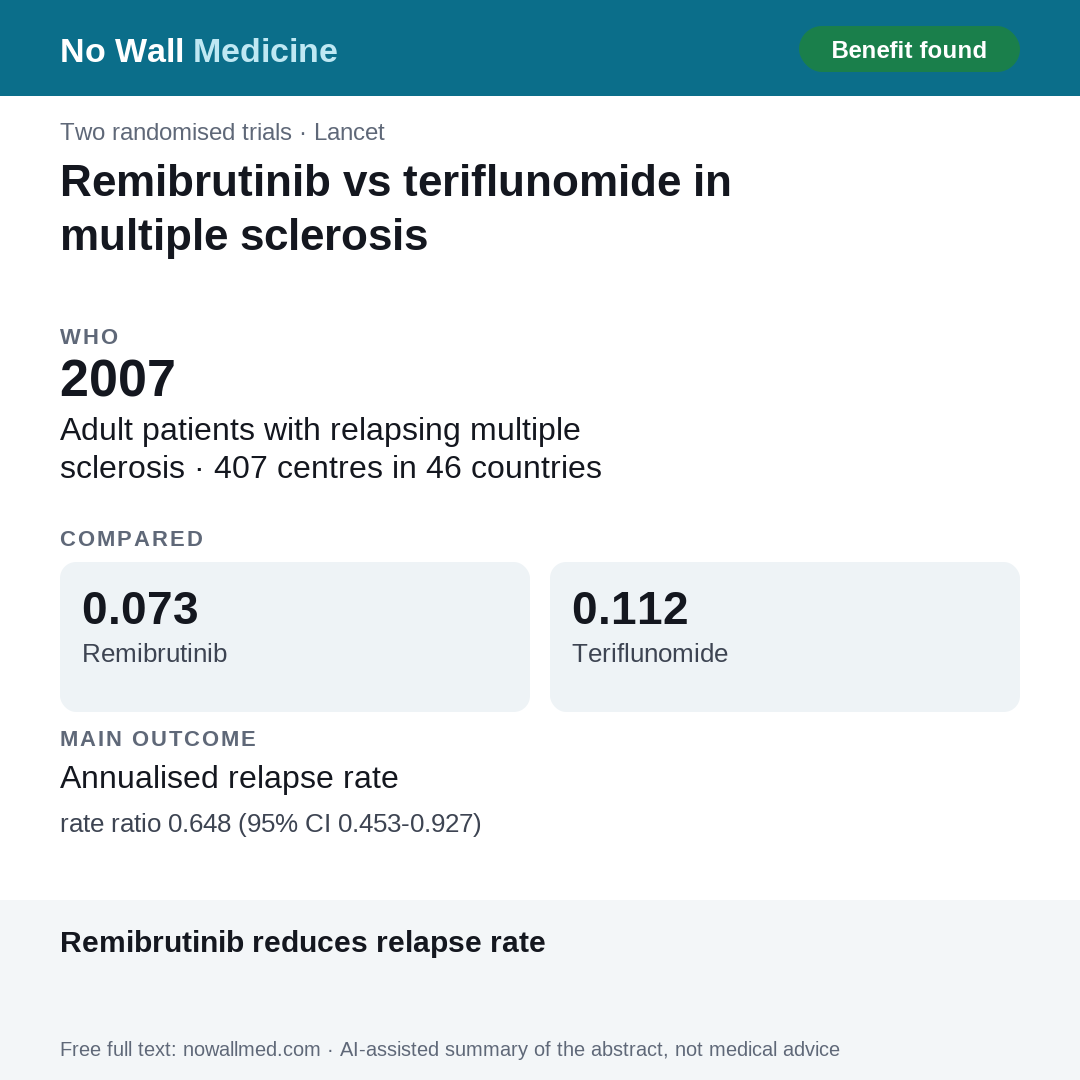
Remibrutinib vs teriflunomide in multiple sclerosis
Who
2007
Adult patients with relapsing multiple sclerosis · 407 centres in 46 countries
Compared
0.073Remibrutinib
0.112Teriflunomide
Main outcome
Annualised relapse rate
Result: rate ratio 0.648 (95% CI 0.453-0.927)
Bottom line: Remibrutinib reduces relapse rate
Funded by: Novartis
Lancet · 2026-10-23Download image
Key points
- Two thousand seven patients with relapsing multiple sclerosis were randomly assigned to remibrutinib or teriflunomide.
- Annualised relapse rate was significantly lower with remibrutinib, 0·073 versus 0·112 in one trial and 0·080 versus 0·116 in the other.
- Adverse events leading to treatment discontinuation were less frequent with remibrutinib, 3·1% versus 5·8% with teriflunomide.
Headline and key points written with AI from the paper’s abstract, with every number checked against it. Read the paper before relying on them.
Abstract
Background
Remibrutinib is a highly selective, potent, covalent, CNS-penetrant, oral BTK inhibitor. We assessed the efficacy and safety of remibrutinib in adult patients with relapsing multiple sclerosis. Methods
REMODEL-1 and REMODEL-2 are two identical, randomised, double-blind, double-dummy, active comparator-controlled, parallel-group, event-driven, phase 3 trials conducted at 407 centres in 46 countries. Patients aged 18-55 years with relapsing multiple sclerosis, an Expanded Disability Status Scale score of 0-5·5, and evidence of recent disease activity were randomly assigned 1:1 to oral remibrutinib 100 mg twice daily or teriflunomide 14 mg once daily via interactive response technology. Randomisation was stratified by geographical region, MRI cohort participation, and multiple sclerosis subtype. Patients, site investigators, and trial team were masked to treatment allocation. The primary endpoint was annualised relapse rate (ARR), defined as the number of confirmed multiple sclerosis relapses per patient-year with up to 30 months of follow-up, and assessed in all randomly assigned patients. These trials are registered with ClinicalTrials.gov (NCT05147220 and NCT05156281) and are ongoing, not recruiting. Findings
Between Dec 13, 2021, and Dec 30, 2025, 2632 patients were screened and 2007 patients were randomly assigned. REMODEL-1 included 1000 patients (remibrutinib 502, teriflunomide 498; mean age 38·2 years, 666 [66·6%] female, 334 [33·4%] male) and REMODEL-2 included 1007 patients (remibrutinib 504, teriflunomide 503; mean age 39·0 years, 675 [67·0%] female, 332 [33·0%] male). ARR was significantly lower with remibrutinib than with teriflunomide: 0·073 versus 0·112 (rate ratio [RR] 0·648 [95% CI 0·453-0·927]; p=0·018) in REMODEL-1 and 0·080 versus 0·116 (RR 0·688 [0·487-0·972]; p=0·034) in REMODEL-2. The most common adverse events were upper respiratory tract infection (132 [13·1%] of 1006 with remibrutinib vs 137 [13·7%] of 1001 with teriflunomide), nasopharyngitis (92 [9·1%] vs 123 [12·3%]), diarrhoea (84 [8·3%] vs 109 [10·9%]), and alopecia (58 [5·8%] vs 135 [13·5%]). Adverse events leading to treatment discontinuation were less frequent with remibrutinib (31 [3·1%]) versus teriflunomide (58 [5·8%]). The safety profile of remibrutinib was consistent with that in other indications, including no liver safety concerns. Interpretation
Remibrutinib was superior to teriflunomide in patients with relapsing multiple sclerosis, while maintaining a favourable safety profile. These findings support remibrutinib as a potential new oral treatment option for relapsing multiple sclerosis. Funding
Novartis.
Abstract reproduced under the article’s CC BY licence.
Topics
Spotted a mistake? Suggest a correction
More in Neurology
Automated model correctly identified 68 out of 90 seizure events as epileptic or nonepileptic
Video-Based Automated Seizure Classification Using Multimodal Large Language Models
Neuroimmune interactions contribute to migraine headache generation
Cortical and meningeal neuroimmune interactions contribute to the generation of migraine headaches
Pain and depressive symptoms linked to lower cognitive performance in older adults
Joint trajectories of pain and depressive symptoms in relation to repeated cognitive performance: a harmonized longitudinal analysis of four aging cohorts
AD biomarker-positive participants with DLB had faster cognitive decline than biomarker-negative ones
Biomarker-informed differences in treatment-associated cognitive decline in dementia with Lewy bodies