Three-variable Boolean remission definition best predicts bone and functional outcomes in rheumatoid arthritis
Remission definitions guiding immunosuppressive therapy in rheumatoid arthritis: which is best fitted for the purpose?
Meta-analysis of individual patient data from eight randomized controlled trialsBenefit found
Which remission definition best predicts good radiographic and functional outcomes in rheumatoid arthritis?
Who
4423
Patients with rheumatoid arthritis
Compared
Boolean: 38.8% predictive accuracy for good radiographic outcome
Updated-Boolean: 44.1% predictive accuracy for good radiographic outcome
3VBoolean: 51.1% predictive accuracy for good radiographic outcome
Main outcome
Good radiographic outcome and good functional outcome
Bottom line: The 3VBoolean remission definition provided the most accurate prediction of good radiographic and functional outcomes.
RMD Open · 2024-03-04Download image
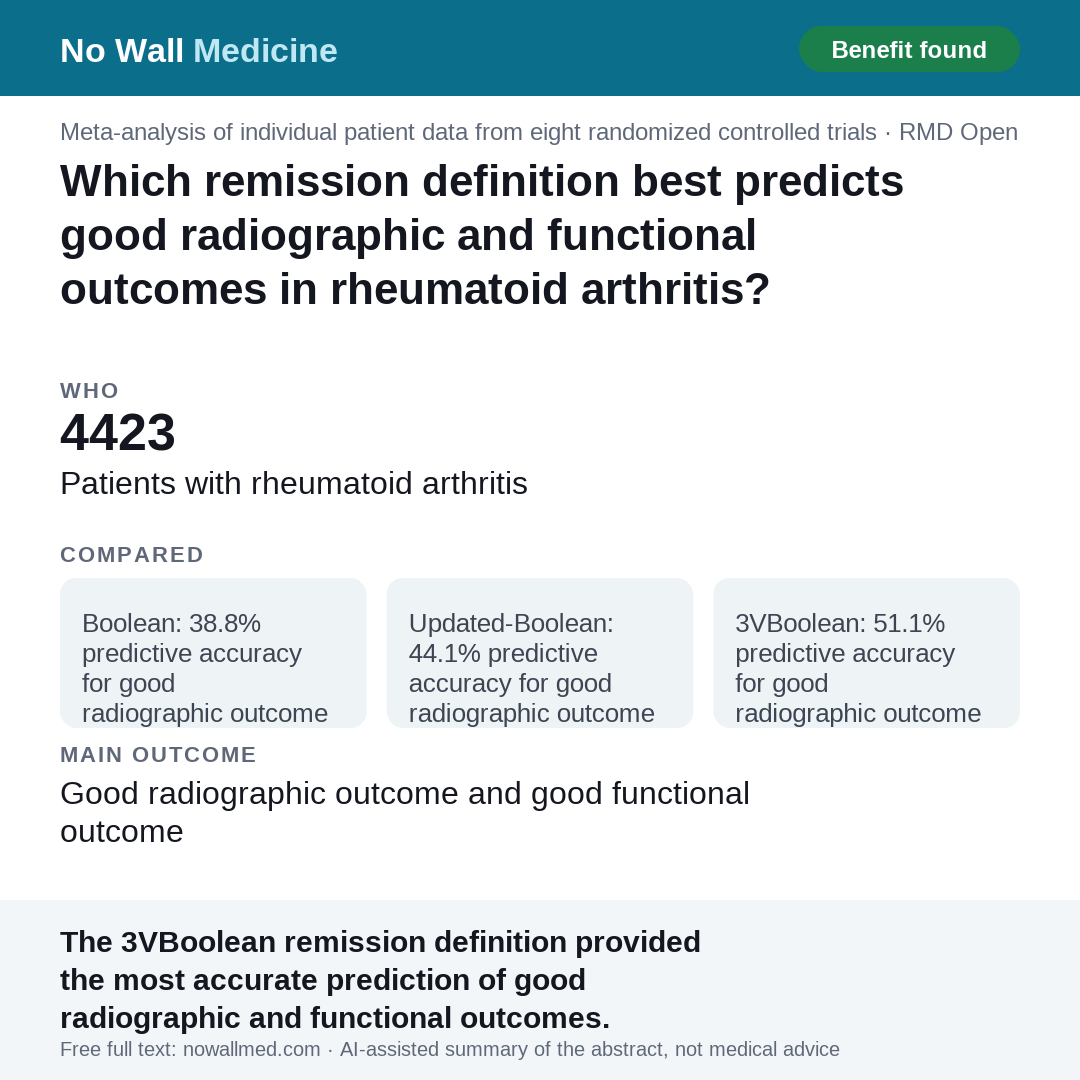
Clinical question: Which remission definition best predicts good radiographic and functional outcomes in rheumatoid arthritis?
Why it matters: It is unclear which specific definition of remission best predicts long-term bone protection and physical function to guide immunosuppressive therapy.
Key points
- Researchers analyzed individual patient data from 4423 people across eight randomized controlled trials to compare six different definitions of remission.
- The 3VBoolean remission definition, which excludes patient global assessment, showed the highest predictive accuracy for good radiographic outcome at 51.1%.
- The proportion of good functional outcome correctly predicted was highest for 3VBoolean at 50.3% and lowest for Boolean at 43.8%.
Headline and key points written with AI from the paper’s abstract, with every number checked against it. Read the paper before relying on them.
Was this summary helpful?
Abstract
Objective
To assess which definition of remission best predicts good radiographic outcome (GRO) and good functional outcome (GFO) in rheumatoid arthritis, focusing the updated American College of Rheumatology/European Alliance of Associations for Rheumatology criteria. Material and methods
Meta-analyses of individual patient data (IPD) from randomised controlled trials (RCTs). Six definitions of remission were considered: (1) Boolean with Patient Global Assessment (PGA)≤1 (Boolean); (2) Simplified Disease Activity Index (SDAI)≤3.3; (3) Clinical Disease Activity Index (CDAI)≤2.8; (4) Boolean with PGA≤2 (Updated-Boolean); (5) Boolean with Physician Global Assessment (PhGA≤1) replacing PGA (Boolean-PhGA) and (6) Boolean excluding PGA (3VBoolean). GRO was defined as a worsening ≤0.5 units in radiographic score and GFO as a no worsening in Health Assessment Questionnaire (HAQ), that is, ∆HAQ-DI≤0.0 units. Relationships between each remission definition at 6 and/or 12 months and GRO and GFO during the second year were analysed. Pooled probabilities for each outcome for each definition and their predictive accuracy were estimated. Results
IPD from eight RCTs (n=4423) were analysed. Boolean, SDAI, CDAI, Updated-Boolean, Boolean-PhGA and 3VBoolean were achieved by 24%, 27%, 28%, 32%, 33% and 43% of all patients, respectively. GRO among patients achieving remission ranged from 82.4% (3VBoolean) to 83.9% (SDAI). 3VBoolean showed the highest predictive accuracy for GRO: 51.1% versus 38.8% (Boolean) and 44.1% (Updated-Boolean). The relative risk of GFO ranged from 1.16 (Boolean) to 1.05 (3VBoolean). However, the proportion of GFO correctly predicted was highest for the 3VBoolean (50.3%) and lowest for the Boolean (43.8%). Conclusion
3VBoolean definition provided the most accurate prediction of GRO and GFO, avoiding the risk of overtreatment in a substantial proportion of patients without increment in radiographic damage progression, supporting the proposal that 3VBoolean remission is preferable to guide immunosuppressive treatment. The patient's perspective, which must remain central, is best served by an additional patient-oriented target: a dual-target approach.
Abstract reproduced under the article’s CC BY NC licence.
Subject terms
Cite this article
Duarte C, Ferreira RJO, Welsing PMJ, Jacobs JWG, Gossec L, Machado PM. Remission definitions guiding immunosuppressive therapy in rheumatoid arthritis: which is best fitted for the purpose?. RMD Open. 2024. doi:10.1136/rmdopen-2023-003972
Spotted a mistake? Suggest a correction
Top studies every Monday
The week’s key trials and guidelines in your specialties, plus any topics you follow. By email, free.
Get the weekly digest