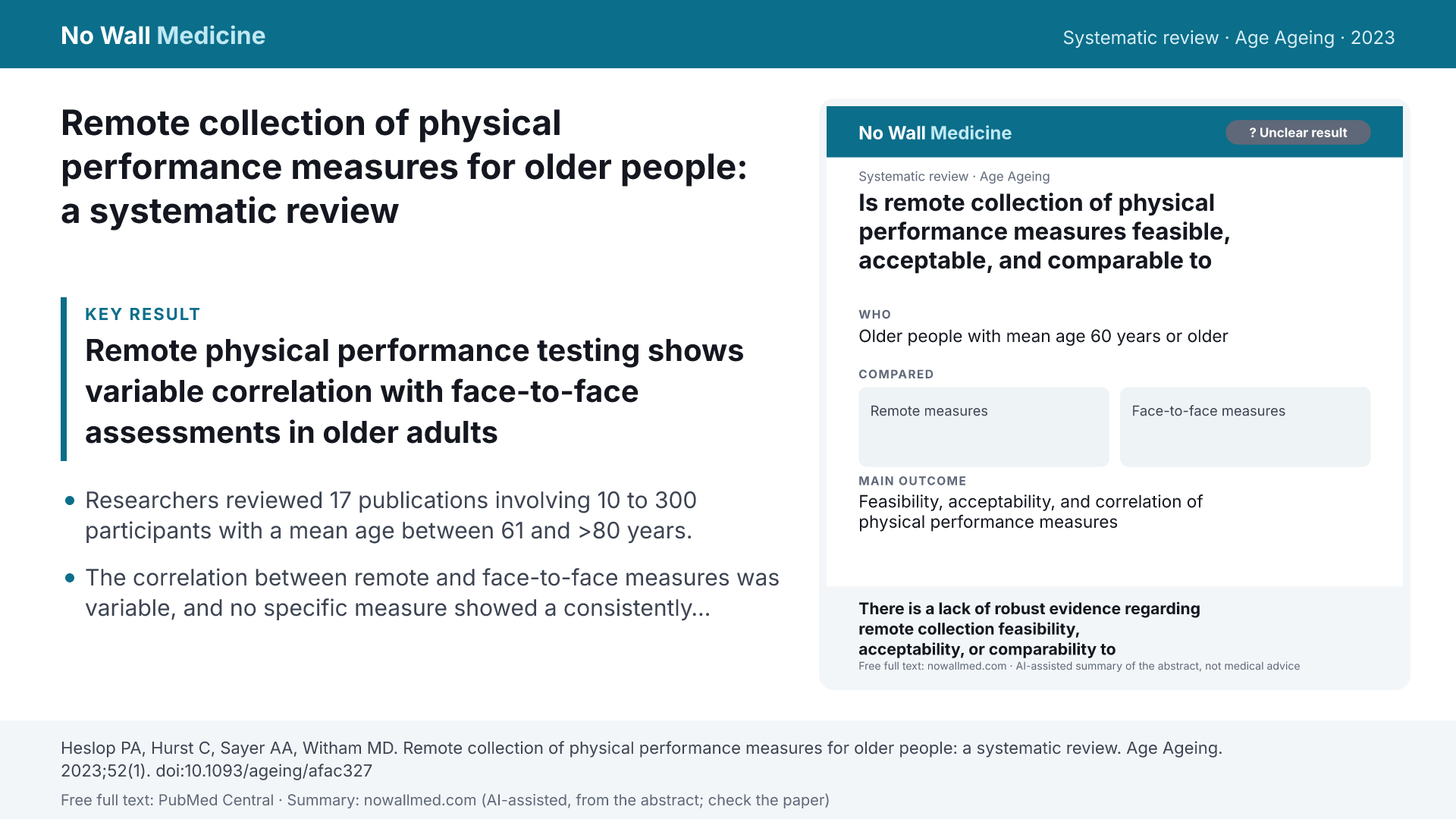
Remote collection of physical performance measures for older people: a systematic review
Key result: Remote physical performance testing shows variable correlation with face-to-face assessments in older adults
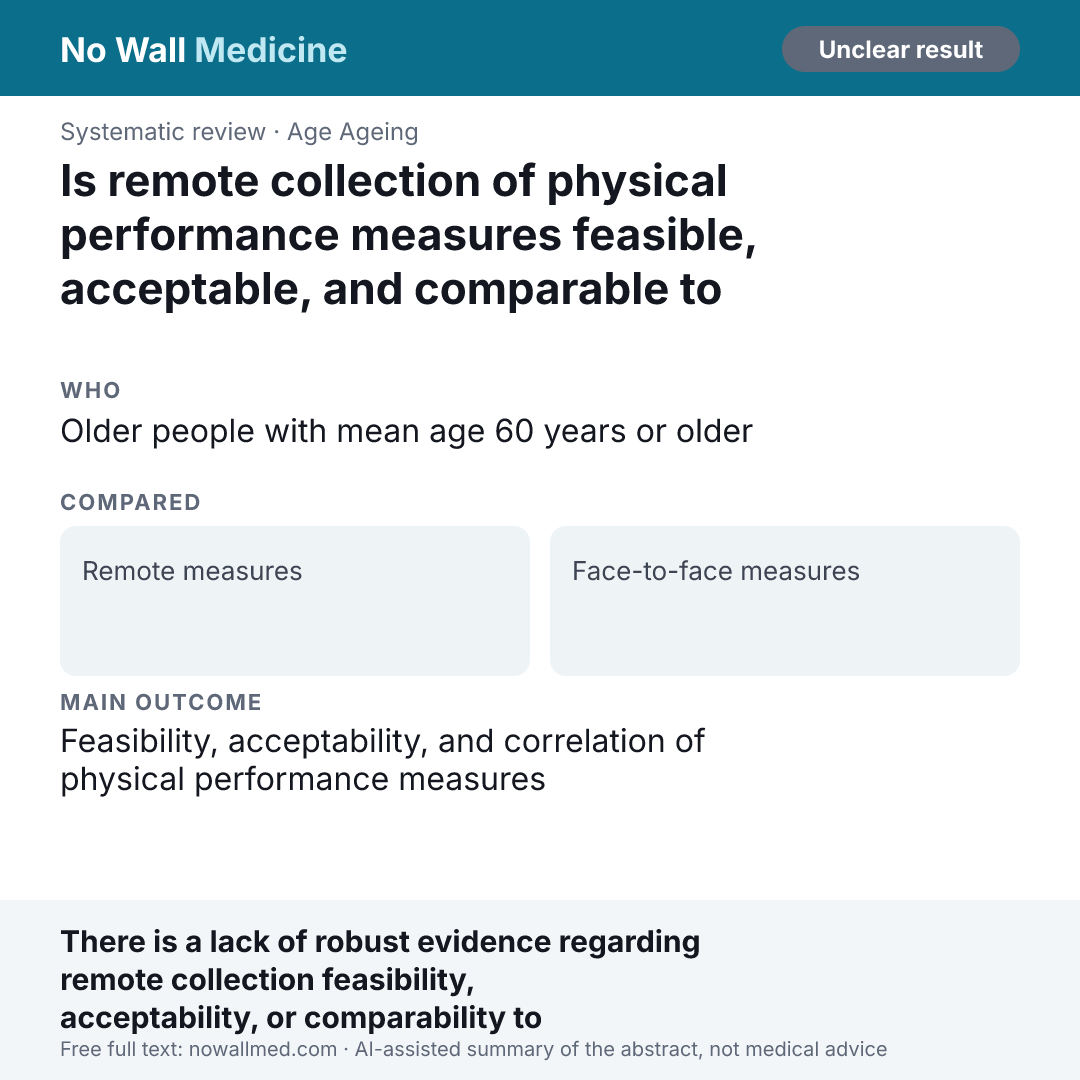
Systematic reviewUnclear result
Is remote collection of physical performance measures feasible, acceptable, and comparable to face-to-face?
Who
Older people with mean age 60 years or older
Compared
Remote measures
Face-to-face measures
Main outcome
Feasibility, acceptability, and correlation of physical performance measures
Bottom line: There is a lack of robust evidence regarding remote collection feasibility, acceptability, or comparability to face-to-face measures.
Limitation: Most studies had a moderate or high risk of bias.
Age Ageing · 2023-02-01 · Save PNG
Key points
- Researchers reviewed 17 publications involving 10 to 300 participants with a mean age between 61 and >80 years.
- The correlation between remote and face-to-face measures was variable, and no specific measure showed a consistently good correlation.
- In six of the nine studies that examined accuracy, the mean difference between remote and face-to-face measures was <5%.
Limitation the authors note: Most studies included in the review had a moderate or high risk of bias.
Discussion prompts
- Would these patients look like yours? Who was left out?
- Is the main outcome one that matters to patients?
- Is the difference large enough to change what you do?
Cite: Heslop PA, Hurst C, Sayer AA, Witham MD. Remote collection of physical performance measures for older people: a systematic review. Age Ageing. 2023;52(1). doi:10.1093/ageing/afac327
Free full text: PubMed Central · Summary and visual abstract: nowallmed.com/a/remote-collection-of-physical-performance-measures-for-older-people-a-1e10y9x/ (AI-assisted from the abstract; check the paper before relying on it).