Remote digital intervention improved heart failure medication scores compared to usual care at six months
Remote digital intervention targeting heart failure medical therapy: a randomized controlled trial
Multicenter, parallel-arm, unblinded, prospective, randomized controlled trialBenefit found
Does a remote digital intervention improve heart failure medical therapy scores?
Who
178
Adults with stable heart failure with reduced ejection fraction · 7 US sites
Compared
digital intervention: mean change of 2.0 (±2.4)
usual care: mean change of 1.4 (±2.2)
Main outcome
change in a heart failure medical therapy score
Result: least squares mean difference 0.78 (95% confidence interval, 0.21-1.34)
Bottom line: A remote digital intervention improved heart failure medical therapy scores compared to usual care in patients with reduced ejection fraction.
Funded by: Story Health
Lancet Reg Health Am · 2026-03-25Download image
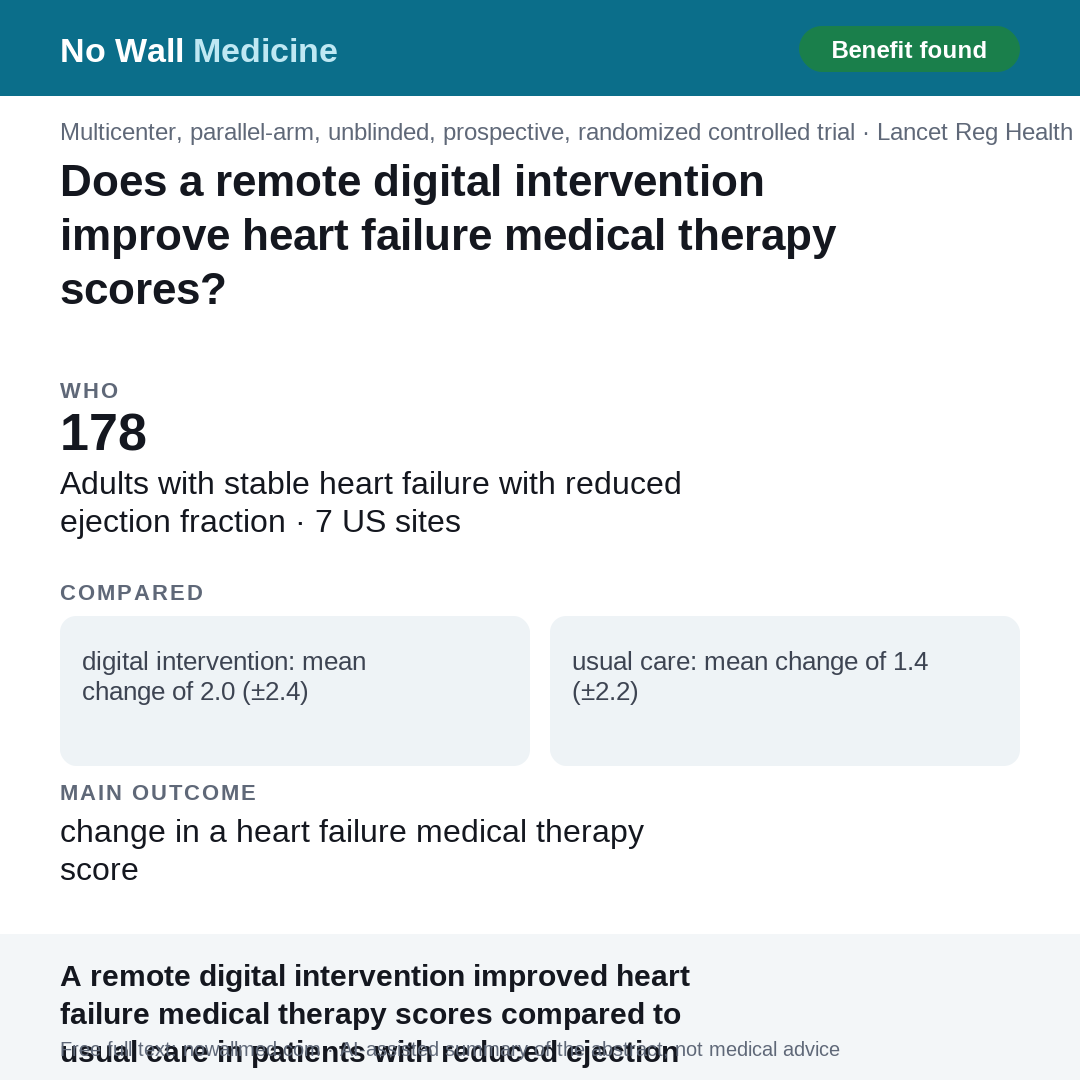
Clinical question: Does a remote digital intervention improve heart failure medical therapy scores?
Why it matters: Evidence-based medications for heart failure are often underused, and the efficacy of remote digital platforms for managing these therapies has not been adequately tested in randomized trials.
Key points
- Researchers studied 178 adults with stable heart failure and reduced ejection fraction, comparing a remote digital platform to usual care.
- The digital intervention group saw a mean heart failure medical therapy score increase of 2.0, compared to an increase of 1.4 in the usual care group.
- The difference in scores between the two groups was 0.78 with a p-value of 0.007, and the intervention was considered safe.
Headline and key points written with AI from the paper’s abstract, with every number checked against it. Read the paper before relying on them.
Spotted a mistake? Suggest a correction