Remote ischaemic conditioning improved functional outcomes for stroke patients receiving endovascular thrombectomy
Remote ischaemic conditioning improves outcomes of ischaemic stroke treated by endovascular thrombectomy: the SERIC-EVT trial
Participant-blinded, randomized controlled clinical trialBenefit found
Does remote ischaemic conditioning improve outcomes of ischaemic stroke treated by endovascular thrombectomy?
Who
488
Patients with acute large vessel occlusion ischaemic stroke · 25 hospitals
Compared
61.1%Remote ischaemic conditioning
48.9%Sham remote ischaemic conditioning
Main outcome
Proportion of patients with modified Rankin Scale score 0-2 at Day 90
Result: unadjusted risk ratio 1.25 (95% confidence interval 1.06-1.47)
Bottom line: Remote ischaemic conditioning for 7 days improved functional outcomes at 90 days compared with sham conditioning.
Eur Heart J · 2025-08-13Download image
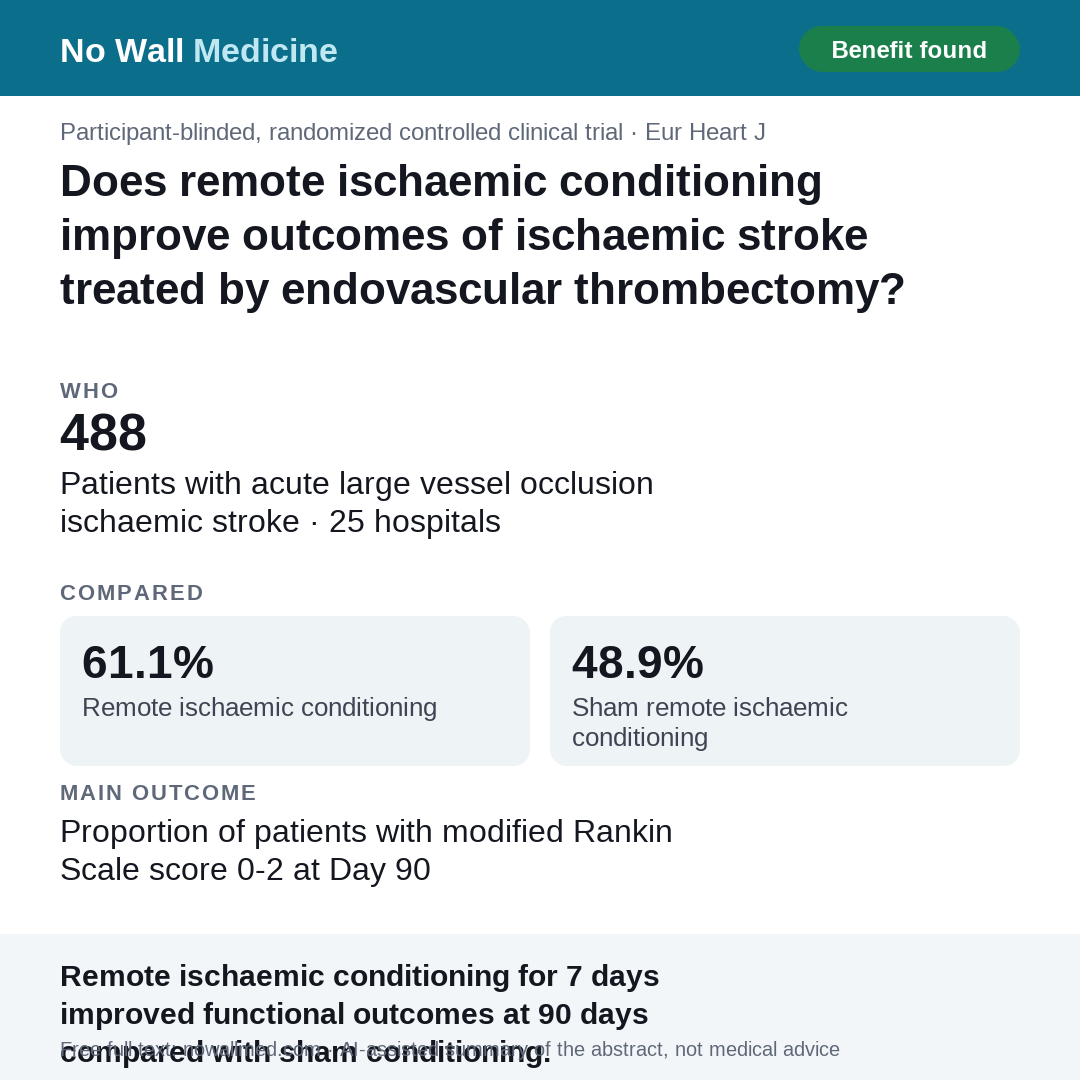
Clinical question: Does remote ischaemic conditioning improve outcomes of ischaemic stroke treated by endovascular thrombectomy?
Why it matters: More than half of patients with acute large vessel occlusion stroke do not achieve favourable outcomes even after receiving endovascular thrombectomy.
Key points
- Researchers conducted a randomized trial with 488 patients receiving either remote ischaemic conditioning or a sham procedure after undergoing endovascular thrombectomy.
- At 90 days, 61.1% of patients in the remote ischaemic conditioning group achieved a modified Rankin Scale score of 0-2 compared to 48.9% in the sham group.
- The proportion of patients experiencing haemorrhagic transformation, or bleeding within the brain, was 37.7% in the treatment group and 35.2% in the sham group.
Headline and key points written with AI from the paper’s abstract, with every number checked against it. Read the paper before relying on them.
Topics
Cite this article
Guo ZN, Abuduxukuer R, Wang C, Qu Y, Zhang P, Zhao JF. Remote ischaemic conditioning improves outcomes of ischaemic stroke treated by endovascular thrombectomy: the SERIC-EVT trial. Eur Heart J. 2025. doi:10.1093/eurheartj/ehaf570
Spotted a mistake? Suggest a correction
Top studies every Monday
The week’s key trials and guidelines in your specialties, plus any topics you follow. By email, free.
Get the weekly digest