Remote ischaemic conditioning did not improve functional outcomes in patients with brain bleeding
Remote ischaemic conditioning in patients with supratentorial intracerebral haemorrhage (RICH-2): a multicentre, randomised, sham-controlled phase 3 trial in China
Randomised, sham-controlled, outcome-blinded trialNo clear difference
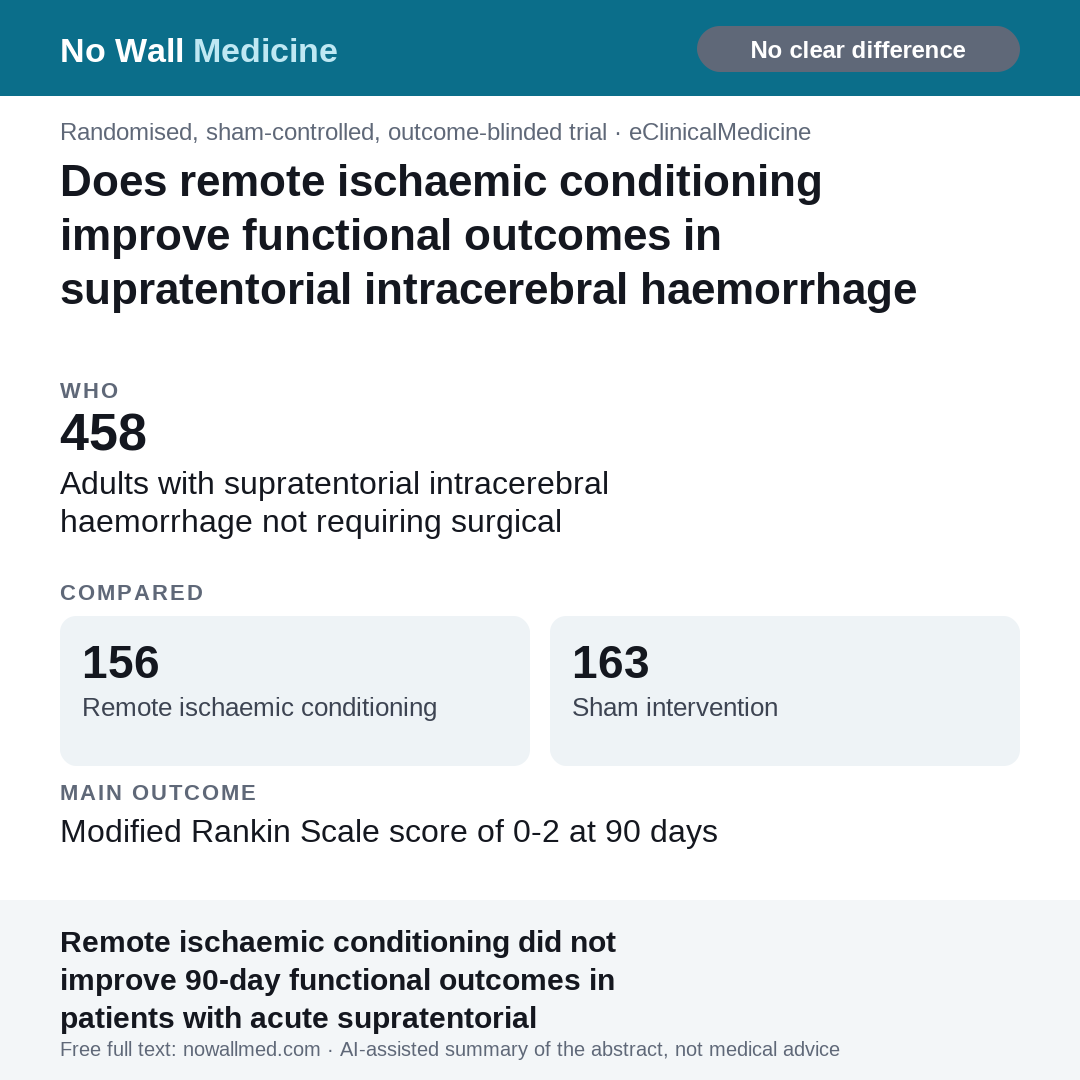
Does remote ischaemic conditioning improve functional outcomes in supratentorial intracerebral haemorrhage patients?
Who
458
Adults with supratentorial intracerebral haemorrhage not requiring surgical intervention · 20 centres in China
Compared
156Remote ischaemic conditioning (68.1%)
163Sham intervention (71.2%)
Main outcome
Modified Rankin Scale score of 0-2 at 90 days
Result: adjusted risk ratio 0.97 (95% confidence interval 0.87-1.08)
Bottom line: Remote ischaemic conditioning did not improve 90-day functional outcomes in patients with acute supratentorial intracerebral haemorrhage.
eClinicalMedicine · 2026-04-13Download image
Clinical question: Does remote ischaemic conditioning improve functional outcomes in supratentorial intracerebral haemorrhage patients?
Why it matters: Doctors have sought ways to accelerate the clearance of blood clots in patients with intracerebral haemorrhage to improve recovery.
Key points
- Researchers studied 458 adults with supratentorial intracerebral haemorrhage, a type of bleeding in the upper part of the brain, comparing remote ischaemic conditioning to a sham treatment.
- At 90 days, a favourable outcome was achieved in 68.1% of the remote ischaemic conditioning group and 71.2% of the sham group, showing no significant difference.
- Serious adverse events within 180 days occurred in 8.3% of the remote ischaemic conditioning group and 8.7% of the sham group, with no deaths attributed to the intervention.
Headline and key points written with AI from the paper’s abstract, with every number checked against it. Read the paper before relying on them.
Spotted a mistake? Suggest a correction