Remote ischemic conditioning did not improve stroke outcomes at 90 days
Remote Ischemic Conditioning for Acute Stroke: The RESIST Randomized Clinical Trial
Randomized clinical trialNo clear difference
Does remote ischemic conditioning improve functional outcome in patients with acute stroke?
Who
1500
Patients with prehospital stroke symptoms for less than 4 hours · 4 stroke centers in Denmark
Compared
Remote ischemic conditioning: median modified Rankin Scale score 2 (IQR, 1-3)
Sham treatment: median modified Rankin Scale score 1 (IQR, 1-3)
Main outcome
improvement in functional outcome measured by modified Rankin Scale score
Result: odds ratio 0.95 (95% CI 0.75 to 1.20)
Bottom line: Remote ischemic conditioning initiated prehospital and continued in hospital did not significantly improve functional outcome at 90 days.
JAMA · 2023-10-03Download image
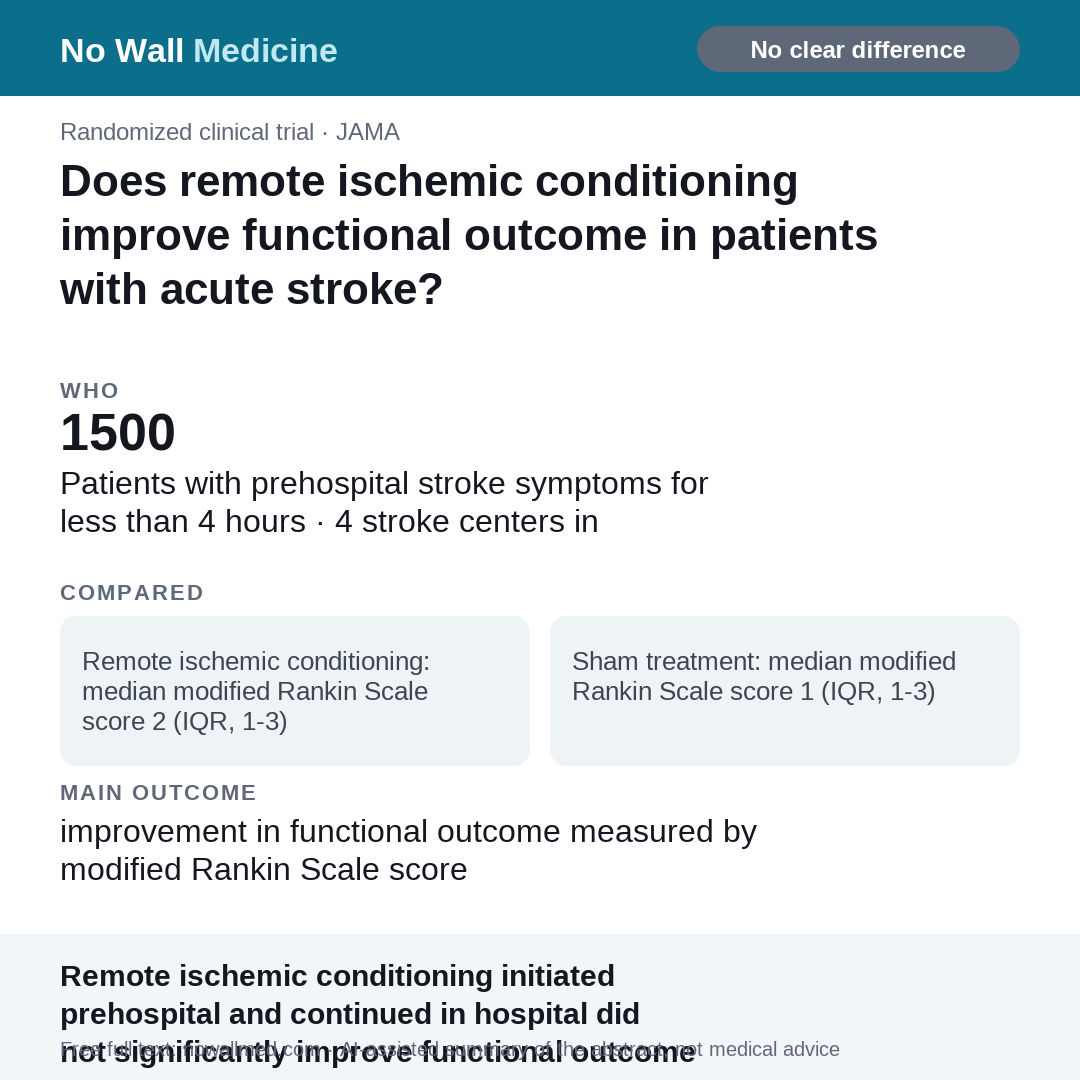
Clinical question: Does remote ischemic conditioning improve functional outcome in patients with acute stroke?
Why it matters: It was uncertain whether remote ischemic conditioning is an effective treatment for acute stroke
Key points
- 1500 patients with acute stroke symptoms were randomized to treatment or sham.
- Remote ischemic conditioning was not significantly associated with improved functional outcome at 90 days.
- No significant difference in serious adverse events was found between the two groups.
Headline and key points written with AI from the paper’s abstract, with every number checked against it. Read the paper before relying on them.
Topics
Cite this article
Blauenfeldt RA, Hjort N, Valentin JB, Homburg AM, Modrau B, Sandal BF. Remote Ischemic Conditioning for Acute Stroke: The RESIST Randomized Clinical Trial. JAMA. 2023. doi:10.1001/jama.2023.16893
Spotted a mistake? Suggest a correction