Telephone-based management of chemotherapy side effects did not reduce hospital visits or admissions
Remote, proactive, telephone based management of toxicity in outpatients during adjuvant or neoadjuvant chemotherapy for early stage breast cancer: pragmatic, cluster randomised trial
Pragmatic, cluster randomised trialNo clear difference
Does remote proactive telephone management of toxicities reduce emergency department visits or hospital admissions?
Who
2158
Patients starting adjuvant or neoadjuvant chemotherapy for early stage breast cancer · 20 cancer centres in Ontario, Canada
Compared
0.91Remote management of toxicities (standard deviation 0.28)
0.94Routine care (0.40)
Main outcome
Mean number of emergency department visits or hospital admissions per patient
Bottom line: Proactive, telephone based management of toxicities did not result in fewer emergency department visits or hospital admissions.
BMJ · 2021-12-08Download image
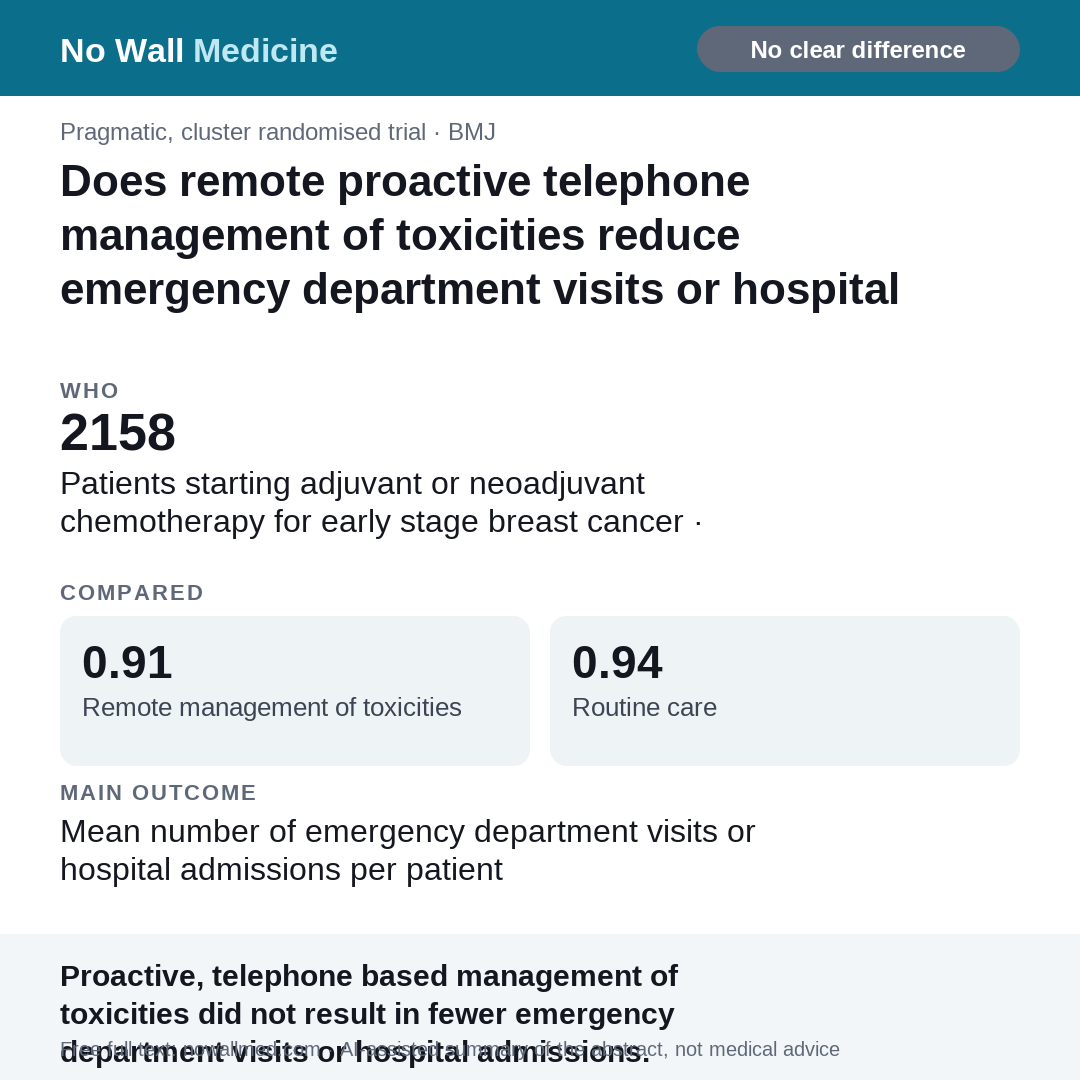
Clinical question: Does remote proactive telephone management of toxicities reduce emergency department visits or hospital admissions?
Why it matters: It is unknown if proactive, remote, nurse-led telephone management can effectively manage side effects for breast cancer patients receiving chemotherapy.
Key points
- Researchers studied 944 patients receiving nurse-led telephone management and 1214 patients receiving routine care during chemotherapy for early stage breast cancer.
- The mean number of emergency department visits or hospital admissions per patient was 0.91 in the intervention group and 0.94 in the control group.
- Among 580 participants completing questionnaires, at least one grade 3 toxicity, or severe side effect, was reported by 48% in the intervention arm and 58% in the control arm.
Headline and key points written with AI from the paper’s abstract, with every number checked against it. Read the paper before relying on them.
Was this summary helpful?
Abstract
Objective
To evaluate the effectiveness of remote proactive management of toxicities during chemotherapy for early stage breast cancer. Design
Pragmatic, cluster randomised trial. Setting
20 cancer centres in Ontario, Canada, allocated by covariate constrained randomisation to remote management of toxicities or routine care. Participants
All patients starting adjuvant or neoadjuvant chemotherapy for early stage breast cancer at each centre. 25 patients from each centre completed patient reported outcome questionnaires. Interventions
Proactive, standardised, nurse led telephone management of common toxicities at two time points after each chemotherapy cycle. Main outcome measures
The primary outcome, cluster level mean number of visits to the emergency department or admissions to hospital per patient during the whole course of chemotherapy treatment, was evaluated with routinely available administrative healthcare data. Secondary patient reported outcomes included toxicity, self-efficacy, and quality of life. Results
Baseline characteristics of participants were similar in the intervention (n=944) and control arms (n=1214); 22% were older than 65 years. Penetration (that is, the percentage of patients who received the intervention at each centre) was 50-86%. Mean number of visits to the emergency department or admissions to hospital per patient was 0.91 (standard deviation 0.28) in the intervention arm and 0.94 (0.40) in the control arm (P=0.94); 47% (1014 of 2158 patients) had at least one visit to the emergency department or a hospital admission during chemotherapy. Among 580 participants who completed the patient reported outcome questionnaires, at least one grade 3 toxicity was reported by 48% (134 of 278 patients) in the intervention arm and by 58% (163 of 283) in the control arm. No differences in self-efficacy, anxiety, or depression were found. Compared with baseline, the functional assessment of cancer therapy trial outcome index decreased by 6.1 and 9.0 points in the intervention and control participants, respectively. Conclusions
Proactive, telephone based management of toxicities during chemotherapy did not result in fewer visits to the emergency department or hospital admissions. With the rapid rise in remote care because of the covid-19 pandemic, identifying scalable strategies for remote management of patients during cancer treatment is particularly relevant. Trial registration
ClinicalTrials.gov NCT02485678.
Abstract reproduced under the article’s CC BY NC licence.
Subject terms
Cite this article
Krzyzanowska MK, Julian JA, Gu CS, Powis M, Li Q, Enright K. Remote, proactive, telephone based management of toxicity in outpatients during adjuvant or neoadjuvant chemotherapy for early stage breast cancer: pragmatic, cluster randomised trial. BMJ. 2021. doi:10.1136/bmj-2021-066588
Spotted a mistake? Suggest a correction
Top studies every Monday
The week’s key trials and guidelines in your specialties, plus any topics you follow. By email, free.
Get the weekly digest