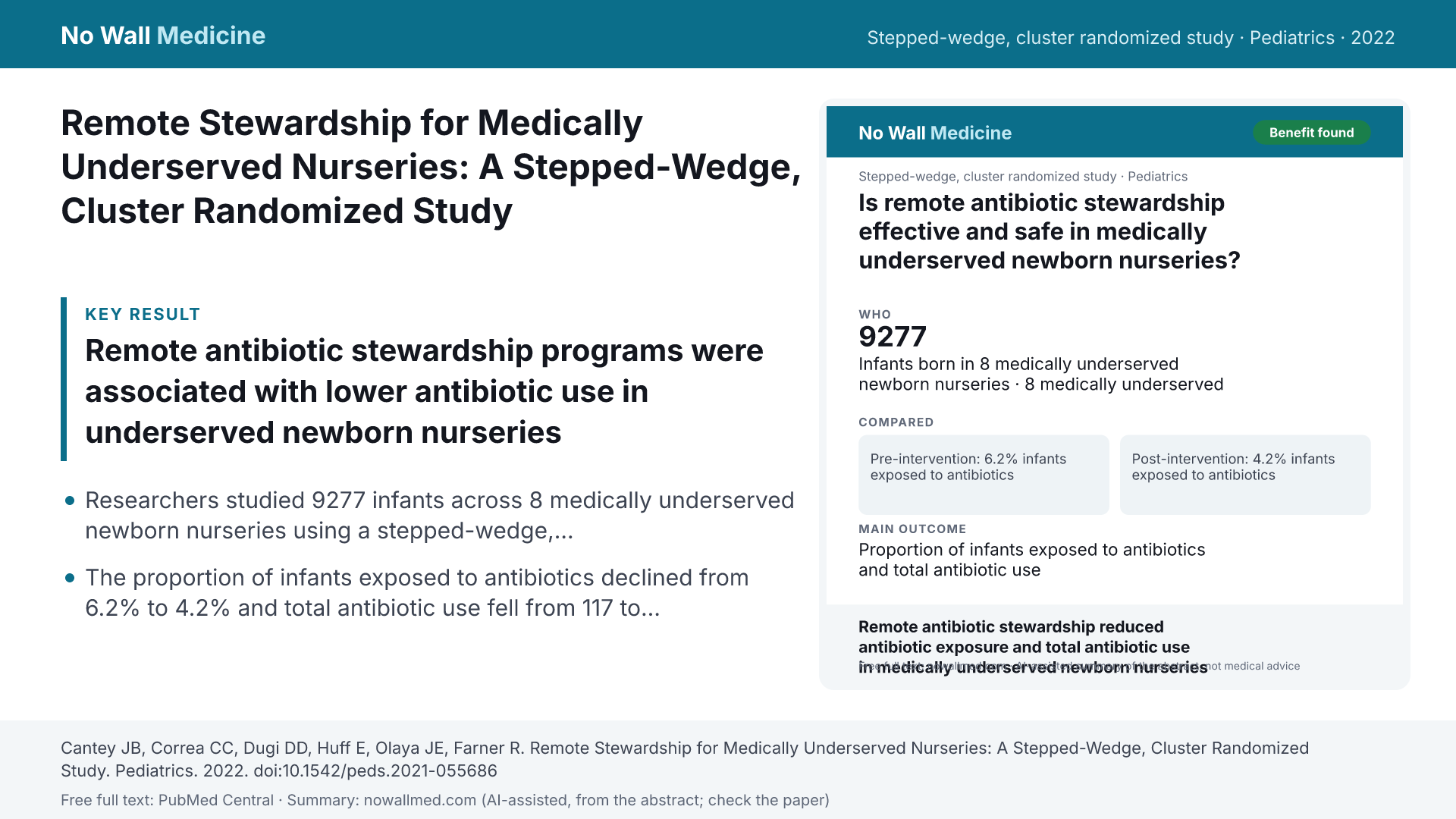
Remote antibiotic stewardship programs were associated with lower antibiotic use in underserved newborn nurseries
Remote Stewardship for Medically Underserved Nurseries: A Stepped-Wedge, Cluster Randomized Study
Stepped-wedge, cluster randomized studyBenefit found
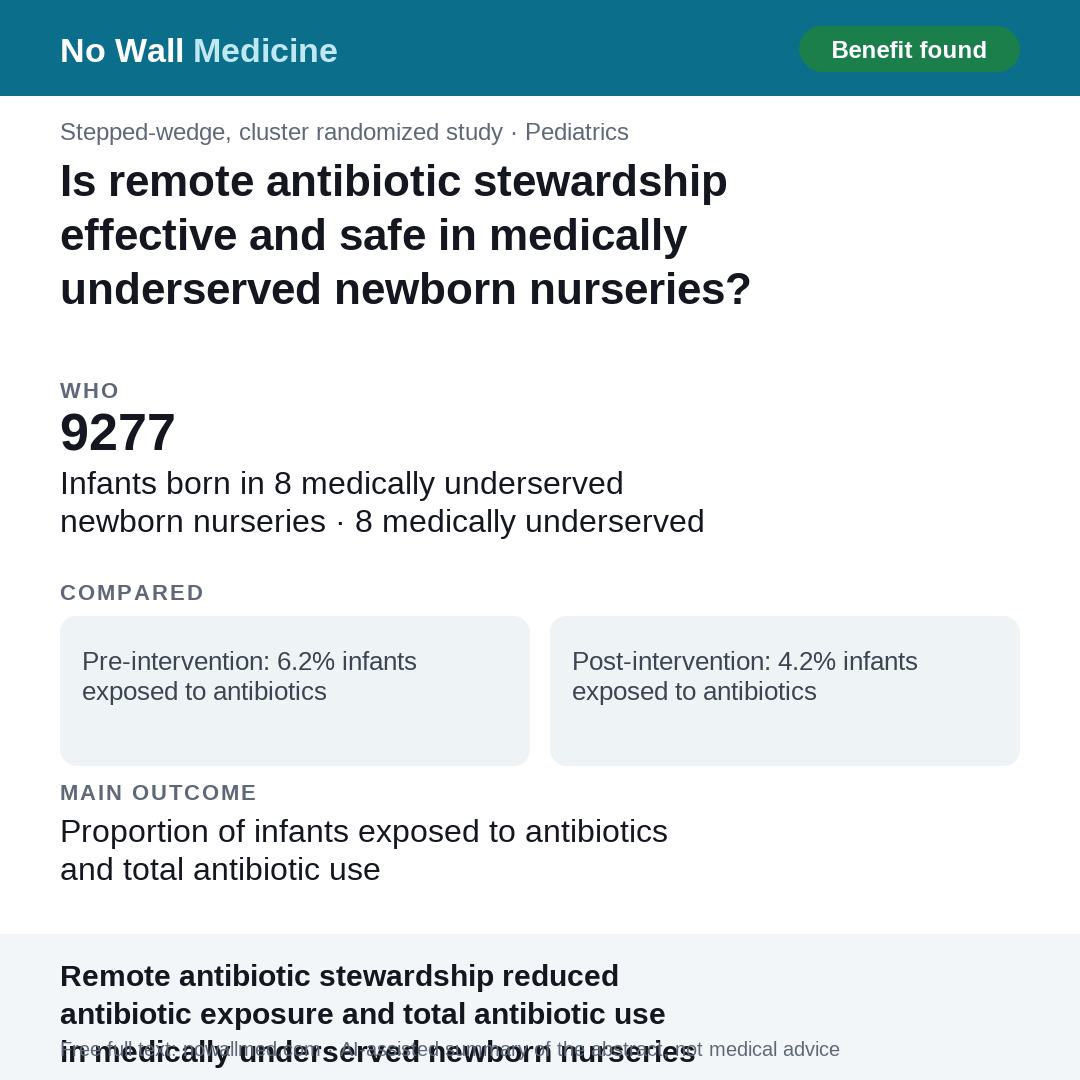
Is remote antibiotic stewardship effective and safe in medically underserved newborn nurseries?
Who
9277
Infants born in 8 medically underserved newborn nurseries · 8 medically underserved newborn nurseries
Compared
Pre-intervention: 6.2% infants exposed to antibiotics
Post-intervention: 4.2% infants exposed to antibiotics
Main outcome
Proportion of infants exposed to antibiotics and total antibiotic use
Result: relative risk 0.68 (95% confidence interval, 0.63% to 0.75%)
Bottom line: Remote antibiotic stewardship reduced antibiotic exposure and total antibiotic use in medically underserved newborn nurseries without safety concerns.
Pediatrics · 2022-04-13Download image
Clinical question: Is remote antibiotic stewardship effective and safe in medically underserved newborn nurseries?
Why it matters: Many medically underserved centers lack support for pediatric antibiotic stewardship programs, which are systems designed to optimize the use of antibiotics.
Key points
- Researchers studied 9277 infants across 8 medically underserved newborn nurseries using a stepped-wedge, cluster-randomized design over 3 years.
- The proportion of infants exposed to antibiotics declined from 6.2% to 4.2% and total antibiotic use fell from 117 to 84.1 days of therapy per 1000 patient-days.
- No safety signals were observed regarding length of stay, facility transfers, sepsis, or mortality.
Headline and key points written with AI from the paper’s abstract, with every number checked against it. Read the paper before relying on them.
Was this summary helpful?
Subject terms
Cite this article
Cantey JB, Correa CC, Dugi DD, Huff E, Olaya JE, Farner R. Remote Stewardship for Medically Underserved Nurseries: A Stepped-Wedge, Cluster Randomized Study. Pediatrics. 2022. doi:10.1542/peds.2021-055686
Spotted a mistake? Suggest a correction