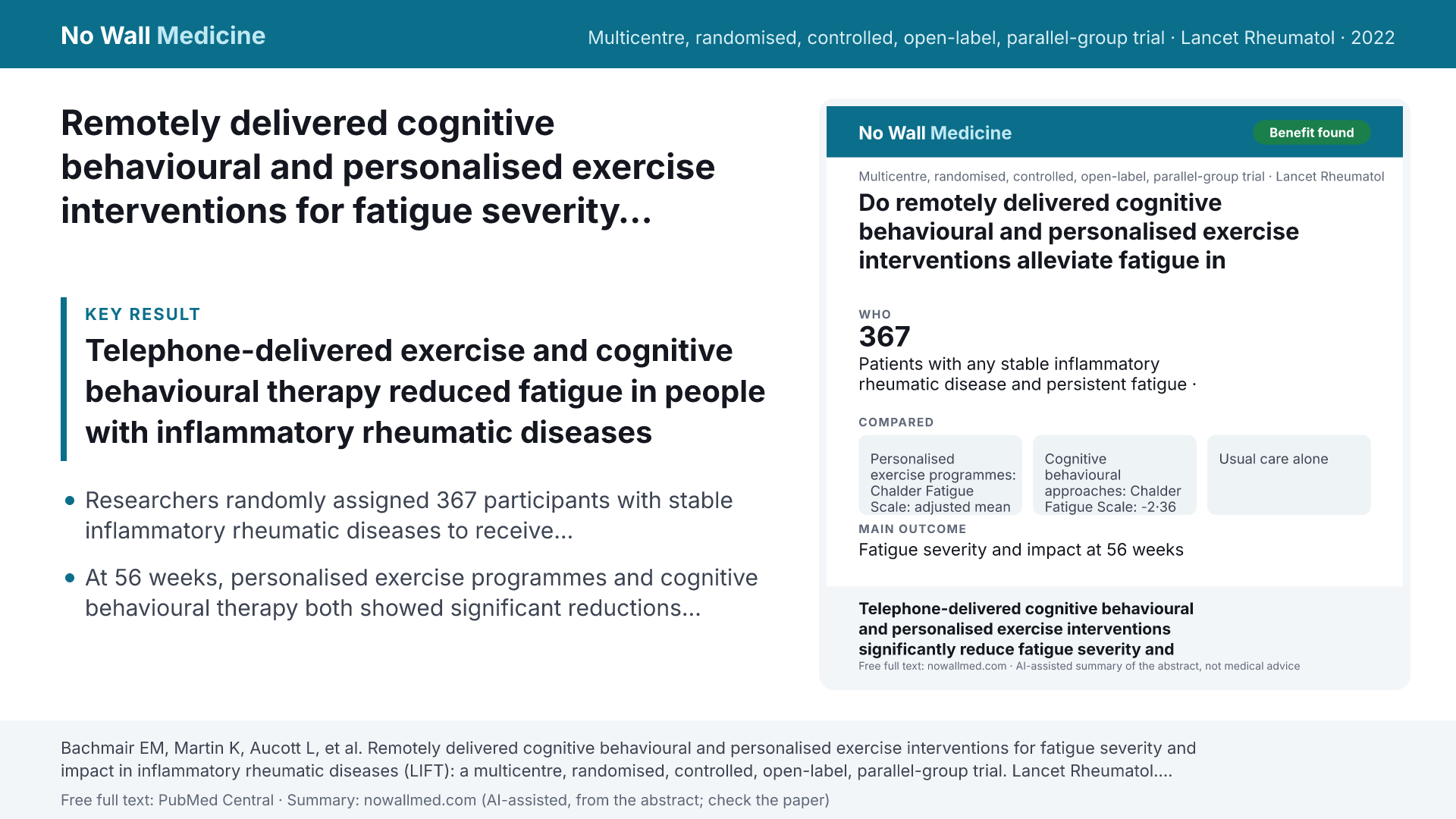
Telephone-delivered exercise and cognitive behavioural therapy reduced fatigue in people with inflammatory rheumatic diseases
Remotely delivered cognitive behavioural and personalised exercise interventions for fatigue severity and impact in inflammatory rheumatic diseases (LIFT): a multicentre, randomised, controlled, open-label, parallel-group trial
Multicentre, randomised, controlled, open-label, parallel-group trialBenefit found
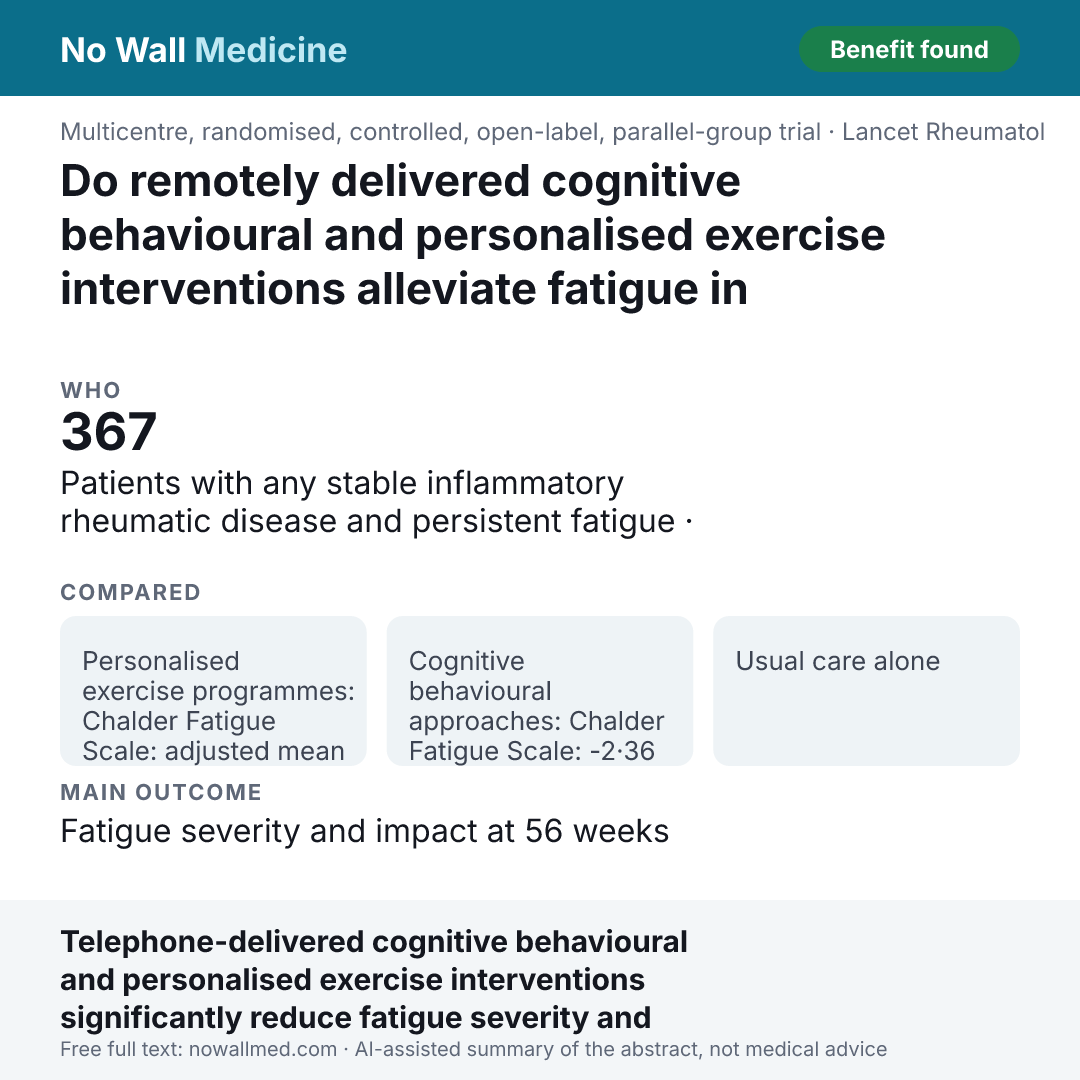
Do remotely delivered cognitive behavioural and personalised exercise interventions alleviate fatigue in inflammatory rheumatic diseases?
Who
367
Patients with any stable inflammatory rheumatic disease and persistent fatigue · United Kingdom hospitals
Compared
Personalised exercise programmes: Chalder Fatigue Scale: adjusted mean difference -3·03 (97·5% CI -5·05 to -1·02)
Cognitive behavioural approaches: Chalder Fatigue Scale: -2·36 (-4·28 to -0·44)
Usual care alone
Main outcome
Fatigue severity and impact at 56 weeks
Result: PEP: Chalder Fatigue Scale -3·03 (97·5% CI -5·05 to -1·02); CBA: -2·36 (-4·28 to -0·44)
Bottom line: Telephone-delivered cognitive behavioural and personalised exercise interventions significantly reduce fatigue severity and impact in inflammatory rheumatic diseases.
Funded by: Versus Arthritis
Lancet Rheumatol · 2022-06-27 · Save PNG
Clinical question: Do remotely delivered cognitive behavioural and personalised exercise interventions alleviate fatigue in inflammatory rheumatic diseases?
Key points
- Researchers randomly assigned 367 participants with stable inflammatory rheumatic diseases to receive personalised exercise programmes, cognitive behavioural therapy, or usual care alone.
- At 56 weeks, personalised exercise programmes and cognitive behavioural therapy both showed significant reductions in fatigue severity and fatigue impact compared to usual care.
- The personalised exercise group had an adjusted mean difference of -3.03 on the Chalder Fatigue Scale and -0.64 on the Fatigue Severity Scale.
Headline and key points written with AI from the paper’s abstract, with every number checked against it. Read the paper before relying on them.
Was this summary helpful?
Abstract
Background
Chronic fatigue is a poorly managed problem in people with inflammatory rheumatic diseases. Cognitive behavioural approaches (CBA) and personalised exercise programmes (PEP) can be effective, but they are not often implemented because their effectivenesses across the different inflammatory rheumatic diseases are unknown and regular face-to-face sessions are often undesirable, especially during a pandemic. We hypothesised that remotely delivered CBA and PEP would effectively alleviate fatigue severity and life impact across inflammatory rheumatic diseases. Methods
LIFT is a multicentre, randomised, controlled, open-label, parallel-group trial to assess usual care alongside telephone-delivered CBA or PEP against usual care alone in UK hospitals. Patients with any stable inflammatory rheumatic disease were eligible if they reported clinically significant, persistent fatigue. Treatment allocation was assigned by a web-based randomisation system. CBA and PEP sessions were delivered over 6 months by trained health professionals in rheumatology. Coprimary outcomes were fatigue severity (Chalder Fatigue Scale) and impact (Fatigue Severity Scale) at 56 weeks. The primary analysis was by full analysis set. This study was registered at ClinicalTrials.gov (NCT03248518). Findings
From Sept 4, 2017, to Sept 30, 2019, we randomly assigned and treated 367 participants to PEP (n=124; one participant withdrew after being randomly assinged), CBA (n=121), or usual care alone (n=122), of whom 274 (75%) were women and 92 (25%) were men with an overall mean age of 57·5 (SD 12·7) years. Analyses for Chalder Fatigue Scale included 101 participants in the PEP group, 107 in the CBA group, and 107 in the usual care group and for Fatigue Severity Scale included 101 in PEP, 106 in CBA, and 107 in usual care groups. PEP and CBA significantly improved fatigue severity (Chalder Fatigue Scale; PEP: adjusted mean difference -3·03 [97·5% CI -5·05 to -1·02], p=0·0007; CBA: -2·36 [-4·28 to -0·44], p=0·0058) and fatigue impact (Fatigue Severity Scale; PEP: -0·64 [-0·95 to -0·33], p<0·0001; CBA: -0·58 [-0·87 to -0·28], p<0·0001); compared with usual care alone at 56 weeks. No trial-related serious adverse events were reported. Interpretation
Telephone-delivered CBA and PEP produced and maintained statistically and clinically significant reductions in the severity and impact of fatigue in a variety of inflammatory rheumatic diseases. These interventions should be considered as a key component of inflammatory rheumatic disease management in routine clinical practice. Funding
Versus Arthritis.
Abstract reproduced under the article’s CC BY licence.
Headline, design, result, key points, caveat and citation as plain text.
Cite this article
Bachmair EM, Martin K, Aucott L, et al. Remotely delivered cognitive behavioural and personalised exercise interventions for fatigue severity and impact in inflammatory rheumatic diseases (LIFT): a multicentre, randomised, controlled, open-label, parallel-group trial. Lancet Rheumatol. 2022. doi:10.1016/S2665-9913(22)00156-4
Spotted a mistake? Suggest a correction