Repetitive Transcranial Magnetic Stimulation as Maintenance Treatment of Depression: The MAINT-R Randomized Clinical Trial
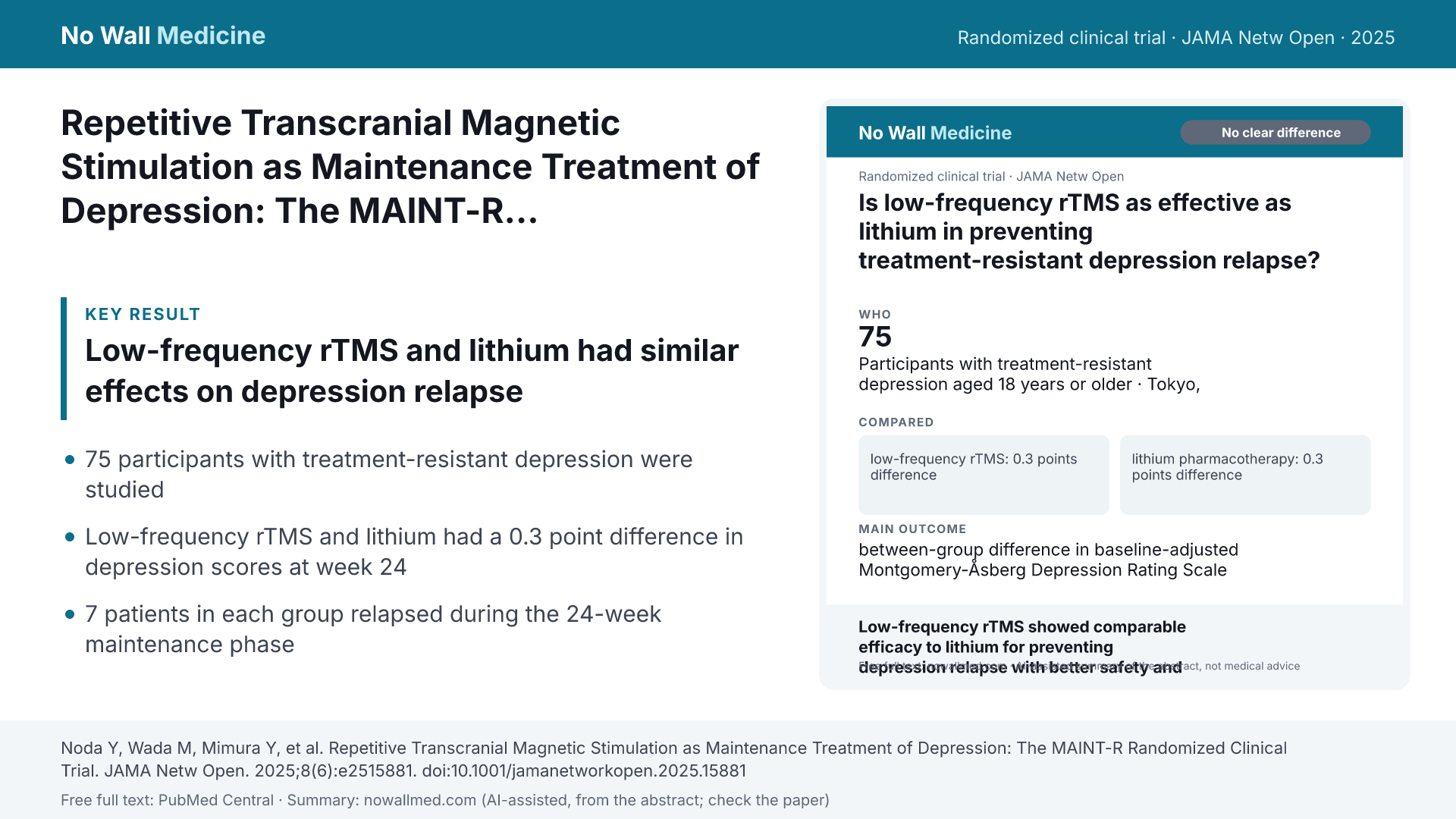
Key result: Low-frequency rTMS and lithium had similar effects on depression relapse
Randomized clinical trialNo clear difference
Is low-frequency rTMS as effective as lithium in preventing treatment-resistant depression relapse?
Who
75
Participants with treatment-resistant depression aged 18 years or older · Tokyo, Japan
Compared
low-frequency rTMS: 0.3 points difference
lithium pharmacotherapy: 0.3 points difference
Main outcome
between-group difference in baseline-adjusted Montgomery-Åsberg Depression Rating Scale scores
Result: 0.3 points (95% CI, -2.7 to 3.3 points)
Bottom line: Low-frequency rTMS showed comparable efficacy to lithium for preventing depression relapse with better safety and tolerance.
JAMA Netw Open · 2025-06-02
Key points
- 75 participants with treatment-resistant depression were studied.
- Low-frequency rTMS and lithium had a 0.3 point difference in depression scores at week 24.
- 7 patients in each group relapsed during the 24-week maintenance phase.
Why it matters: Guidelines are needed on maintenance treatment to prevent depression relapse
Discussion prompts
- Would these patients look like yours? Who was left out?
- Is the main outcome one that matters to patients?
- Is the difference large enough to change what you do?
Cite: Noda Y, Wada M, Mimura Y, et al. Repetitive Transcranial Magnetic Stimulation as Maintenance Treatment of Depression: The MAINT-R Randomized Clinical Trial. JAMA Netw Open. 2025;8(6):e2515881. doi:10.1001/jamanetworkopen.2025.15881
Free full text: PubMed Central · Summary and visual abstract: nowallmed.com/a/repetitive-transcranial-magnetic-stimulation-as-maintenance-treatment-1vg72wu/ (AI-assisted from the abstract; check the paper before relying on it).