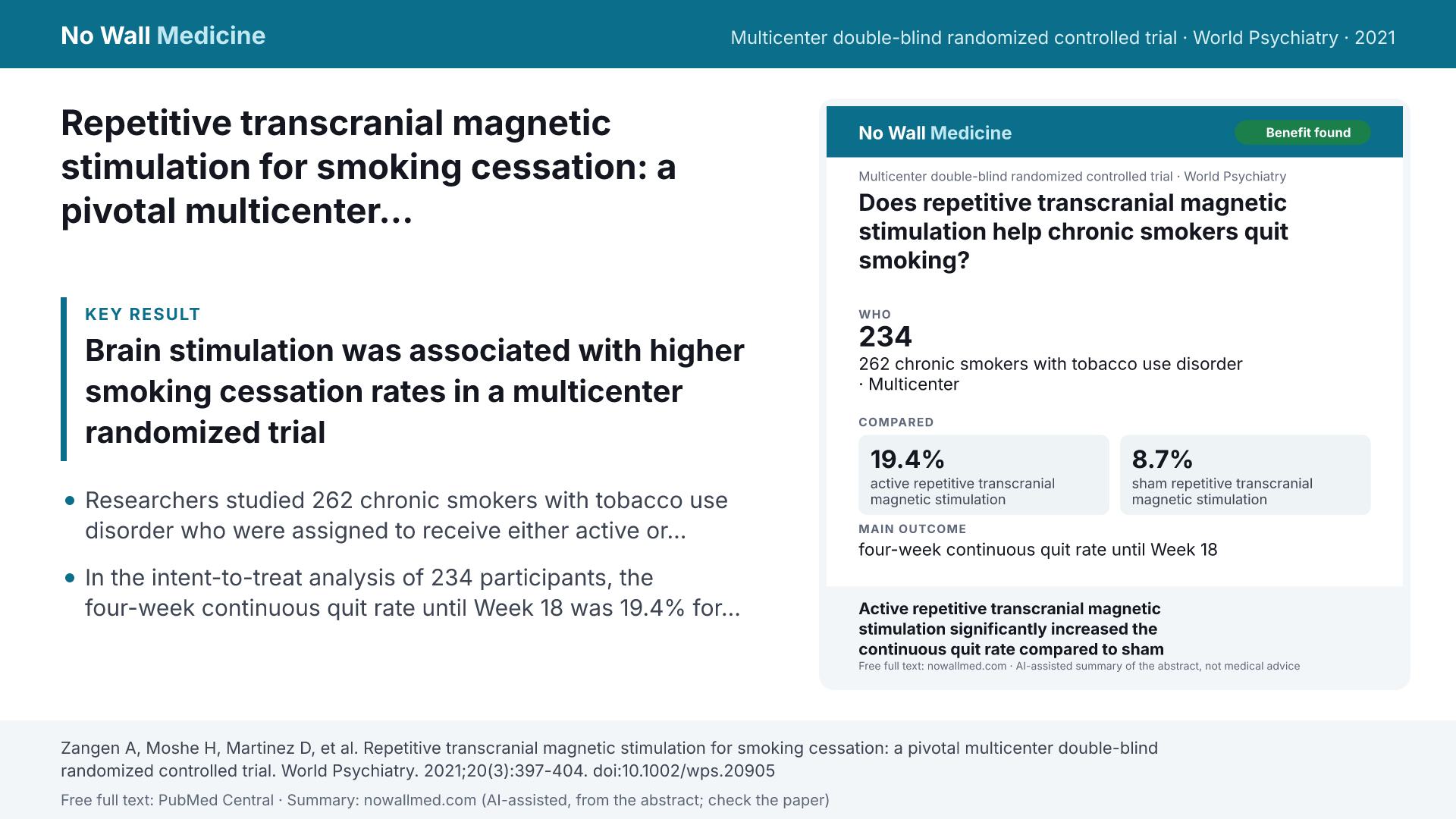
Brain stimulation was associated with higher smoking cessation rates in a multicenter randomized trial
Repetitive transcranial magnetic stimulation for smoking cessation: a pivotal multicenter double-blind randomized controlled trial
Multicenter double-blind randomized controlled trialBenefit found
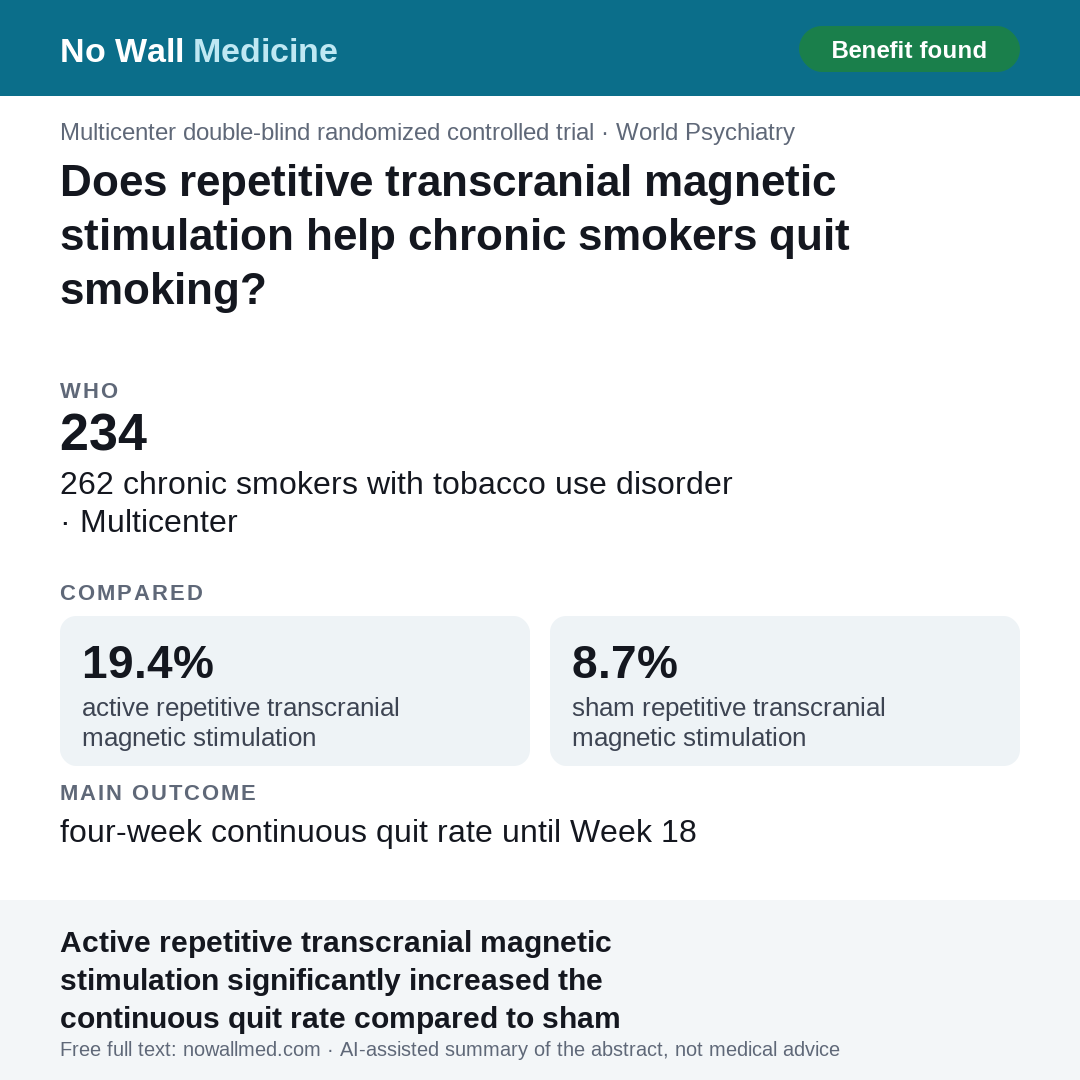
Does repetitive transcranial magnetic stimulation help chronic smokers quit smoking?
Who
234
262 chronic smokers with tobacco use disorder · Multicenter
Compared
19.4%active repetitive transcranial magnetic stimulation
8.7%sham repetitive transcranial magnetic stimulation
Main outcome
four-week continuous quit rate until Week 18
Result: X2 =5.655, p=0.017
Bottom line: Active repetitive transcranial magnetic stimulation significantly increased the continuous quit rate compared to sham stimulation in chronic smokers.
World Psychiatry · 2021-09-10Download image
Clinical question: Does repetitive transcranial magnetic stimulation help chronic smokers quit smoking?
In absolute numbers
active repetitive transcranial magnetic stimulation: 19.4% · sham repetitive transcranial magnetic stimulation: 8.7% → a difference of 10.7 percentage points, so about 10 people would need the treatment for 1 more to benefit (number needed to treat) over the trial’s follow-up.
Worked out by us from the two group results above, not reported by the authors. Check the paper for the exact outcome and timing.
Key points
- Researchers studied 262 chronic smokers with tobacco use disorder who were assigned to receive either active or sham repetitive transcranial magnetic stimulation, a non-invasive brain stimulation method.
- In the intent-to-treat analysis of 234 participants, the four-week continuous quit rate until Week 18 was 19.4% for the active group compared to 8.7% for the sham group.
- Among the 169 participants who completed the study, the continuous quit rate until Week 18 was 28.0% in the active group and 11.7% in the sham group.
Headline and key points written with AI from the paper’s abstract, with every number checked against it. Read the paper before relying on them.
Was this summary helpful?
Headline, design, result, key points, caveat and citation as plain text.
Cite this article
Zangen A, Moshe H, Martinez D, et al. Repetitive transcranial magnetic stimulation for smoking cessation: a pivotal multicenter double-blind randomized controlled trial. World Psychiatry. 2021. doi:10.1002/wps.20905
Spotted a mistake? Suggest a correction