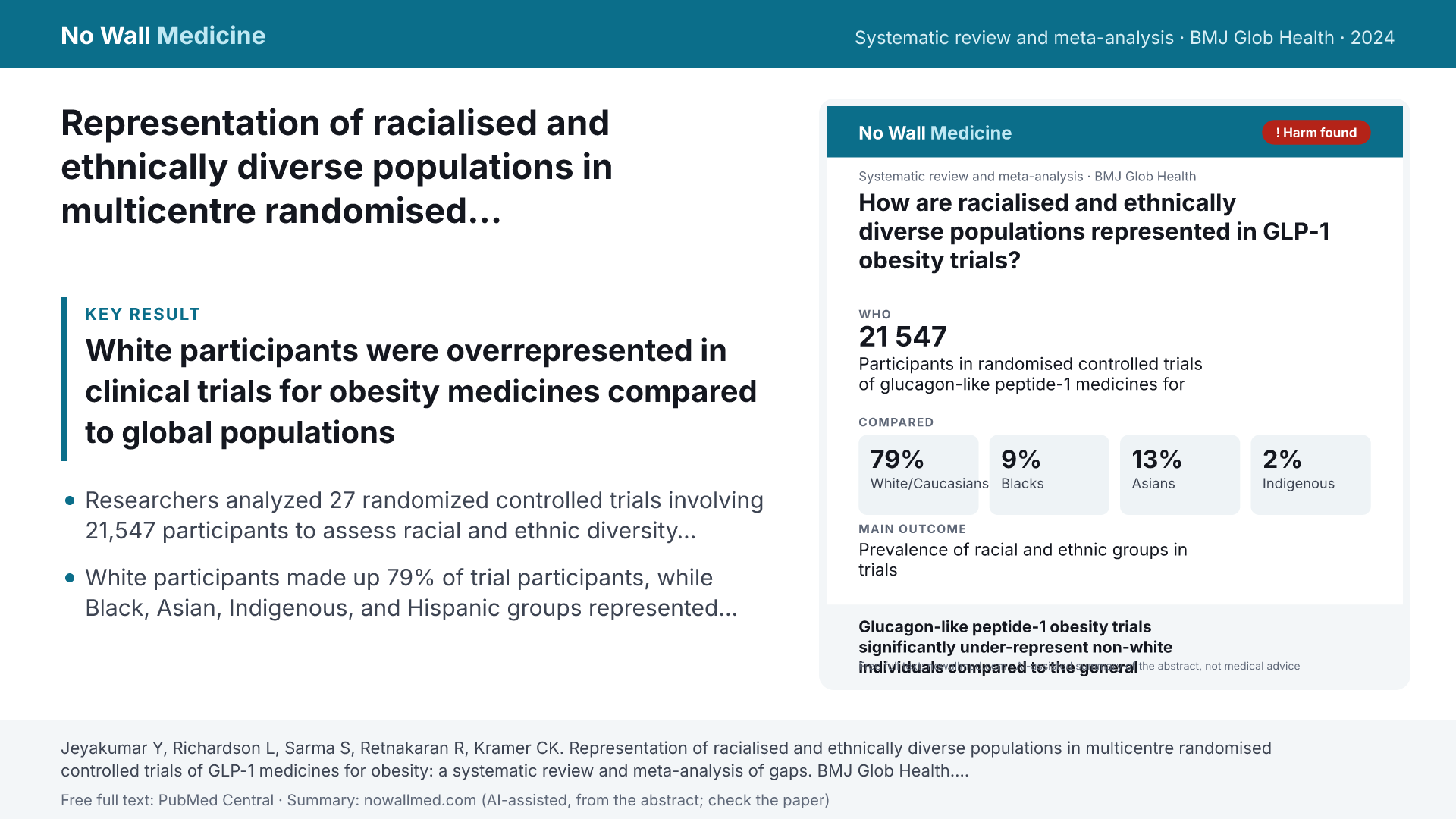
White participants were overrepresented in clinical trials for obesity medicines compared to global populations
Representation of racialised and ethnically diverse populations in multicentre randomised controlled trials of GLP-1 medicines for obesity: a systematic review and meta-analysis of gaps
Systematic review and meta-analysisHarm found
How are racialised and ethnically diverse populations represented in GLP-1 obesity trials?
Who
21 547
Participants in randomised controlled trials of glucagon-like peptide-1 medicines for obesity · Multicentre trial sites across various countries
Compared
79%White/Caucasians
9%Blacks
13%Asians
2%Indigenous
Main outcome
Prevalence of racial and ethnic groups in trials
Bottom line: Glucagon-like peptide-1 obesity trials significantly under-represent non-white individuals compared to the general populations of several nations.
BMJ Glob Health · 2024-11-28 · Save PNG
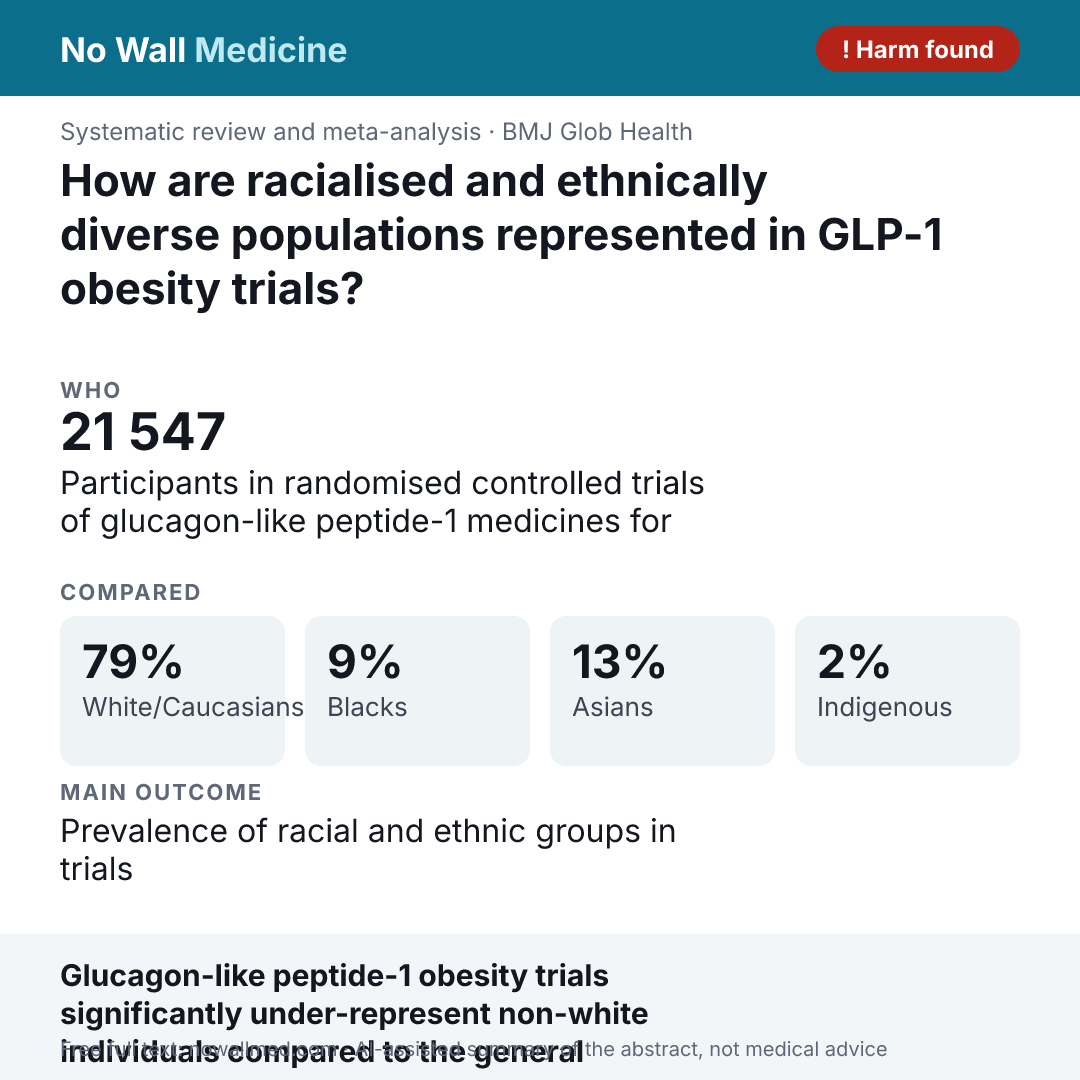
Clinical question: How are racialised and ethnically diverse populations represented in GLP-1 obesity trials?
Key points
- Researchers analyzed 27 randomized controlled trials involving 21,547 participants to assess racial and ethnic diversity in glucagon-like peptide-1 medicine studies.
- White participants made up 79% of trial participants, while Black, Asian, Indigenous, and Hispanic groups represented 9%, 13%, 2%, and 22% respectively.
- Trial sites were located mostly in high-income countries at a rate of 84.2%, which differed from the global prevalence of obesity.
Headline and key points written with AI from the paper’s abstract, with every number checked against it. Read the paper before relying on them.
Was this summary helpful?
Abstract
Introduction
Trials of GLP-1 (glucagon-like peptide-1) medicines have changed the paradigm of obesity treatment. Diversity in trial participation is imperative considering that obesity disproportionately impacts marginalised populations worldwide. We performed a systematic review and meta-analyses to evaluate the representation of racialised and ethnically diverse populations in randomised controlled trials (RCTs) of GLP-1 medicines for obesity. Methods
We searched PubMed/Embase/ClinicalTrials.gov. Prevalence of each racial/ethnic group was compared in relation to the USA, Canada, the UK, Brazil and South Africa. The geographical locations of the trial sites were extracted. Results
27 RCTs were identified (n=21 547 participants). Meta-analyses of prevalence demonstrated the vast predominance of white/Caucasians (79%) with smaller proportion of blacks (9%), Asians (13%), Indigenous (2%) and Hispanics (22%). The gaps in representation were evidenced by the significantly under-represented proportion of non-white individuals in these RCTs as compared with the prevalence of non-white individuals in the general population of the USA (-23%, p=0.002) and Canada (-34%, p<0.0001), reaching an alarming gap of -58% in relation to Brazil and striking under-representation of -68% as compared with South Africa. Similar discrepancies in proportions of blacks, Asians and Indigenous peoples as compared with reference nations were found. Moreover, the trial sites (n=1859) were predominately located in high-income countries (84.2%), in sharp contrast to the global prevalence of obesity that is predominantly in low-income and middle-income countries. Conclusion
There are discrepancies in representation of racialised and ethnically diverse populations in obesity trials as compared with multiethnic populations worldwide. These data highlight the need for broader reform in the research process in order to ultimately address health inequities.
Abstract reproduced under the article’s CC BY NC licence.
Subject terms
Headline, design, result, key points, caveat and citation as plain text.
Cite this article
Jeyakumar Y, Richardson L, Sarma S, Retnakaran R, Kramer CK. Representation of racialised and ethnically diverse populations in multicentre randomised controlled trials of GLP-1 medicines for obesity: a systematic review and meta-analysis of gaps. BMJ Glob Health. 2024;9(11). doi:10.1136/bmjgh-2024-017177
Spotted a mistake? Suggest a correction