Reproductive outcomes and reproductive tract microbiota shift in women with moderate-to-severe intrauterine adhesions following 30-day post-hysteroscopic placement of balloon stents or intrauterine contraceptive devices: A randomized controlled trial
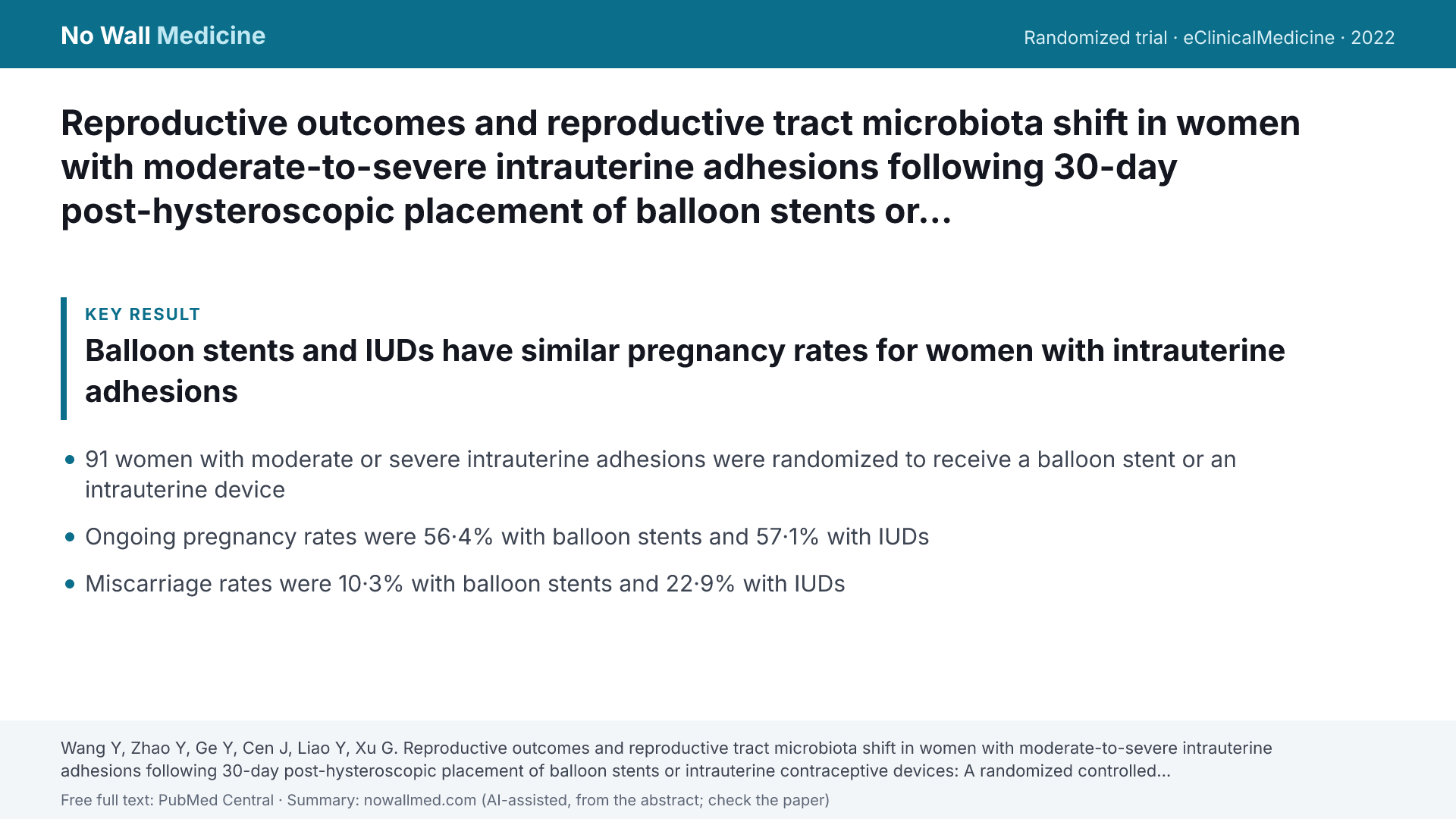
Key result: Balloon stents and IUDs have similar pregnancy rates for women with intrauterine adhesions
Key points
- 91 women with moderate or severe intrauterine adhesions were randomized to receive a balloon stent or an intrauterine device.
- Ongoing pregnancy rates were 56·4% with balloon stents and 57·1% with IUDs.
- Miscarriage rates were 10·3% with balloon stents and 22·9% with IUDs.
Discussion prompts
- Would these patients look like yours? Who was left out?
- Is the main outcome one that matters to patients?
- Is the difference large enough to change what you do?
Cite: Wang Y, Zhao Y, Ge Y, Cen J, Liao Y, Xu G. Reproductive outcomes and reproductive tract microbiota shift in women with moderate-to-severe intrauterine adhesions following 30-day post-hysteroscopic placement of balloon stents or intrauterine contraceptive devices: A randomized controlled trial. EClinicalMedicine. 2022;43:101200. doi:10.1016/j.eclinm.2021.101200
Free full text: PubMed Central · Summary and visual abstract: nowallmed.com/a/reproductive-outcomes-and-reproductive-tract-microbiota-shift-in-1cvdauw/ (AI-assisted from the abstract; check the paper before relying on it).