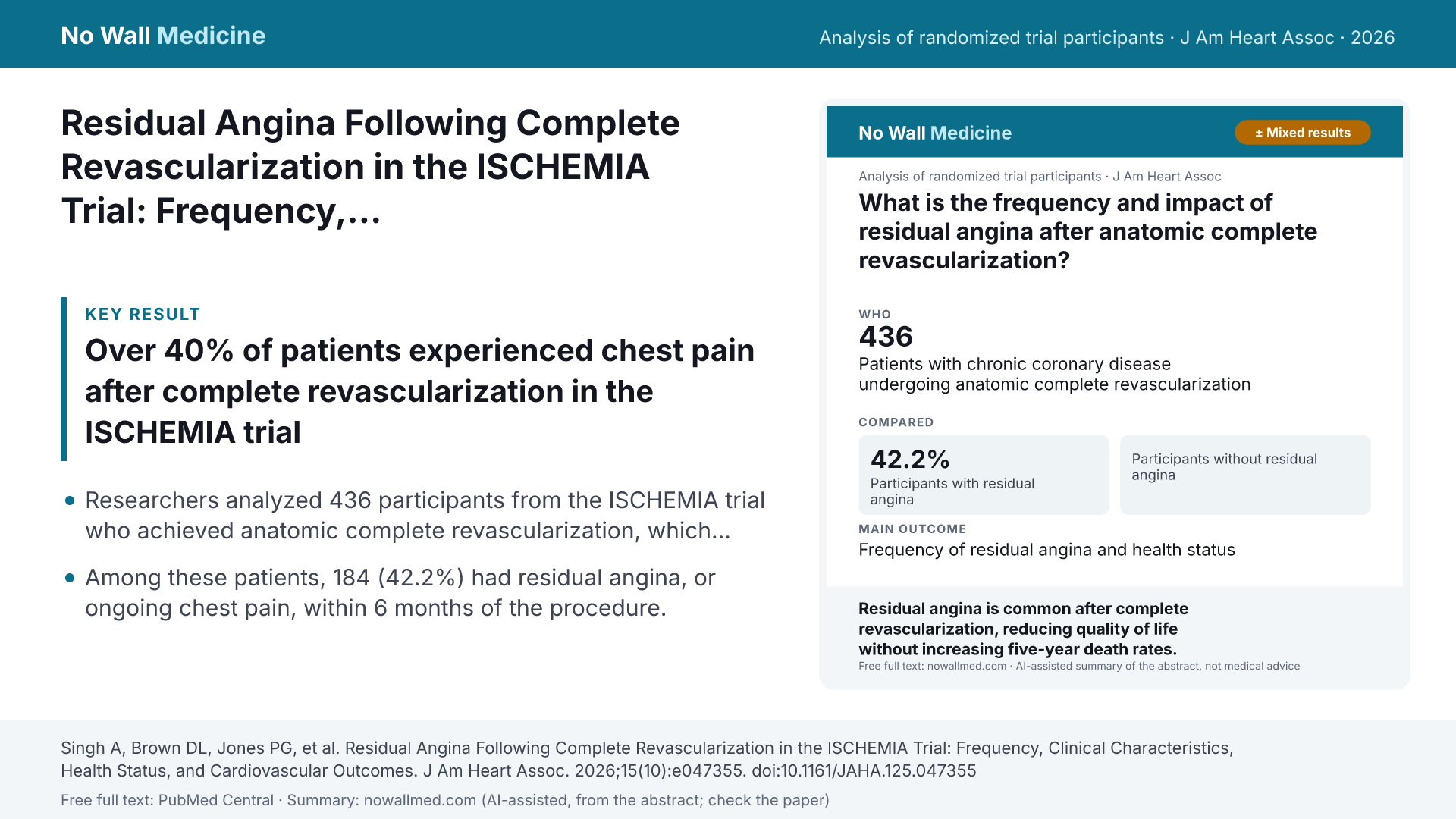
Over 40% of patients experienced chest pain after complete revascularization in the ISCHEMIA trial
Residual Angina Following Complete Revascularization in the ISCHEMIA Trial: Frequency, Clinical Characteristics, Health Status, and Cardiovascular Outcomes
Analysis of randomized trial participantsMixed results
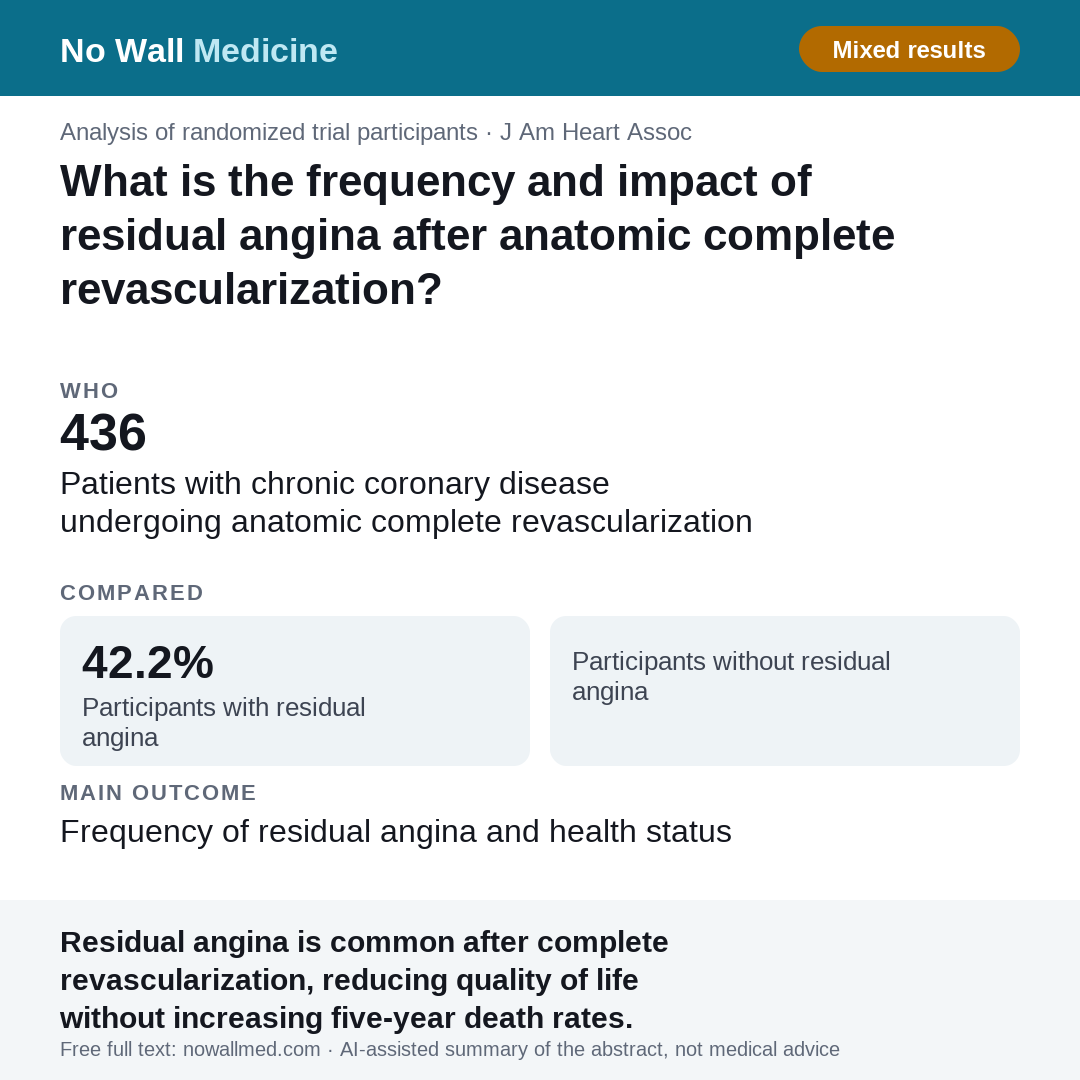
What is the frequency and impact of residual angina after anatomic complete revascularization?
Who
436
Patients with chronic coronary disease undergoing anatomic complete revascularization · International
Compared
42.2%Participants with residual angina
Participants without residual angina
Main outcome
Frequency of residual angina and health status
Bottom line: Residual angina is common after complete revascularization, reducing quality of life without increasing five-year death rates.
J Am Heart Assoc · 2026-05-14Download image
Same trial (NCT01471522)
Papers we list that report this registered trial, oldest first. Read a secondary analysis alongside the main results.
- Related analysis No clear difference
Invasive treatment did not reduce heart events or death in stable coronary disease NEJM 2020-03 - Secondary analysis Mixed results
Different definitions of heart attack change reported rates and outcomes in the ISCHEMIA trial Circulation 2020-12 - Secondary analysis No clear difference
Conservative management showed more days alive out of hospital than invasive management for two years JAMA Cardiol 2021-05 - Related analysis No clear difference
Ischemia severity was not associated with increased mortality in patients with stable coronary artery disease Circulation 2021-09 - Main results No clear difference
Initial invasive treatment was not more effective than conservative management for total cardiovascular events Eur Heart J 2021-09 - Secondary analysis No clear difference
Clinical and stress testing markers were weakly predictive of left main coronary artery disease JACC 2022-02 - Related analysis Mixed results
Invasive treatment strategy showed better quality of life for patients with frequent angina symptoms Circulation 2022-03 - Related analysis Benefit found
Medication adherence was associated with better health status in patients with chronic coronary disease JACC 2022-08 - Related analysis Benefit found
Complete revascularization was associated with lower rates of cardiovascular death or heart attack JACC 2023-07 - Related analysis Benefit found
Complete revascularization was associated with better angina-related health status in patients with chronic coronary disease JACC 2023-07 - Secondary analysis
Women had lower revascularization rates and less coronary artery disease than men in ISCHEMIA trial J Am Heart Assoc 2024-02 - Secondary analysis Mixed results
Younger age and worse baseline health status were linked to better outcomes with invasive management JACC 2024-04 - Secondary analysis Mixed results
Stress and depressive symptoms were linked to worse angina status in women and men J Am Heart Assoc 2025-02 - Related analysis Key finding
Achieving multiple medical therapy goals was associated with fewer cardiovascular deaths and heart attacks JACC 2025-03 - Related analysis No clear difference
Invasive versus conservative management showed similar cardiovascular death and heart attack rates in patients with blocked arteries JACC 2025-03
Clinical question: What is the frequency and impact of residual angina after anatomic complete revascularization?
Key points
- Researchers analyzed 436 participants from the ISCHEMIA trial who achieved anatomic complete revascularization, which means all blocked arteries were treated.
- Among these patients, 184 (42.2%) had residual angina, or ongoing chest pain, within 6 months of the procedure.
- Residual angina was associated with lower quality of life, more physical limitation, more shortness of breath, and higher medication use, but not with 5-year death.
Headline and key points written with AI from the paper’s abstract, with every number checked against it. Read the paper before relying on them.
Was this summary helpful?
Subject terms
Headline, design, result, key points, caveat and citation as plain text.
Cite this article
Singh A, Brown DL, Jones PG, et al. Residual Angina Following Complete Revascularization in the ISCHEMIA Trial: Frequency, Clinical Characteristics, Health Status, and Cardiovascular Outcomes. J Am Heart Assoc. 2026;15(10):e047355. doi:10.1161/JAHA.125.047355
Spotted a mistake? Suggest a correction