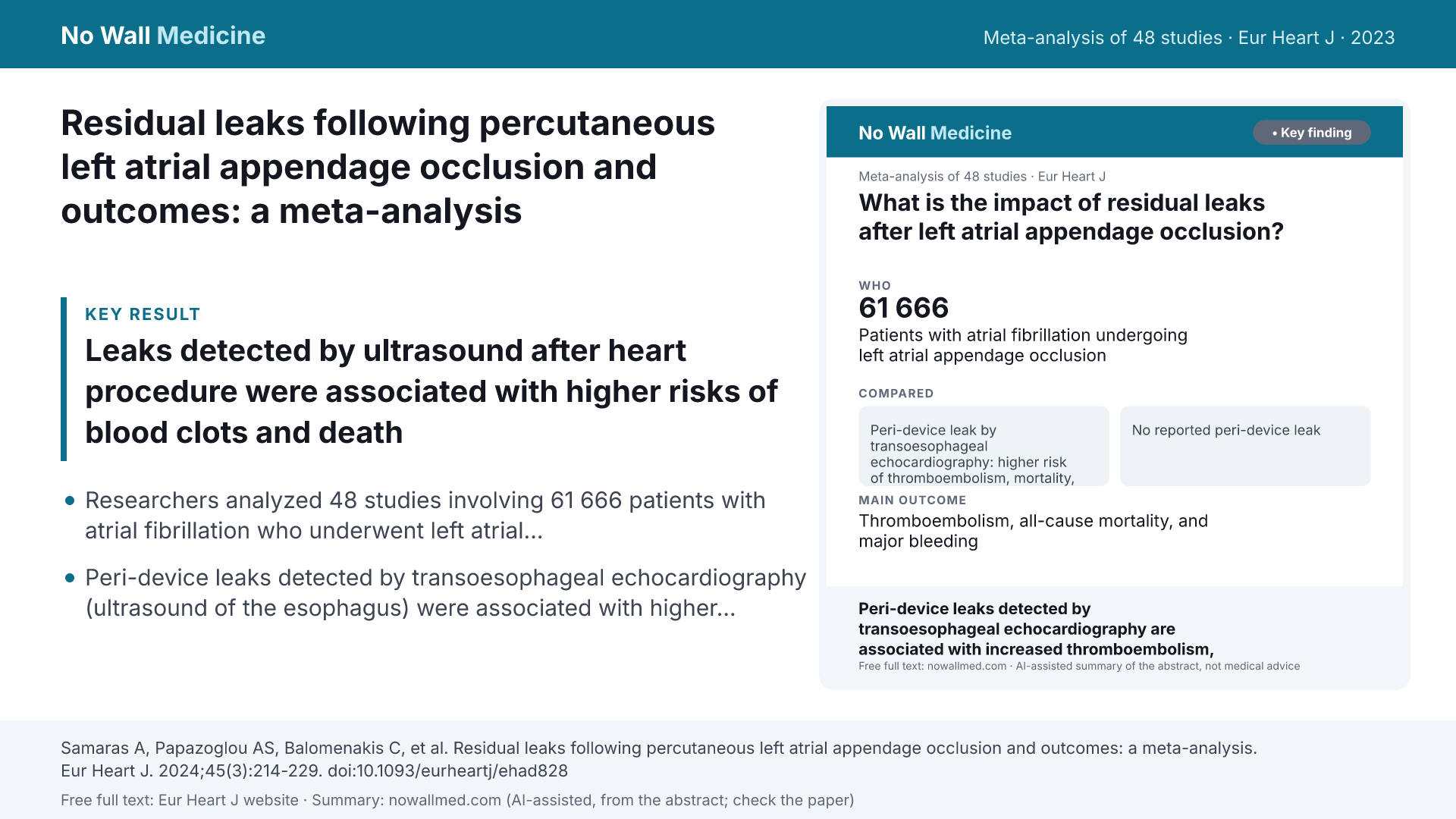
Residual leaks following percutaneous left atrial appendage occlusion and outcomes: a meta-analysis
Key result: Leaks detected by ultrasound after heart procedure were associated with higher risks of blood clots and death
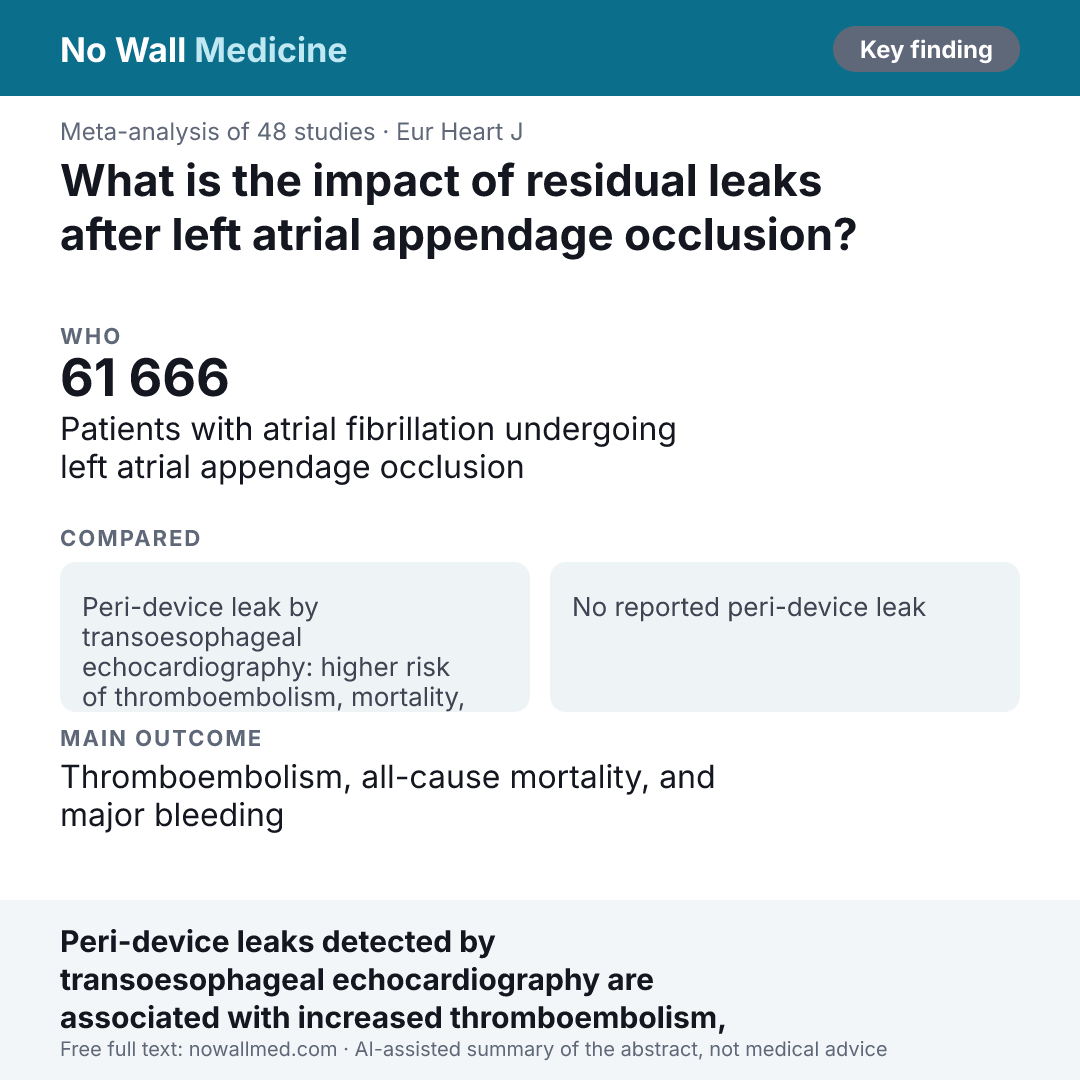
Meta-analysis of 48 studiesKey finding
What is the impact of residual leaks after left atrial appendage occlusion?
Who
61 666
Patients with atrial fibrillation undergoing left atrial appendage occlusion
Compared
Peri-device leak by transoesophageal echocardiography: higher risk of thromboembolism, mortality, and major bleeding
No reported peri-device leak
Main outcome
Thromboembolism, all-cause mortality, and major bleeding
Result: pooled odds ratio 2.04 (95% CI 1.52-2.74) for thromboembolism
Bottom line: Peri-device leaks detected by transoesophageal echocardiography are associated with increased thromboembolism, mortality, and major bleeding risks.
Limitation: 44 of the 48 studies were non-randomized or observational
Eur Heart J · 2023-12-13 · Save PNG
Key points
- Researchers analyzed 48 studies involving 61 666 patients with atrial fibrillation who underwent left atrial appendage occlusion, a procedure to close a part of the heart.
- Peri-device leaks detected by transoesophageal echocardiography (ultrasound of the esophagus) were associated with higher risks of thromboembolism, all-cause mortality, and major bleeding.
- Leaks detected by computed tomography (CT scan) were more frequent but were not associated with thromboembolism.
Discussion prompts
- Would these patients look like yours? Who was left out?
- Is the main outcome one that matters to patients?
- Is the difference large enough to change what you do?
Cite: Samaras A, Papazoglou AS, Balomenakis C, et al. Residual leaks following percutaneous left atrial appendage occlusion and outcomes: a meta-analysis. Eur Heart J. 2024;45(3):214-229. doi:10.1093/eurheartj/ehad828
Free full text: Eur Heart J website · Summary and visual abstract: nowallmed.com/a/residual-leaks-following-percutaneous-left-atrial-appendage-occlusion-pz2xpb/ (AI-assisted from the abstract; check the paper before relying on it).