Different methods of cord clamping show comparable effects on clinical outcomes in preterm infants
Respiratory stabilization before umbilical cord clamping in preterm neonates: a systematic review and network meta-analysis
Systematic review and network meta-analysisNo clear difference
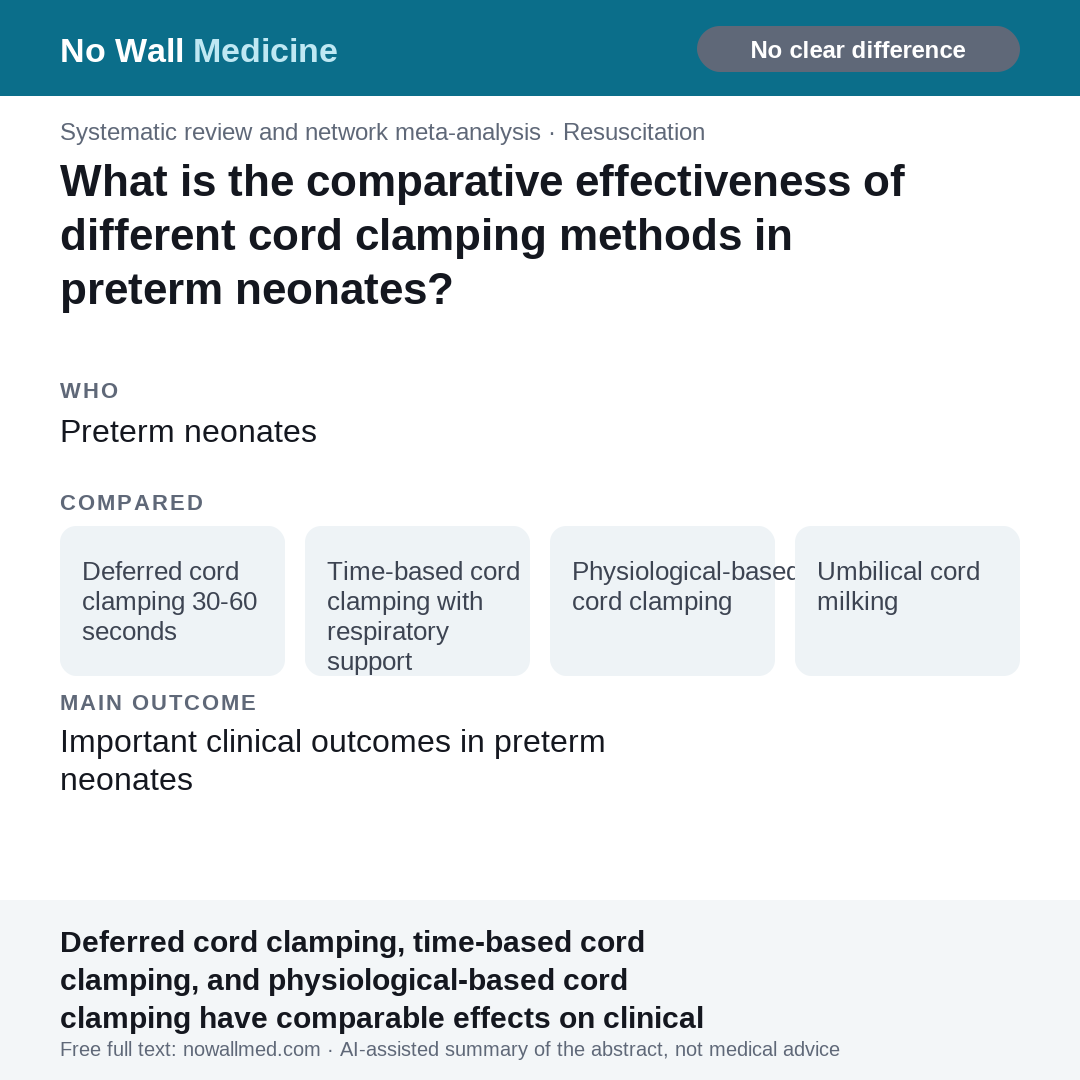
What is the comparative effectiveness of different cord clamping methods in preterm neonates?
Who
Preterm neonates
Compared
Deferred cord clamping 30-60 seconds
Time-based cord clamping with respiratory support
Physiological-based cord clamping
Umbilical cord milking
Main outcome
Important clinical outcomes in preterm neonates
Bottom line: Deferred cord clamping, time-based cord clamping, and physiological-based cord clamping have comparable effects on clinical outcomes.
Resuscitation · 2025-08-15Download image
Clinical question: What is the comparative effectiveness of different cord clamping methods in preterm neonates?
Why it matters: The comparative effectiveness of different cord clamping and respiratory stabilization methods for preterm neonates remains unclear.
Key points
- Researchers analyzed 11 randomized controlled trials and 8 non-randomized controlled trials comparing deferred cord clamping, umbilical cord milking, time-based cord clamping with respiratory support, and physiological-based cord clamping.
- Deferred cord clamping for 30-60 s possibly decreased the risk of periventricular leukomalacia and necrotizing enterocolitis stage 2 or higher compared to time-based cord clamping with respiratory support for at least 60 s.
- Time-based cord clamping with respiratory support for more than 60 s compared to immediate cord clamping possibly decreased the risk of mortality or neurodevelopmental impairment at 2 years' corrected age.
Headline and key points written with AI from the paper’s abstract, with every number checked against it. Read the paper before relying on them.
Topics
Cite this article
Ramaswamy VV, Krishnegowda VK, Bandyopadhyay T, Abiramalatha T, Pullattayil AK, Katheria AC. Respiratory stabilization before umbilical cord clamping in preterm neonates: a systematic review and network meta-analysis. Resuscitation. 2025. doi:10.1016/j.resuscitation.2025.110777
Spotted a mistake? Suggest a correction
Top studies every Monday
The week’s key trials and guidelines in your specialties, by email. Free.
Get the weekly digest